
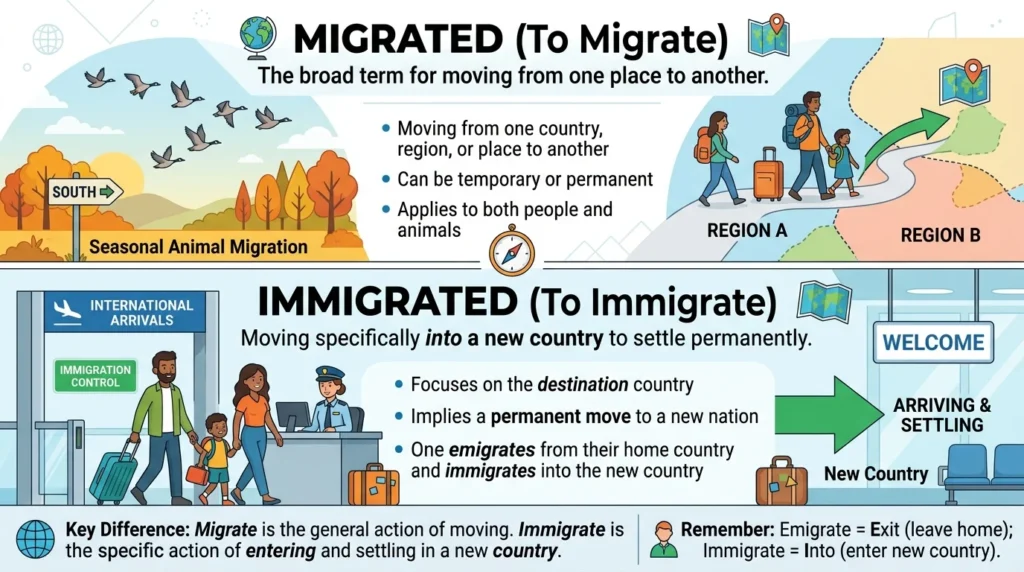
Quick Answer: Immigrated vs. Migrated
Immigrated means moved to a new country or place to live there permanently or for an extended period, usually from the perspective of entering that destination.
Migrated means moved from one place to another, often referring to people, animals, or populations. It does not necessarily imply permanent relocation.
The easiest way to remember:
- Immigrated = moved IN
- Migrated = moved FROM one place TO another
For example:
She immigrated to Canada in 2015.
Thousands of birds migrated south for the winter.
What Does “Immigrated” Mean?
Immigrated is the past tense of immigrate.
To immigrate means to come into a foreign country or region with the intention of establishing residence there, generally for a long-term or permanent stay.
The important idea is entering a new country to live there.
Examples of “Immigrated”
- Her parents immigrated to the United States in the 1990s.
- He immigrated to Australia after receiving a work visa.
- Many families immigrated to the country in search of better opportunities.
Key Insight
Immigrate focuses on the destination.
Think:
Immigrate = move into a new country.
That’s why the preposition to is commonly used:
She immigrated to Canada.
What Does “Migrated” Mean?
Migrated is the past tense of migrate.
To migrate means to move from one place to another, often as part of a larger or recurring pattern.
The word has a much broader meaning than immigrate.
It can describe:
- People moving between countries
- Animals moving seasonally
- Populations relocating
- Historical population movements
- Workers moving between regions
- Even data or technology moving from one system to another
Examples of “Migrated”
- The birds migrated south before winter.
- The population migrated toward the cities in search of work.
- Thousands of people migrated from rural areas to urban centers.
Key Insight
Migrate focuses on the movement itself, rather than specifically on entering a new country for permanent residence.
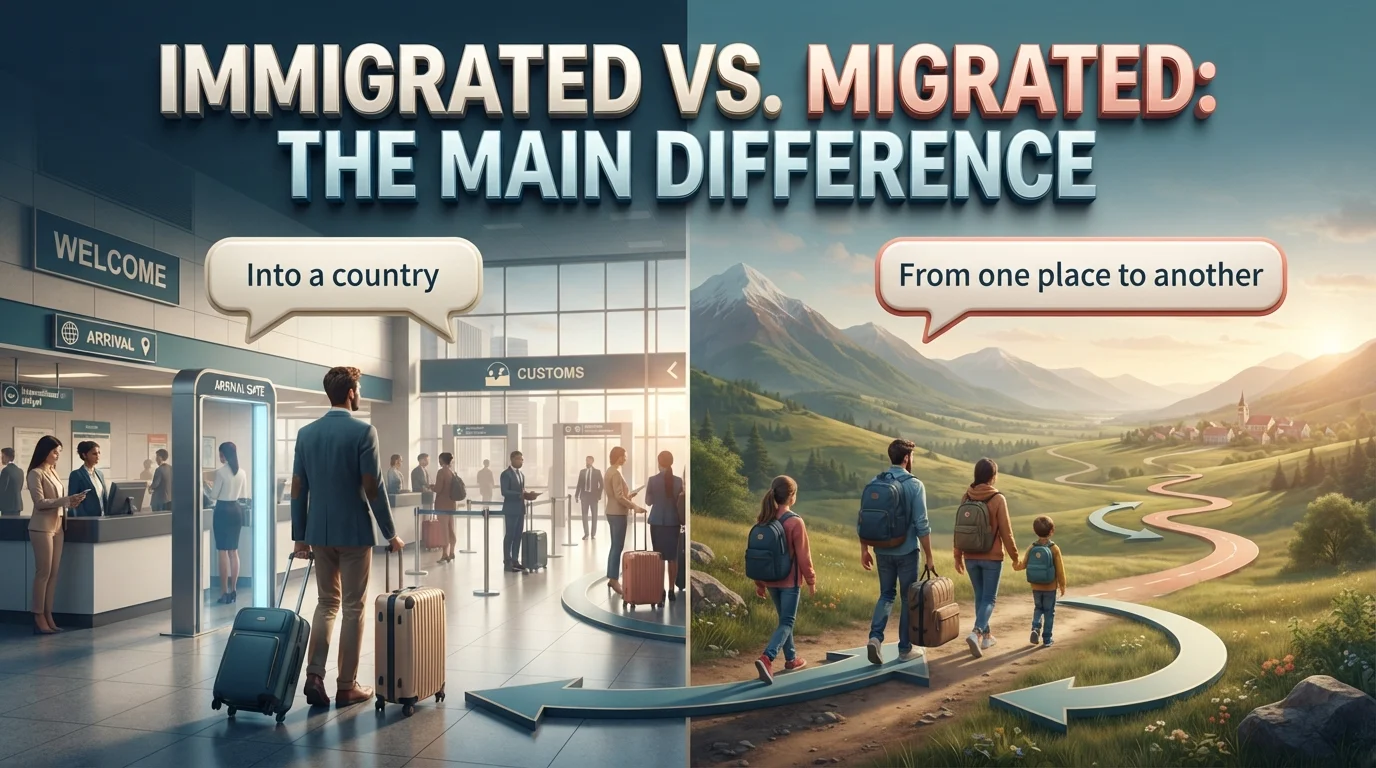
Immigrated vs. Migrated: The Main Difference
The biggest difference is specificity.
Immigrated
- Specifically associated with moving into a country or region
- Usually involves establishing residence
- Most often used for people
- Often implies a long-term or permanent move
- Focuses on the destination
Migrated
- Means moved from one place to another
- Can be temporary, seasonal, or permanent
- Used for people, animals, populations, and more
- Does not necessarily involve crossing an international border
- Focuses on movement
Comparison Table
| Feature | Immigrated | Migrated |
|---|---|---|
| Meaning | Moved into a new country/place to establish residence | Moved from one place to another |
| Focus | Destination | Movement |
| Usually permanent? | Generally long-term or permanent | Not necessarily |
| Used for people? | Yes | Yes |
| Used for animals? | Generally no | Yes |
| International movement? | Usually | Not necessarily |
| Seasonal movement? | No | Yes |
| Example | She immigrated to Canada. | Birds migrated south. |
Immigrate, Emigrate, and Migrate
One of the most common sources of confusion is the difference between immigrate and emigrate.
Immigrate = Move Into
She immigrated to Canada.
The focus is on entering Canada.
Emigrate = Move Out Of
She emigrated from Pakistan.
The focus is on leaving Pakistan.
Migrate = Move From One Place to Another
She migrated from Pakistan to Canada.
This describes the overall movement without using the specific immigration/emigration perspective.
Easy Formula
Immigrate = IN
Emigrate = EXIT
Migrate = MOVE
Real-World Usage Scenarios
Scenario 1: Moving Permanently to Another Country
Ali immigrated to the United Kingdom in 2020.
🎯 Lesson: The sentence emphasizes that Ali moved into the UK to live there, so immigrated is appropriate.
Scenario 2: Moving From One Country to Another
The family migrated from one country to another during the conflict.
🎯 Lesson: Migrated works because the sentence focuses on the broader movement rather than the legal or residential status of entering a particular country.
Scenario 3: Seasonal Animal Movement
The birds migrated south before winter.
🎯 Lesson: Use migrated, not immigrated, because seasonal animal movement is called migration.
Scenario 4: Rural-to-Urban Movement
Many workers migrated from rural areas to major cities.
🎯 Lesson: The movement is within a country, so migrated is the natural choice.
Scenario 5: Immigration History
Her grandparents immigrated to the United States in the 1950s.
🎯 Lesson: The sentence focuses on establishing a new life in a particular destination, so immigrated is more precise.
Common Mistakes With Immigrated and Migrated
Mistake 1: Using “immigrated” for animal movement
❌ The birds immigrated south for the winter.
✅ The birds migrated south for the winter.
Why it happens:
Both words describe movement, but immigrate is normally associated with people entering a new country or place to establish residence.
Mistake 2: Assuming all movement is immigration
❌ The workers immigrated from the countryside to the city.
✅ The workers migrated from the countryside to the city.
Why it happens:
Migration is the broader term and can describe movement within the same country.
Mistake 3: Ignoring the destination perspective
Consider:
She immigrated to Australia.
versus:
She emigrated from India.
Both can describe the same international move, but the first emphasizes entering Australia, while the second emphasizes leaving India.
Mistake 4: Treating “migrate” as automatically temporary
Migration does not always mean temporary movement.
For example:
Many families migrated to the region and settled there permanently.
So migrate can describe permanent movement as well.
How to Choose Between Immigrated and Migrated
Ask yourself three questions.
1. Is the subject moving into a new country to live there?
Use immigrated.
They immigrated to Germany.
2. Is the sentence simply describing movement from one place to another?
Use migrated.
They migrated from the countryside to the city.
3. Is the subject an animal making seasonal or geographical movements?
Use migrated.
The whales migrated to warmer waters.
Immigrated vs. Migrated: A Context Guide
Use “immigrated” when discussing:
- Permanent relocation
- Moving to a foreign country
- Establishing residence
- Immigration history
- Immigration records
- Immigration policies
- Families settling in another country
Use “migrated” when discussing:
- Population movement
- Animal movement
- Seasonal movement
- Rural-to-urban movement
- Historical population shifts
- Movement within a country
- General movement between regions
Memory Tricks: Immigrated vs. Migrated
🏠 Trick 1: Immigrate = IN
The beginning im- can remind you of in.
Immigrate → move IN
If someone enters another country to establish residence, think immigrate.
🚶 Trick 2: Migrate = Move
Think:
Migrate → move
Migration is the broader concept of moving from one place to another.
🌍 Trick 3: Immigration Is About a New Home
If the sentence makes you think:
“They moved to another country to make a new home.”
Immigrated is likely the more precise word.
⭐ One-Line Memory Trick
Immigrated = moved in to live; migrated = moved from place to place.
Expert Insight: The Linguistic Difference
The words immigrate and migrate share a common historical connection to the idea of movement, but modern English has developed a useful distinction between them.
Migrate is the broader term. It describes movement from one place to another and can apply to people, animals, and populations.
Immigrate is more specific. It describes entering a new country or place with the intention of establishing residence.
There is also an important perspective distinction:
- Immigrate focuses on the destination
- Emigrate focuses on the place left behind
- Migrate focuses on the movement itself
For example, one person can be described in all three ways:
She immigrated to Canada.
She emigrated from Pakistan.
She migrated from Pakistan to Canada.
These sentences can describe the same physical move while emphasizing different aspects of it.
A Note About “Immigrate” and “Migrate”
In some contexts, migrate can describe international human movement that results in permanent settlement.
For example:
Large numbers of people migrated across the border during the conflict.
This is grammatically and semantically possible.
However, if the specific meaning is entering a foreign country to establish residence, immigrate is usually the more precise choice.
So the words are not strict opposites.
Instead:
Migration is the broader category. Immigration is a more specific type of movement.
Quick Test: Immigrated or Migrated?
Choose the correct word.
- The birds ________ south for the winter.
- Her family ________ to Canada in 2018.
- Thousands of workers ________ from villages to cities.
- His grandparents ________ to Australia after the war.
- The whales ________ to warmer waters.
Answers
- migrated
- immigrated
- migrated
- immigrated
- migrated
The Pattern
Immigrated = entered a new country/place to establish a home
Migrated = moved from one place to another