
Quick Answer: It vs. Its
It is a pronoun used to refer to a thing, animal, situation, or idea.
I bought a new phone. It is expensive.
Its is the possessive form of it, used to show that something belongs to or is associated with something.
The phone lost its signal.
The easiest rule
It = the thing itself
Its = belonging to the thing
And don’t forget:
It’s = it is / it has
Quick Test
If you can replace the word with “it is” or “it has,” use it’s.
If you’re showing possession or association, use its.
What Does “It” Mean?
It is a third-person singular pronoun.
We use it to refer to:
- Objects
- Animals
- Situations
- Ideas
- Weather
- Time
- Distance
- Previously mentioned things
Referring to an Object
I found my phone. It was under the bed.
Here, it refers to the phone.
Referring to an Animal
The cat is hungry. It wants food.
Here, it refers to the cat.
Referring to a Situation
It was difficult to understand the instructions.
Here, it refers to the situation or general circumstance.
Weather and Time
It is raining.
It is five o’clock.
In these sentences, it is used as a grammatical subject without referring to a specific physical object.
🎯 Key Insight: It generally functions as a pronoun or grammatical subject.
What Does “Its” Mean?
Its is the possessive form of it.
It shows that something belongs to, comes from, or is associated with a thing, animal, organization, or situation.
Examples
The company changed its policy.
The policy belongs to or is associated with the company.
The dog hurt its leg.
The leg belongs to the dog.
The tree lost its leaves.
The leaves belong to the tree.
The machine has lost its power.
The power is associated with the machine.
🎯 Key Insight: Its usually comes before a noun and shows possession or association.
It vs. Its: Main Difference
| Feature | It | Its |
|---|---|---|
| Type | Pronoun | Possessive determiner |
| Main function | Refers to a thing, animal, idea, or situation | Shows possession or association |
| Usually followed by a noun? | No | Yes |
| Example | It is broken. | Its screen is broken. |
| Meaning | The thing itself | Belonging to the thing |
| Memory clue | Refers | Belongs |
Compare
The car is old. It needs repairs.
It = the car.
The car needs its engine repaired.
Its = belonging to the car.
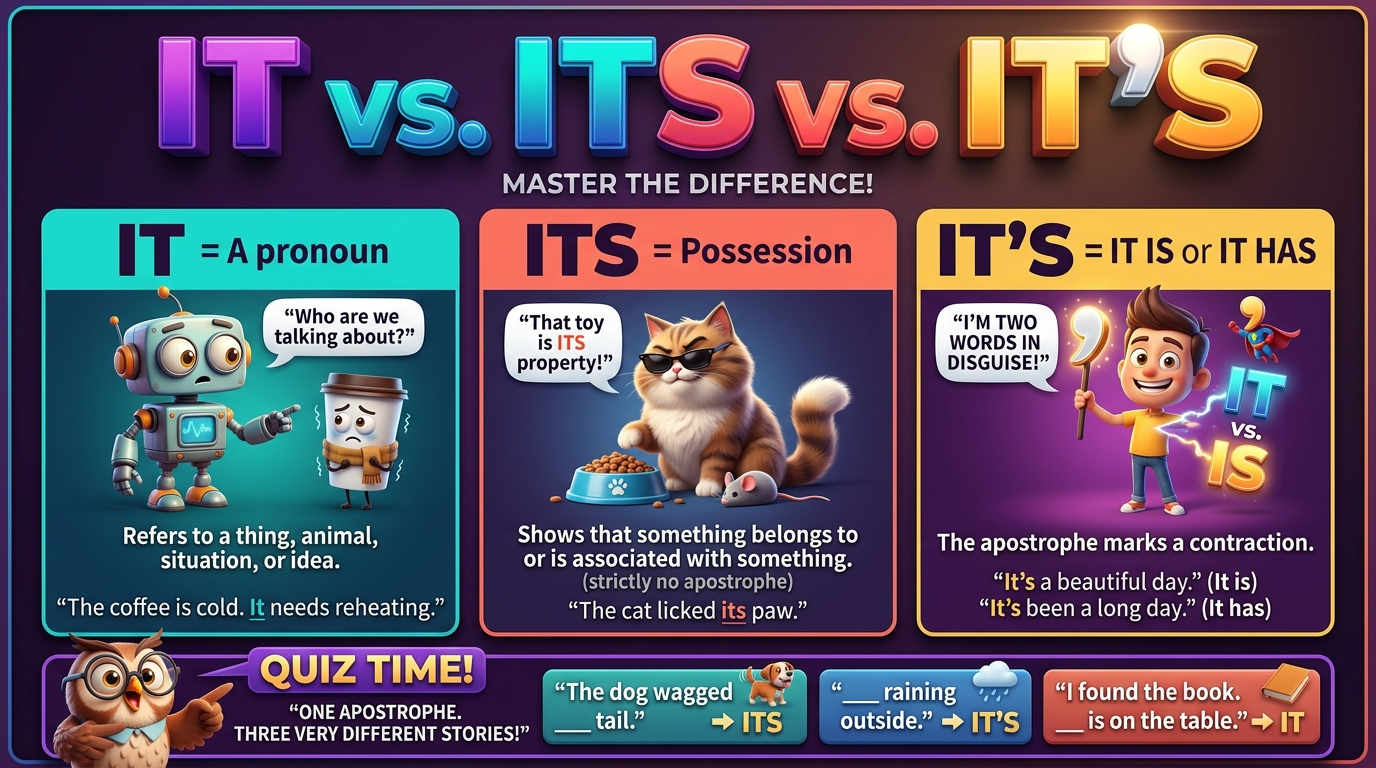
It vs. Its vs. It’s
This is the most important comparison.
| Word | Meaning | Example |
|---|---|---|
| It | Pronoun | It is cold. |
| Its | Possessive | The dog wagged its tail. |
| It’s | It is / It has | It’s cold. |
| It’s | It is / It has | It’s been repaired. |
The Golden Rule
Its = possession
It’s = it is / it has
This is unusual because possessive forms normally use apostrophes in English:
John’s car
Sarah’s book
But its is an important exception.
Why Doesn’t “Its” Have an Apostrophe?
This is one of the most common grammar questions.
Usually, apostrophes can indicate possession:
the dog’s tail
the company’s policy
But possessive pronouns and possessive determiners don’t follow that same pattern.
For example:
my
your
his
her
our
their
its
So:
The dog wagged its tail. ✅
Not:
The dog wagged it’s tail. ❌
It’s is a contraction, not the possessive form.
What Does “It’s” Mean?
It’s is a contraction.
It can mean:
it is
or:
it has
It’s = It Is
It’s cold outside.
= It is cold outside.
It’s a beautiful day.
= It is a beautiful day.
It’s = It Has
It’s been a difficult week.
= It has been a difficult week.
It’s already started.
= It has already started.
🎯 Key Insight: If it’s can be expanded to it is or it has, the apostrophe is correct.
The Best Trick for Choosing It or Its
Use the “it is” test.
Example 1
The company changed it’s policy.
Try expanding:
The company changed it is policy. ❌
That doesn’t make sense.
Therefore:
The company changed its policy. ✅
Example 2
Its raining outside.
Expand it:
It is raining outside. ✅
Therefore:
It’s raining outside. ✅
🎯 Lesson: If “it is” works, use it’s.
If you mean belonging to it, use its.
Real-World Usage Scenarios
Scenario 1: A Dog
The dog is eating its food.
Its shows that the food belongs to or is intended for the dog.
🎯 Lesson: Possession → its
Scenario 2: Weather
It’s raining heavily.
Expand:
It is raining heavily.
🎯 Lesson: “It is” → it’s
Scenario 3: A Company
The company announced its new product.
Its refers to something associated with the company.
🎯 Lesson: Belonging/association → its
Scenario 4: A Problem
It’s getting worse.
Expand:
It is getting worse.
🎯 Lesson: “It is” → it’s
Scenario 5: A Machine
The machine stopped because its battery was empty.
The battery belongs to or is part of the machine.
🎯 Lesson: Possession → its
Its Usage
Its is a possessive determiner used to show that something belongs to, relates to, or is associated with a thing, animal, organization, or other entity. It is the possessive form of the pronoun it.
For example:
The dog wagged its tail.
The company changed its name.
The house lost its roof during the storm.
The tree dropped its leaves in autumn.
The phone has its own charger.
In each sentence, its shows a relationship or possession. The tail belongs to the dog, the name belongs to the company, and the roof belongs to the house.
When to Use Its
Use its when you need to express possession without naming the owner again.
Animals: The cat cleaned its paws.
Objects: The car needs its tires replaced.
Organizations: The school updated its rules.
Nature: The flower opened its petals.
Abstract concepts: The plan has its advantages.
A useful rule is to replace its with “belonging to it” or “associated with it.” If the sentence makes sense, its may be appropriate.
Remember that its does not contain an apostrophe. The form it’s means it is or it has, not possession.
It vs. Its Examples
The words it and its look similar, but they serve different grammatical purposes. It is a pronoun used as a subject or object, while its expresses possession or association.
Examples of It
It is raining outside.
I found the book and put it on the desk.
It looks beautiful.
The baby dropped it.
It was a wonderful experience.
I think it will work.
The company announced that it would expand.
In these examples, it refers to a thing, situation, animal, organization, or idea, or acts as a grammatical subject.
Examples of Its
The bird built its nest.
The computer needs its software updated.
The restaurant changed its menu.
The country celebrated its independence.
The tree spread its branches.
The business increased its prices.
The book has its own unique style.
Here, its shows possession, connection, or association.
It vs. Its in the Same Sentence
It is a small dog, and its ears are floppy.
It looks like the phone has lost its case.
It was a difficult test, but its final question was easy.
It is a popular restaurant because of its food.
It started raining, and the storm reached its peak an hour later.
The first word identifies or refers to something; the second shows what belongs to or is associated with that thing.
It vs. Its Quiz
Choose the correct word, it or its, to complete each sentence.
The cat licked _____ paws.
A. It
B. Its
_____ is getting late.
A. It
B. Its
The company announced _____ new policy.
A. It
B. Its
I bought a new phone, and _____ works perfectly.
A. It
B. Its
The tree lost _____ leaves during the storm.
A. It
B. Its
_____ was the best day of my vacation.
A. It
B. Its
The school changed _____ schedule.
A. It
B. Its
The puppy chased _____ tail.
A. It
B. Its
I found the remote and put _____ on the table.
A. It
B. Its
The restaurant is known for _____ homemade desserts.
A. It
B. Its
It vs. Its Quiz Answers
Its — Shows that the paws belong to the cat.
It — Functions as the subject in “It is getting late.”
Its — Shows that the policy belongs to the company.
It — Refers to the phone as the subject of “works.”
Its — Shows that the leaves belong to the tree.
It — Refers to the day or experience.
Its — Shows that the schedule belongs to the school.
Its — Shows that the tail belongs to the puppy.
It — Functions as the object of “put.”
Its — Shows that the desserts are associated with the restaurant.
Its vs. Its
The comparison “its vs. its” involves the same word written twice, so there is no spelling or grammatical difference between the two forms.
However, people sometimes search for this phrase when they actually mean “it vs. its” or “its vs. it’s.” These are different comparisons.
It: A pronoun. Example: It is cold outside.
Its: A possessive determiner. Example: The house has lost its roof.
It’s: A contraction of it is or it has. Example: It’s cold outside.
If you are comparing two sentences that both contain its, the correct interpretation depends on how the word is used in each sentence. The spelling remains the same.
It vs. Its Meaning
The meaning of it and its depends on whether the sentence refers to something or shows possession.
What Does It Mean?
It is a third-person singular pronoun commonly used to refer to a thing, animal, situation, idea, or organization. It can function as a subject or an object.
Examples:
It is broken.
I fixed it.
It seems like a good idea.
The company said it would respond soon.
English also uses it in expressions where no specific object is being referred to, such as “It is raining” and “It is important to practice.”
What Does Its Mean?
Its is a possessive determiner that indicates ownership, association, or a relationship.
Examples:
The dog found its toy.
The city is famous for its architecture.
The book has lost its cover.
In each sentence, its connects a noun with the thing or entity associated with it.
It vs. Its: The Main Difference
| Word | Grammatical role | Example |
|---|---|---|
| It | Subject or object pronoun | It fell off the shelf. |
| Its | Possessive determiner | The box lost its lid. |
| It’s | Contraction | It’s on the shelf. |
The apostrophe in it’s indicates missing letters, not possession. This is the opposite of many possessive forms in English, which can make the distinction confusing for learners.
It vs. Its on Reddit
People searching for it vs. its on Reddit are often looking for practical explanations of apostrophes, grammar mistakes, and examples from everyday writing.
The main rule is simple: use it when referring to something and its when showing possession or association.
For example:
“The dog is sleeping. It looks comfortable.”
“The dog is sleeping in its bed.”
“It’s sleeping in its bed.”
The first sentence uses it as a pronoun. The second uses its to show possession. The third uses it’s to mean it is, followed by the possessive determiner its.
Online discussions may include informal writing and personal opinions, but the standard grammatical distinction is well established. When proofreading a sentence, identify whether you need a pronoun, a possessive determiner, or a contraction rather than relying on how the word sounds.
It vs. Its Grammar
Understanding the grammar of it and its becomes easier when you consider their roles in a sentence.
It as a Pronoun
A pronoun replaces or refers to a noun, situation, or idea.
As a subject:
It is raining.
It looks expensive.
It belongs to my brother.
As an object:
I bought it yesterday.
She opened it carefully.
We discussed it during the meeting.
In these sentences, it identifies the thing or situation being discussed.
Its as a Possessive Determiner
A possessive determiner appears before a noun to show possession or association.
Examples:
Its color is bright.
The dog shook its head.
The company revised its website.
The machine stopped because its motor overheated.
Unlike it, its normally accompanies a noun, such as color, head, website, or motor.
It’s as a Contraction
Although the main comparison is it versus its, the contraction it’s is important because it is frequently confused with its.
It’s can mean:
It is: It’s raining. → It is raining.
It has: It’s been a long day. → It has been a long day.
A practical test is to replace it’s with it is or it has. If the sentence still makes sense, the contraction may be correct.
For example:
“The dog wagged it’s tail.” — Incorrect, because “The dog wagged it is tail” does not make sense.
“The dog wagged its tail.” — Correct, because its shows possession.
“It’s wagging its tail.” — Correct, because the first word means it is and the second shows possession.
Is Its a Word?
Yes, its is a standard English word. It is the possessive form of it and is used before a noun to show that something belongs to or is associated with a thing, animal, organization, or situation.
Examples:
The bird spread its wings.
The company changed its name.
The computer restarted because its battery was low.
The town is known for its historic buildings.
Although its is sometimes confused with it’s, both are correct words with different grammatical functions.
Its: Possessive determiner — “The dog chased its ball.”
It’s: Contraction of it is or it has — “It’s a beautiful day.”
The key takeaway is that its is a word without an apostrophe, and it expresses possession or association. Use it’s only when you mean it is or it has.
Common Mistakes With It and Its
Mistake 1: Using “It’s” to Show Possession
❌ The company changed it’s website.
Correct:
✅ The company changed its website.
Why?
Because its means the website belongs to or is associated with the company.
Mistake 2: Forgetting the Apostrophe in “It’s”
❌ Its raining outside.
Correct:
✅ It’s raining outside.
Why?
Because:
It’s = It is
Mistake 3: Writing “It’s Own”
This is a particularly common mistake.
❌ The company has it’s own website.
Correct:
✅ The company has its own website.
The phrase is:
its own
not:
it’s own
Mistake 4: Confusing “Its” With “It Is”
❌ The dog wagged it is tail.
Correct:
✅ The dog wagged its tail.
Its is the possessive form.
It vs. Its in Formal and Academic Writing
The distinction is especially important in professional and academic writing because an incorrect apostrophe can make otherwise polished writing look careless.
Correct
The study has its limitations.
The company revised its strategy.
The theory has its origins in earlier research.
Incorrect
❌ The study has it’s limitations.
❌ The company revised it’s strategy.
❌ The theory has it’s origins in earlier research.
🎯 Key Insight: Before a noun, its is usually the correct possessive form.
It vs. Its With Animals
English allows both it and gendered pronouns for animals depending on context.
General Reference
The dog hurt its paw.
Known Gender
A person may use:
The dog hurt her paw.
or:
The dog hurt his paw.
But when using it, the possessive form is always:
its
Not:
❌ it’s paw
It vs. Its: A Simple Sentence Pattern
“It” as the Subject
It is beautiful.
It looks expensive.
It works perfectly.
“Its” Before a Noun
Its color is beautiful.
Its price is high.
Its design is impressive.
Notice the difference:
It looks expensive.
vs.
Its price is expensive.
It stands by itself as a pronoun.
Its normally modifies a noun.
Memory Tricks: It vs. Its
🧠 Trick 1: Its = His / Her
Think of its like:
his
her
their
For example:
The dog wagged its tail.
Compare:
John wagged his hand.
Both are possessive.
✂️ Trick 2: Apostrophe Means Missing Letters
In it’s, the apostrophe represents missing letters:
it’s = it is
The apostrophe is not showing possession.
⭐ One-Line Memory Trick
Its = belongs to it.
It’s = it is / it has.
Expert Insight: Why “Its” Is Confusing
The confusion exists because English normally uses apostrophes to indicate possession:
the dog’s collar
the company’s office
So learners naturally expect:
❌ it’s collar
But its belongs to the same family as possessive words such as:
his, hers, ours, yours, theirs
These forms do not use apostrophes.
Historically, the possessive form of it developed differently from the contraction it’s, which is why modern English has this seemingly unusual distinction.
The result is:
its = possessive
it’s = contraction
This is one of the most important apostrophe rules in English.
Quick Test: It, Its, or It’s?
1. The dog wagged ________ tail.
Answer: its
The tail belongs to the dog.
2. ________ raining outside.
Answer: It’s
= It is raining.
3. The company changed ________ policy.
Answer: its
The policy belongs to or is associated with the company.
4. ________ been a difficult day.
Answer: It’s
= It has been a difficult day.
5. The phone lost ________ signal.
Answer: its
The signal is associated with the phone.
6. ________ difficult to explain.
Answer: It’s
= It is difficult to explain.
7. The machine stopped because ________ battery was dead.
Answer: its
The battery belongs to the machine.