
Quick Answer (Featured Snippet Target)
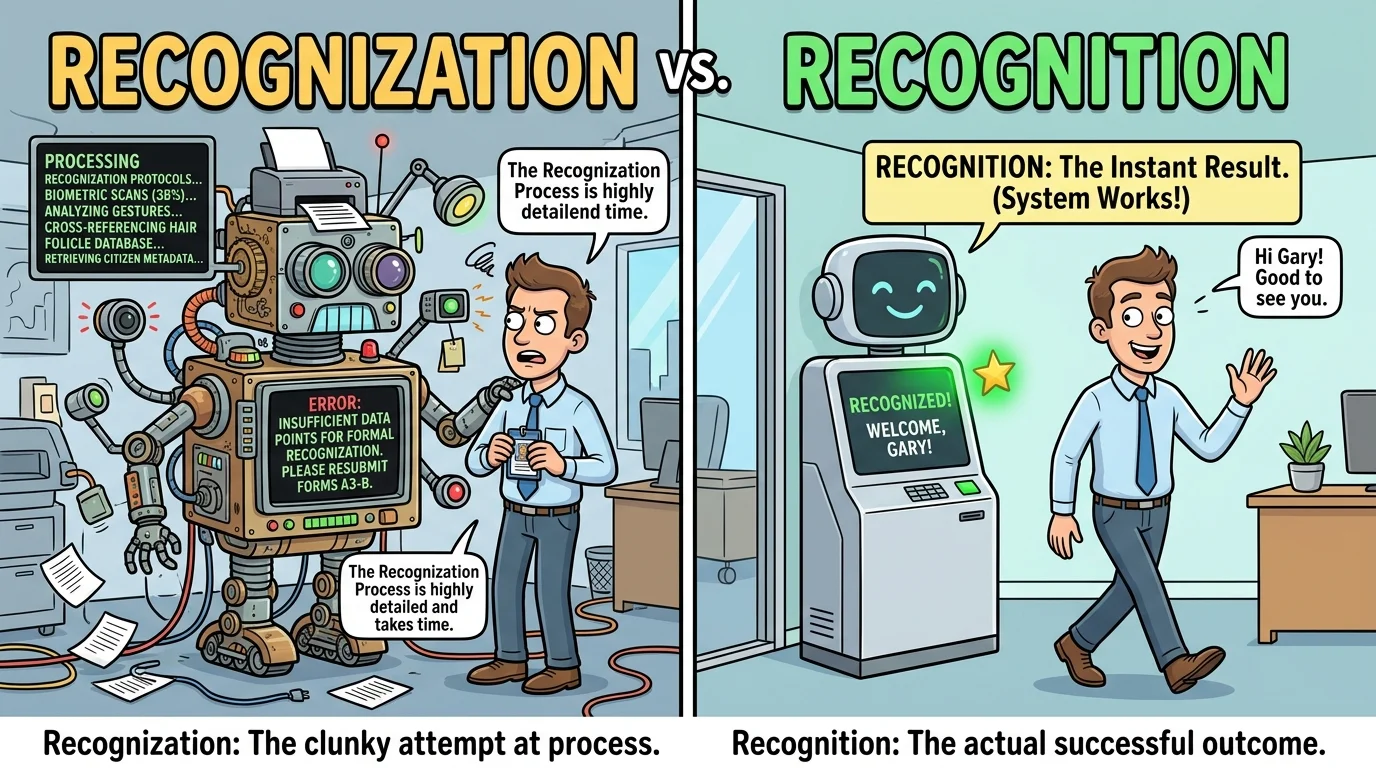
Recognition is the correct and standard noun form of the verb recognize. It means acknowledgment, identification, or appreciation of someone or something.
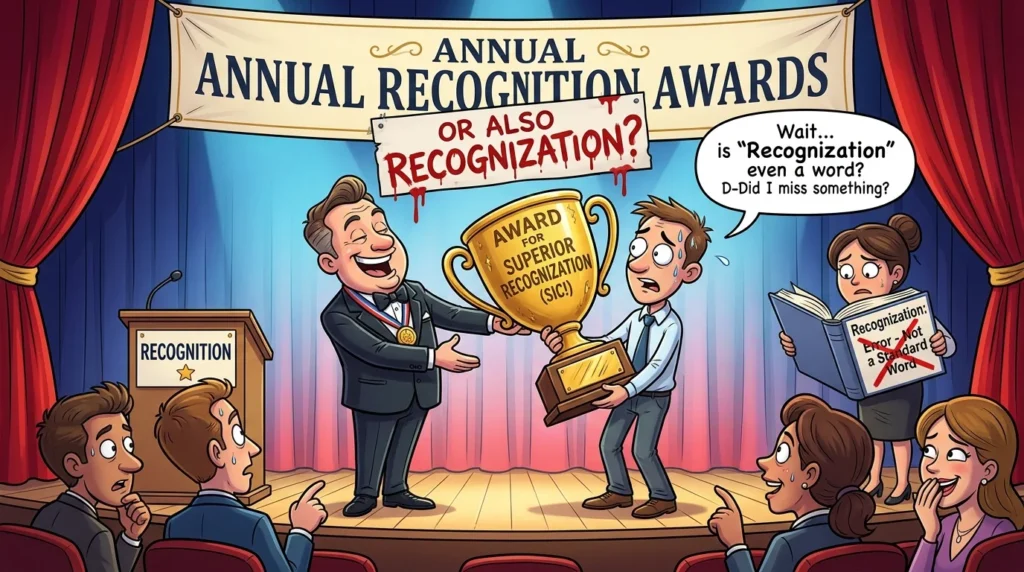
Recognization is generally considered a nonstandard, rare, or outdated form and is not recommended in modern English writing.
Correct: Recognition
Usually Incorrect: Recognization
What Does Recognition Mean?
Recognition is a noun that refers to the act of identifying, acknowledging, appreciating, or officially accepting something.
It is the accepted and preferred word in modern English.
Definition
Recognition means:
- Identifying someone or something previously known
- Acknowledging achievements or contributions
- Official acceptance or approval
- Awareness or realization
Examples of Recognition
- She received recognition for her outstanding work.
- Facial recognition technology is becoming more common.
- The artist gained international recognition.
- His efforts deserve public recognition.
Key Insight
Recognition is used across:
- Academic writing
- Business communication
- Journalism
- Government documents
- Legal contexts
- Everyday English
If you’re unsure which word to use, recognition is almost always the correct choice.
What Does Recognization Mean?
Recognization is a rare and largely nonstandard noun derived from recognize.
While it occasionally appears in historical texts or informal writing, it is generally not accepted as standard modern English.
Definition
Recognization attempts to express the same idea as recognition:
- Identification
- Acknowledgment
- Acceptance
However, English has already established recognition as the standard noun for these meanings.
Examples of Recognization
You might occasionally encounter sentences like:
- The recognization of his achievements was delayed.
- The recognization process took several months.
However, modern editors and grammar experts would usually revise these to:
- The recognition of his achievements was delayed.
- The recognition process took several months.
Key Insight
Even though recognization exists in some dictionaries as a rare historical variant, it is generally avoided in professional and formal English.
Recognization vs Recognition: Key Differences
Major Differences
Recognition
- Standard English word
- Widely accepted
- Used globally
- Appropriate for formal writing
- Found in dictionaries and style guides
Recognization
- Rarely used
- Considered nonstandard by many writers
- May sound awkward to native speakers
- Generally avoided in professional communication
Comparison Table
| Feature | Recognization | Recognition |
|---|---|---|
| Standard English | No (generally) | Yes |
| Modern Usage | Rare | Very common |
| Formal Writing | Not recommended | Recommended |
| Dictionaries | Limited recognition | Fully accepted |
| Professional Documents | Avoid | Use |
| Academic Writing | Avoid | Use |
| Example | Recognization of success | Recognition of success |
Why Is Recognition the Preferred Form?
English often forms nouns from verbs in ways that don’t always follow a simple pattern.
For example:
| Verb | Standard Noun |
|---|---|
| Recognize | Recognition |
| Realize | Realization |
| Organize | Organization |
| Authorize | Authorization |
Many learners assume recognize should become recognization, but English developed differently.
The established noun became recognition, which has been accepted for centuries.
Real-World Usage Scenarios
Scenario 1: Employee Award
❌ Incorrect:
“The company gave her recognization for her achievements.”
✅ Correct:
“The company gave her recognition for her achievements.”
🎯 Lesson: Professional writing almost always uses recognition.
Scenario 2: Technology
❌ Incorrect:
“Speech recognization software has improved.”
✅ Correct:
“Speech recognition software has improved.”
🎯 Lesson: Technology fields universally use recognition.
Scenario 3: Academic Writing
❌ Incorrect:
“The recognization of climate risks is increasing.”
✅ Correct:
“The recognition of climate risks is increasing.”
🎯 Lesson: Academic publications prefer recognition.
Scenario 4: Government Approval
❌ Incorrect:
“The recognization of the organization was approved.”
✅ Correct:
“The recognition of the organization was approved.”
🎯 Lesson: Legal and governmental contexts use recognition.
Scenario 5: Personal Achievement
❌ Incorrect:
“He finally received recognization for his hard work.”
✅ Correct:
“He finally received recognition for his hard work.”
🎯 Lesson: In everyday English, recognition is the natural choice.
Common Mistakes People Make
Mistake 1: Assuming Every “-ize” Verb Uses “-ization”
Many words follow this pattern:
- Organize → Organization
- Authorize → Authorization
Because of this, writers mistakenly create:
- Recognize → Recognization
Why It Happens
English word formation is not always consistent.
Recognition became the accepted form through historical usage.
Mistake 2: Trusting Spellcheck Alternatives
Some software may not immediately flag recognization.
Why It Happens
The word has appeared historically and occasionally in niche contexts.
Correct Choice
Use recognition whenever possible.
Mistake 3: Using Recognization in Formal Documents
Professional readers may view recognization as an error.
Better Option
Always replace it with recognition in:
- Business writing
- Academic papers
- Reports
- Applications
- Website content
Memory Tricks to Remember the Difference
Trick 1: Think of Recognition as the Real Word
Ask yourself:
“Have I ever heard someone say employee recognization program?”
Probably not.
You almost always hear:
Employee recognition program.
Trick 2: Remember Common Phrases
These standard phrases all use recognition:
- Facial recognition
- Speech recognition
- Brand recognition
- Public recognition
- Industry recognition
- Recognition award
If the phrase sounds familiar, recognition is likely correct.
Trick 3: Recognition = Dictionary Favorite
When in doubt:
Recognition wins.
Simple and effective.

Expert Insight: Why Recognition Survived
From a linguistic perspective, English vocabulary evolved through a combination of Latin, French, and Germanic influences.
The noun recognition entered English through historical language development and became firmly established long before modern standardization rules emerged.
Although recognization occasionally appeared in historical records, it never achieved widespread acceptance.
As a result:
- Recognition became the dominant standard.
- Recognization remained rare and largely obsolete.
This is an example of how actual language usage often matters more than theoretical word-formation rules.