
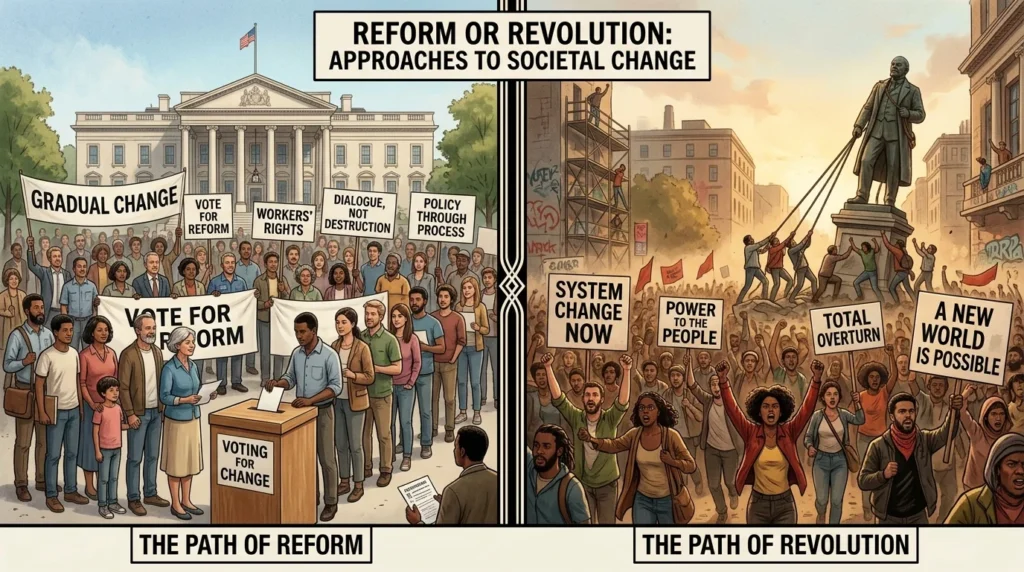
Quick Answer: Reform vs. Revolution
Reform means changing or improving an existing system while generally keeping its basic structure.
Revolution means fundamentally transforming or replacing an existing system or order.
The easiest rule
Reform = change the system.
Revolution = change the system fundamentally.
Think of it this way:
🛠️ Reform = repair or improve the house.
🏗️ Revolution = replace the house with something fundamentally different.
What Does “Reform” Mean?
Reform means to make changes to something in order to improve it, correct problems, or make it more effective or fair.
The existing system generally remains in place.
Examples
The government introduced tax reforms.
The company implemented reforms to improve working conditions.
Education reform has become a major political issue.
The organization needs significant reform.
In each case, the goal is to change part of an existing system rather than completely overthrow it.
🎯 Key Insight: Reform usually works within an existing structure.
What Does “Revolution” Mean?
Revolution means a fundamental and far-reaching change in a political, social, economic, or technological system.
In political history, it can refer to an uprising that overthrows an established government or ruling order.
Examples
The French Revolution transformed France’s political and social structure.
The revolution overthrew the existing government.
The word can also be used outside politics.
The internet caused a revolution in communication.
Artificial intelligence is driving a technological revolution.
Here, revolution means a dramatic transformation rather than necessarily a violent political uprising.
🎯 Key Insight: Revolution implies a much more fundamental transformation than ordinary reform.
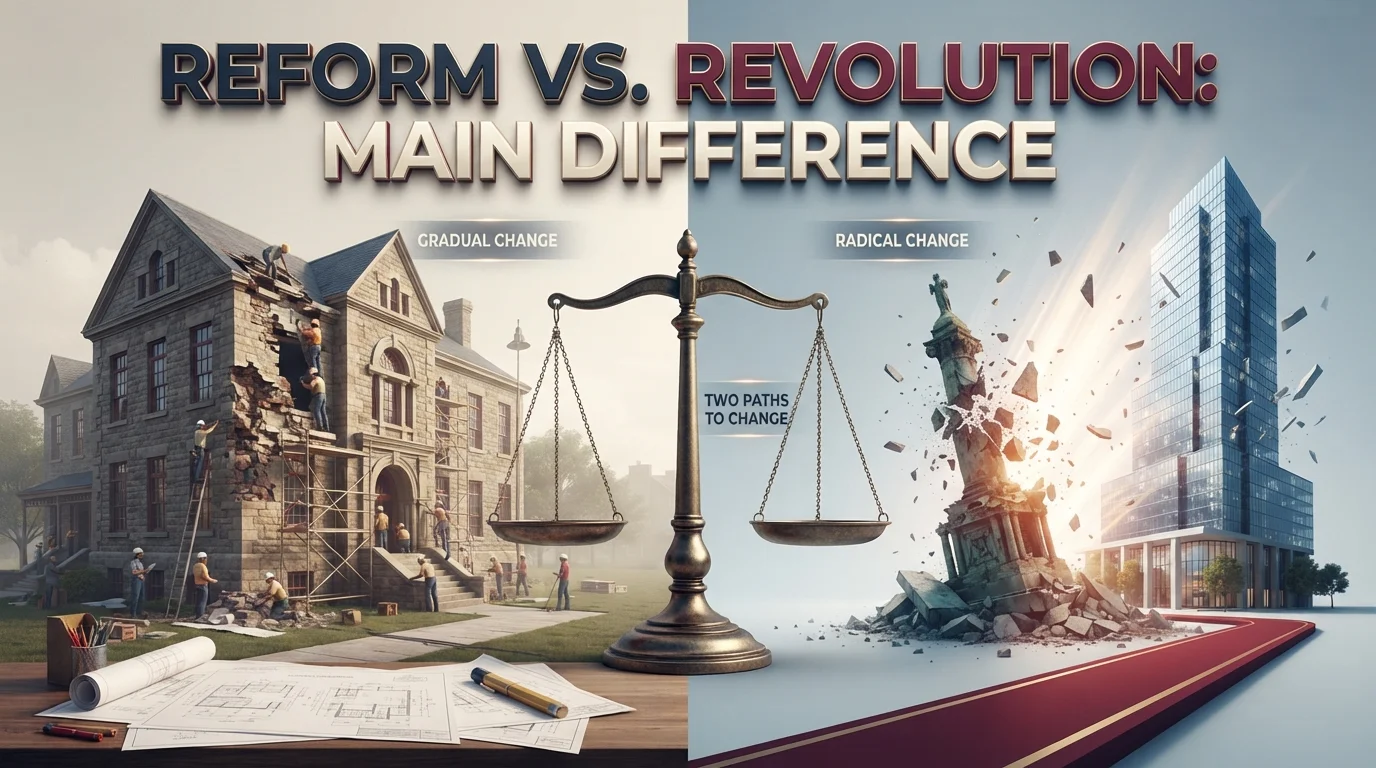
Reform vs. Revolution: Main Difference
| Feature | Reform | Revolution |
|---|---|---|
| Basic meaning | Improve or modify an existing system | Fundamentally transform or replace a system |
| Scale | Usually gradual or limited | Usually profound and far-reaching |
| Existing system | Generally retained | May be overthrown or fundamentally replaced |
| Method | Often legal, institutional, or gradual | Can involve mass movements, upheaval, or force |
| Goal | Improvement or correction | Fundamental transformation |
| Example | Education reform | Political revolution |
| Memory clue | Improve | Transform |
Bottom Line
Reform changes parts of an existing system.
Revolution changes the system at a fundamental level.
Reform: Change Without Complete Overthrow
A reform usually accepts that the existing institution or system can be improved rather than completely destroyed.
For example:
The government reformed the healthcare system.
This suggests the healthcare system remained in place but underwent important changes.
Common Types of Reform
You may hear:
- Political reform
- Economic reform
- Social reform
- Education reform
- Legal reform
- Electoral reform
- Healthcare reform
- Tax reform
Example
The government passed electoral reforms to make elections more transparent.
The electoral system still exists, but some of its rules have changed.
🎯 Lesson: Reform usually means improvement from within an existing framework.
Revolution: Fundamental Transformation
A revolution goes much further.
It can involve:
- Overthrowing a government
- Replacing political institutions
- Changing social structures
- Transforming economic systems
- Challenging established authority
Political Example
The revolution resulted in the collapse of the old regime.
The existing political order was fundamentally disrupted.
Social Example
The Industrial Revolution transformed production and employment.
This was not simply a small improvement to existing manufacturing. It represented a major transformation in how goods were produced.
🎯 Lesson: Revolution suggests deep, structural change.
Reform vs. Revolution: Real-World Scenarios
Scenario 1: Education
The government introduced education reforms to improve public schools.
The school system remains, but policies and practices change.
🎯 Lesson: Reform = improvement within the existing system.
Scenario 2: Government
The revolution replaced the existing political order.
The change is fundamental.
🎯 Lesson: Revolution = major structural transformation.
Scenario 3: Company
The company reformed its hiring policies.
The company still operates under the same overall structure.
🎯 Lesson: Reform can describe targeted organizational change.
Scenario 4: Technology
The smartphone revolution changed how people communicate.
No government necessarily needs to be overthrown for something to be called a revolution.
🎯 Lesson: Revolution can also describe a dramatic transformation in technology, culture, or society.
Scenario 5: Legal System
Parliament introduced legal reforms.
The legal system remains, but specific laws or procedures are changed.
🎯 Lesson: Reform is appropriate when the goal is to improve an existing institution.
Reform vs. Revolution in Politics
The distinction is particularly important in political discussions.
Reformist Approach
A reformist generally seeks to:
- Change existing laws
- Improve institutions
- Correct unfair policies
- Expand rights
- Modify government practices
The underlying political system can remain intact.
Revolutionary Approach
A revolutionary movement may seek to:
- Overthrow an existing government
- Replace political institutions
- Fundamentally change social structures
- Establish a new political order
Simple Comparison
Reformer: “The system needs major improvements.”
Revolutionary: “The existing system needs to be fundamentally replaced.”
🎯 Key Insight: The biggest distinction is often the relationship to the existing system.
Reform vs. Revolution: Gradual vs. Rapid
People sometimes summarize the difference as:
Reform = gradual
Revolution = rapid
This is useful, but it is not a complete definition.
A reform can sometimes happen quickly.
A revolution can also develop over a long period.
The more important distinction is the depth and nature of the change.
Compare
A government quickly passes a major education reform.
This is still reform.
A political movement gradually develops into a revolution that eventually replaces the government.
This is still revolution.
🎯 Expert Insight: Speed alone does not determine whether something is a reform or revolution.
Reform vs. Revolution: Violent or Peaceful?
Another common misconception is:
Reform = peaceful
Revolution = violent
This is too simplistic.
Reforms can involve conflict, protests, strikes, or political confrontation.
Revolutions can also occur with varying degrees of violence.
The defining difference is more about the scale and structural consequences of change than whether violence occurred.
Common Mistakes With Reform and Revolution
Mistake 1: Calling Every Major Change a Revolution
❌ The government changed its tax policy, so it was a revolution.
Better:
✅ The government introduced tax reform.
🎯 Why? A policy change within an existing system is usually a reform, even if it is significant.
Mistake 2: Assuming Every Reform Is Small
A reform can be extremely important.
Major constitutional reforms transformed the political system.
The word reform does not automatically mean “minor.”
🎯 Why? Reform describes the type of change, not necessarily its size.
Mistake 3: Thinking Revolution Always Means Violence
Not necessarily.
The digital revolution transformed communication.
Here, revolution refers to profound technological change.
🎯 Why? Revolution can describe any major transformation, not only armed political conflict.
Mistake 4: Using “Revolution” When “Reform” Is More Precise
❌ The company underwent a revolution in its employee policies.
Possible in highly dramatic marketing language, but:
✅ The company introduced major reforms to its employee policies.
is more precise when the underlying organization remains intact.
Reform vs. Revolution as Verbs and Nouns
Reform as a Noun
The government introduced economic reforms.
Reform as a Verb
The government plans to reform the tax system.
Revolution as a Noun
The revolution changed the political system.
Revolution as a Verb
Revolution is generally not used as an ordinary verb in the same way as reform.
Instead, English commonly uses:
revolutionize
For example:
The technology revolutionized the industry.
🎯 Lesson: Reform works naturally as both a noun and verb, while revolution is primarily a noun; revolutionize is the usual verb.
Reform vs. Revolution: Related Words
Words Related to Reform
- Improve
- Modify
- Revise
- Correct
- Restructure
- Update
- Modernize
Words Related to Revolution
- Overthrow
- Transform
- Uprising
- Upheaval
- Radical change
- Regime change
- Revolutionize
These words are not exact synonyms, but they help clarify the semantic difference.
Memory Tricks: Reform vs. Revolution
🛠️ Trick 1: Reform = Repair
Think:
Reform → repair/improve
You’re changing something that already exists.
🔥 Trick 2: Revolution = Radical Change
Think:
Revolution → replace or transform the old order
The change goes much deeper.
⭐ One-Line Memory Trick
Reform = fix the system.
Revolution = fundamentally change the system.
Expert Insight: The Continuum Between Reform and Revolution
In real history and politics, the boundary is not always perfectly clear.
A series of reforms can gradually produce revolutionary consequences.
Likewise, a revolution may introduce reforms after a new political order has been established.
This means the terms describe different patterns and degrees of structural change, rather than two completely isolated categories.
For example:
The government introduced constitutional reform.
The existing political framework remains but is modified.
Compare:
A revolution replaced the existing constitutional order.
The second statement describes a much deeper transformation.
The Important Question
When deciding between the two, ask:
Is the existing system being improved, or is the underlying system being fundamentally transformed or replaced?
That question will usually lead you to the right word.
Quick Test: Reform or Revolution?
1. The government changed several tax laws.
Answer: Reform
The government introduced tax reforms.
2. A movement overthrew the existing government and created a new political order.
Answer: Revolution
The revolution transformed the political system.
3. A company changed its workplace policies.
Answer: Reform
The company introduced workplace reforms.
4. A new technology completely transformed an industry.
Answer: Revolution
The technology caused a revolution in the industry.
5. Parliament modified existing election laws.
Answer: Reform
Parliament introduced electoral reforms.
6. A social movement fundamentally changed the country’s social structure.
Answer: Revolution
The movement sparked a social revolution.