
Quick Answer
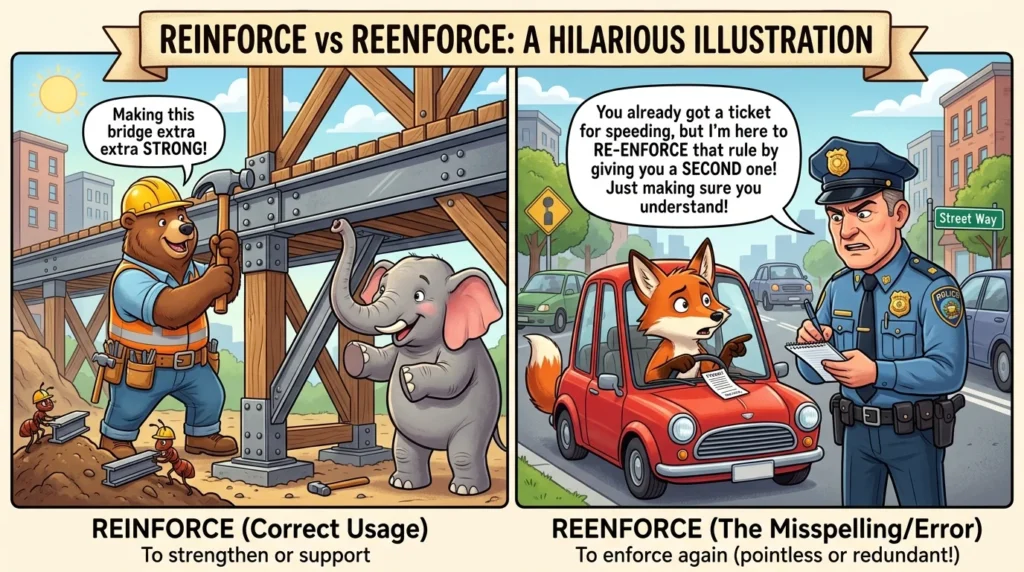
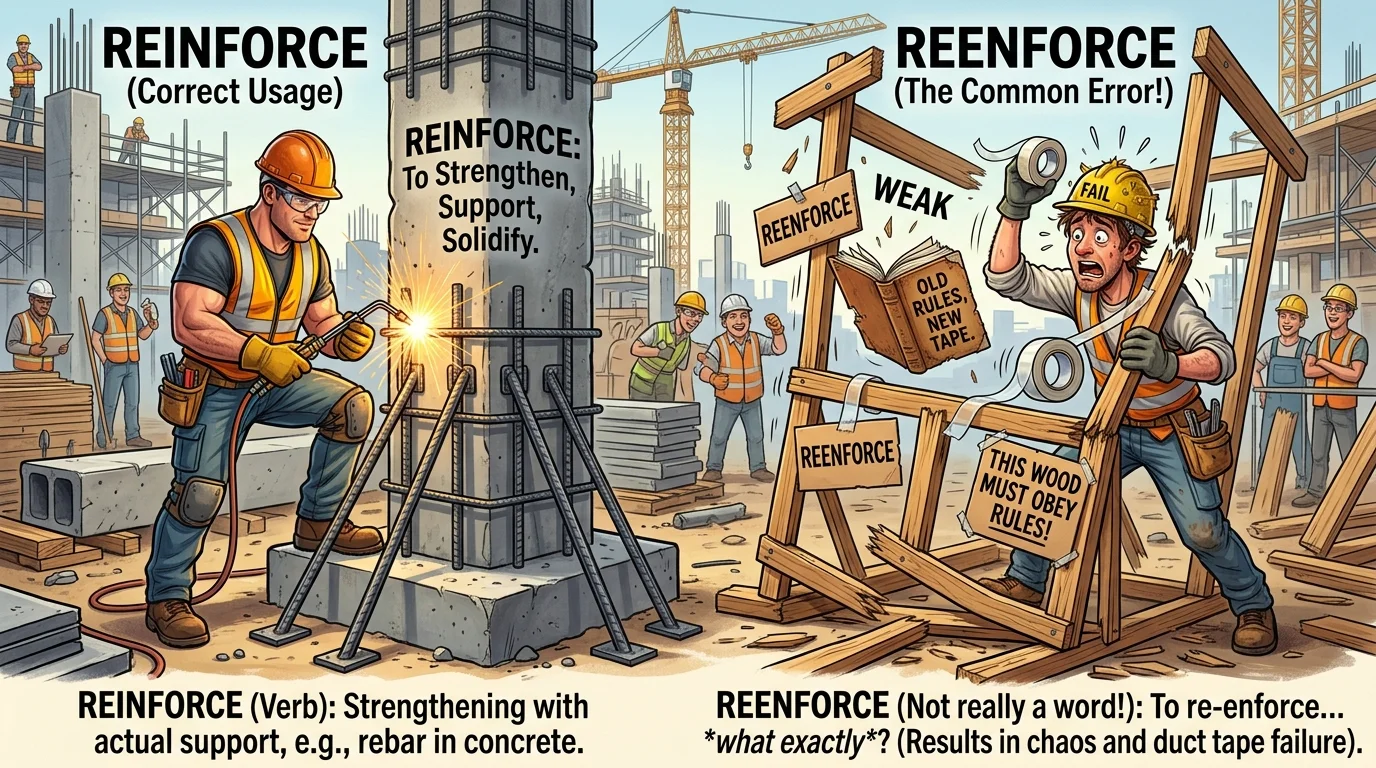
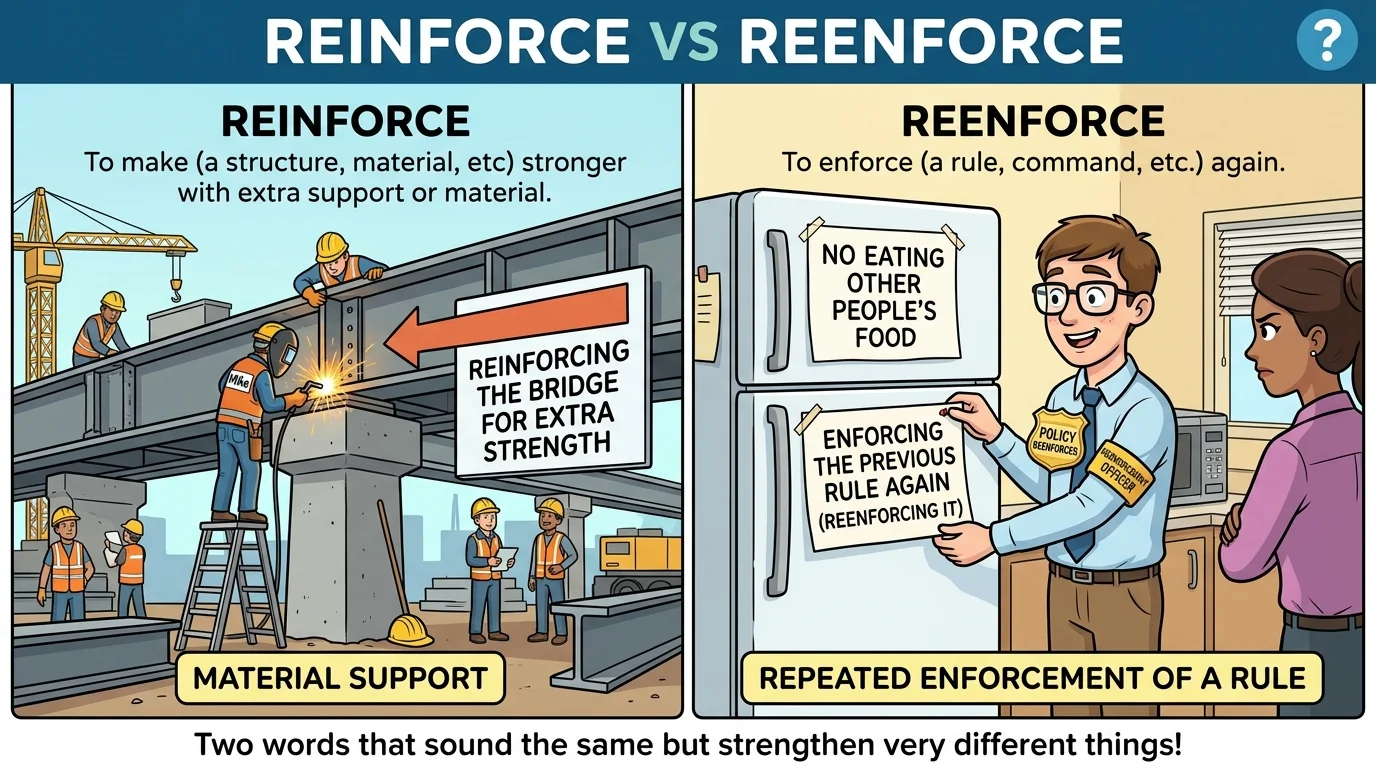
Reinforce is the correct and preferred spelling in modern English.
Reenforce is an older alternative spelling that has largely fallen out of use.
Example:
- Correct: The workers reinforced the bridge.
- Outdated: The workers reenforced the bridge.
For nearly all writing situations today, use reinforce.
What Does Reinforce Mean?
Definition
Reinforce means:
- To strengthen something
- To make something stronger or more effective
- To provide additional support
- To increase the impact of an idea, behavior, structure, or system
The word is commonly used in:
- Construction
- Engineering
- Military contexts
- Education
- Psychology
- Everyday communication
Usage Rules
Use reinforce when talking about:
Physical Strengthening
Example:
- The builders reinforced the wall with steel beams.
- Engineers reinforced the bridge to improve safety.
Strengthening Ideas or Messages
Example:
- The teacher reinforced the lesson with practical examples.
- The advertisement reinforced brand awareness.
Supporting Behavior
Example:
- Parents can reinforce good habits through praise.
- Positive feedback reinforces confidence.
Key Insight
Reinforce always suggests adding strength, support, or effectiveness to something that already exists.
What Does Reenforce Mean?
Definition
Reenforce is an alternative historical spelling of reinforce.
It carries the same meaning:
- To strengthen
- To support
- To make stronger
However, it is rarely used in modern English.
Historical Context
In earlier centuries, English spelling was less standardized.
As a result, both:
- reinforce
- reenforce
appeared in books, newspapers, and official documents.
Over time, reinforce became the dominant and accepted spelling.
Today, dictionaries, style guides, educators, and publishers overwhelmingly prefer reinforce.
Examples
Historical usage:
- Troops were sent to reenforce the frontier.
- Additional materials were used to reenforce the structure.
Modern editors would usually replace reenforce with reinforce.
Key Insight
While reenforce is not technically incorrect historically, it is considered outdated in contemporary English.
Reinforce vs Reenforce: Key Differences
Quick Comparison
Reinforce
- Modern standard spelling
- Widely accepted
- Used in academic and professional writing
- Preferred by dictionaries and style guides
Reenforce
- Historical spelling variant
- Rarely used today
- Can appear old-fashioned
- Generally avoided in modern writing
Comparison Table
| Feature | Reinforce | Reenforce |
|---|---|---|
| Meaning | Strengthen or support | Strengthen or support |
| Modern Usage | Yes | Rare |
| Dictionary Preference | Preferred | Secondary/obsolete variant |
| Professional Writing | Recommended | Not recommended |
| Academic Writing | Recommended | Rarely accepted |
| Common Today | Very common | Very uncommon |
| Example | Reinforce the wall | Reenforce the wall |
Real-World Usage Scenarios
Scenario 1: Construction
❌ Incorrect Modern Usage
“The workers reenforced the building before the storm.”
✅ Preferred Modern Usage
“The workers reinforced the building before the storm.”
🎯 Lesson: Use reinforce in current English.
Scenario 2: Education
Teacher:
“We will reinforce today’s lesson with additional exercises.”
Student:
“What does reinforce mean?”
Teacher:
“It means strengthening your understanding.”
🎯 Lesson: Reinforce often refers to strengthening knowledge.
Scenario 3: Business Communication
Manager:
“We need data to reinforce our proposal.”
Employee:
“I’ll gather supporting statistics.”
🎯 Lesson: Reinforce can strengthen an argument or recommendation.
Scenario 4: Parenting
Parent:
“We should reinforce positive behavior with praise.”
🎯 Lesson: Psychology frequently uses reinforce to encourage desired actions.
Scenario 5: Military Context
“The army sent additional troops to reinforce the position.”
🎯 Lesson: Reinforce can mean providing extra support or resources.
Common Mistakes
Mistake 1: Thinking Reenforce Is the Modern Spelling
Many writers assume adding “re-” makes the spelling more logical.
Correct
- reinforce
Avoid
- reenforce
Why it happens:
People associate “re-” with repetition and mistakenly insert an extra “e.”
Mistake 2: Using Reenforce in Professional Documents
Modern readers may view the spelling as outdated.
Better Choice
- reinforce
Why it matters:
Professional writing should follow current language standards.
Mistake 3: Assuming the Words Have Different Meanings
They do not.
Both historically mean the same thing.
The difference is primarily spelling and modern acceptance.
Memory Tricks to Remember the Difference
Trick 1: Think of “Rein”
The word reinforce begins with rein, like horse reins.
Remember:
Rein + force = reinforce
This is the accepted modern spelling.
Trick 2: Modern English Uses Reinforce
If you’re writing for:
- School
- Work
- Business
- Websites
- Social media
Choose reinforce every time.
Trick 3: One Word to Remember
Ask yourself:
“Which spelling do modern dictionaries prefer?”
The answer is always:
reinforce
Expert Insight: Why Reinforce Became Standard
English contains many words that historically had multiple spellings.
Before spelling standardization, writers often used different versions of the same word.
As dictionaries became influential, one form typically emerged as the standard.
For this word, reinforce won widespread acceptance because it aligned with established spelling conventions and became dominant in publishing, education, journalism, and academic writing.
Today, major style guides and dictionaries overwhelmingly recognize reinforce as the preferred form.
This is why most readers rarely encounter reenforce outside historical texts or archived documents.