
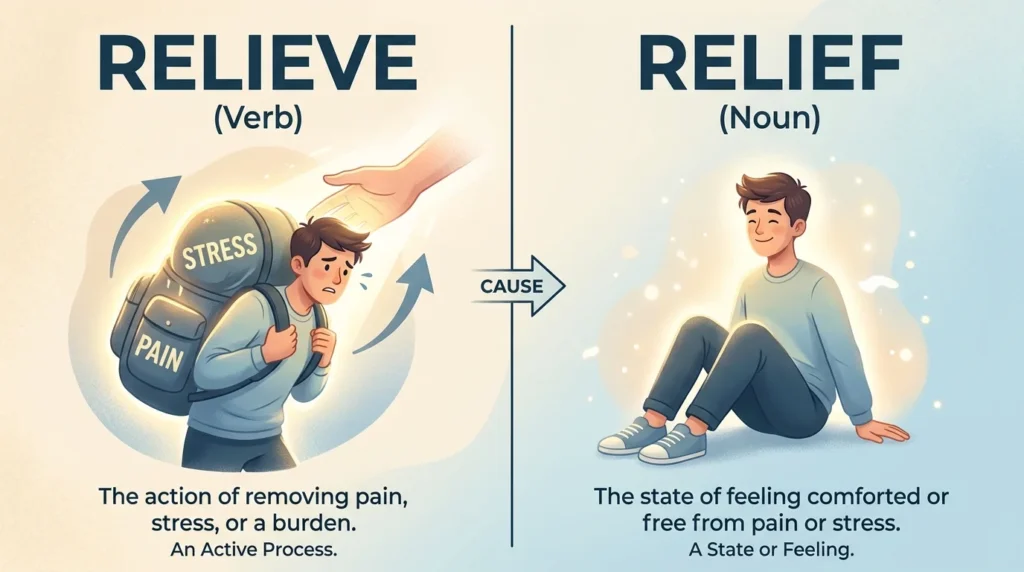

Quick Answer: Relieve vs. Relief
Relieve = to reduce or remove something unpleasant.
This medicine may relieve the pain.
Relief = the feeling or state that comes when something unpleasant is reduced or removed.
The medicine provided relief from the pain.
The easiest way to remember:
Relieve = do something
Relief = the result or feeling
What Does “Relieve” Mean?
Relieve is a verb. It means to make something unpleasant less severe or to remove it completely.
It can be used with things such as:
- Pain
- Stress
- Anxiety
- Pressure
- Discomfort
- Hunger
- Boredom
- Responsibility
- Duties
Examples of “Relieve”
- The medicine relieved her headache.
- A short break can relieve stress.
- The new treatment helped relieve his pain.
- The manager relieved her of some responsibilities.
In each example, relieve describes an action or change.
Common Grammar Patterns
Relieve + something
The medication relieved the pain.
Relieve someone of + something
The assistant relieved him of some of his duties.
Help relieve + something
Exercise can help relieve stress.
🎯 Key Insight: If the word describes reducing or removing a problem, you usually need relieve.
What Does “Relief” Mean?
Relief is primarily a noun.
It can describe the feeling of comfort or reassurance that occurs when something painful, stressful, or worrying has been reduced or removed.
Examples of “Relief”
- She felt a sense of relief when she heard the good news.
- The medicine provided relief from the pain.
- He sighed with relief after the exam ended.
- There was visible relief on her face.
Common Expressions With “Relief”
A sense of relief
A sigh of relief
Relief from pain
Relief from stress
Much to my relief
For example:
Much to my relief, the missing documents were found.
🎯 Key Insight: Relief is the comfort or release experienced after a problem becomes less severe.
Relieve vs. Relief
Relieve and relief are closely related words, but they have different grammatical roles. Relieve is primarily a verb, meaning to reduce pain, stress, discomfort, or difficulty, or to take someone’s place so they can stop working. Relief is primarily a noun, referring to the feeling or condition that occurs when pain, worry, pressure, or difficulty is reduced or removed.
A simple way to remember the difference is: you relieve a problem, but you feel relief from it.
Relieve Meaning
Relieve is a verb meaning to make something less painful, difficult, stressful, or unpleasant. It can also mean to replace someone who is performing a duty or to free someone from an obligation.
For example:
This medicine may relieve the pain.
A short break helped relieve her stress.
The new policy could relieve some of the financial pressure.
The night guard arrived to relieve the day guard.
The word focuses on the action of reducing or removing something unpleasant.
Relief Meaning
Relief is a noun describing the feeling of comfort that comes when pain, worry, stress, or difficulty is reduced or removed. It can also refer to assistance provided to people experiencing hardship.
For example:
I felt a sense of relief when the test results arrived.
The medicine provided relief from the pain.
She sighed with relief after finding her lost phone.
The organization delivered relief supplies after the disaster.
Here, relief names the result, feeling, or assistance rather than the action itself.

Relieve vs. Relief: What Is the Difference?
The biggest difference is part of speech.
Relieve is generally a verb:
The treatment helped relieve his headache.
Relief is generally a noun:
The treatment provided relief from his headache.
Both sentences communicate a similar idea, but they use the related words differently.
| Word | Part of speech | Basic meaning | Example |
|---|---|---|---|
| Relieve | Verb | To reduce or remove pain, stress, or difficulty | The treatment relieved her pain. |
| Relief | Noun | The reduction of pain, stress, or difficulty | The treatment gave her relief. |
Relief or Relieve From Duty
When talking about removing someone from a duty or replacing them, relieve is normally the verb:
The supervisor relieved him from duty.
The officer was relieved from duty after the investigation began.
Relief can be used as a noun when referring to the person or replacement taking over a duty:
The relief guard arrived at midnight.
The soldier was waiting for relief.
So, relieve someone from duty describes the action, while relief can refer to the replacement or the condition of being freed from the duty.
Relief or Relieve Pain
When describing the action of reducing pain, use relieve:
This medication can relieve pain.
When referring to the reduction or easing of pain itself, use relief:
This medication provides relief from pain.
A useful pattern is:
relieve pain → action
pain relief → result or condition
relief from pain → freedom or reduction from pain
For example:
The treatment relieved her back pain and gave her significant relief.
Relief or Relieve Someone From Work
If someone is being replaced so they can stop working, relieve is the verb:
Can you relieve me from work for an hour?
More natural alternatives in everyday English may include:
Can you relieve me of my duties?
or
Can you take over for me?
Relief is a noun when referring to the replacement or the assistance:
The manager sent someone to provide relief during my break.
Relief or Relieve Stress
Use relieve when describing what reduces stress:
Exercise can relieve stress.
Use relief when describing the resulting feeling or reduction:
Exercise can provide relief from stress.
Both forms are correct, but their grammatical functions are different.
Relieve vs. Relief Examples
Compare these sentences:
The cold compress helped relieve the swelling.
The cold compress provided relief from the discomfort.
Talking to a friend can relieve stress.
Talking to a friend can bring emotional relief.
The rain relieved the heat.
The cooler weather brought relief from the heat.
The new employee will relieve her of some responsibilities.
The additional staff will provide relief during busy hours.
Which Is Correct: Relieve or Relief?
Neither word is simply “more correct.” The right choice depends on how you use it.
Use relieve when you need a verb meaning to reduce, ease, remove, or replace:
The medicine helped relieve my headache.
Use relief when you need a noun describing the resulting comfort, reduction, assistance, or replacement:
The medicine gave me relief from my headache.
Quick rule: Relieve = the action. Relief = the result or feeling.
Comparison Table
| Feature | Relieve | Relief |
|---|---|---|
| Part of speech | Verb | Noun |
| Meaning | Reduce or remove something unpleasant | Comfort after something unpleasant is reduced |
| Focus | Action | Result/feeling |
| Example | This may relieve pain. | This provides pain relief. |
| Common phrase | Relieve stress | A sense of relief |
| Memory clue | Do | Feeling/result |
Real-World Usage Scenarios
Scenario 1: Headache
The medicine relieved my headache.
🎯 Lesson: Relieve is correct because the sentence describes what the medicine did.
Compare:
The medicine gave me relief from my headache.
Here, relief is the noun describing the result.
Scenario 2: Stress
Taking a walk can relieve stress.
🎯 Lesson: Relieve is a verb because it describes an action that reduces stress.
Scenario 3: Good News
I felt enormous relief when I heard the results.
🎯 Lesson: Relief is a noun because it describes the feeling experienced after the worry disappeared.
Scenario 4: Completing an Exam
She sighed with relief after finishing the exam.
🎯 Lesson: The phrase “with relief” describes the emotional response to the end of a stressful situation.
Scenario 5: Removing Responsibility
The supervisor relieved him of his duties.
🎯 Lesson: Relieve can also mean to remove a responsibility or obligation from someone.
Common Mistakes With Relieve and Relief
Mistake 1: “This gives me relieve”
❌ This gives me relieve.
✅ This gives me relief.
Why it happens:
After give, you need the noun relief.
give + relief
Mistake 2: “It provides relieve”
❌ This treatment provides relieve from pain.
✅ This treatment provides relief from pain.
Why it happens:
Provides needs a noun here.
provide + relief
Mistake 3: “It will relief the pain”
❌ This medicine will relief the pain.
✅ This medicine will relieve the pain.
Why it happens:
After will, you need the base form of the verb.
will + relieve
Not:
❌ will + relief
Mistake 4: “I feel relieve”
❌ I feel relieve after hearing the news.
Better:
✅ I feel relief after hearing the news.
Or:
✅ I feel relieved after hearing the news.
This introduces another useful word:
Relieve → relieved → relief
Relieve, Relieved, Relief, and Relieving
Understanding the entire word family makes the difference much easier.
Relieve
Verb:
The medicine may relieve the pain.
Relieved
Adjective/past participle:
I was relieved to hear the news.
Relief
Noun:
I felt a sense of relief.
Relieving
Present participle:
The treatment is relieving the discomfort.
Quick Pattern
Relieve = action
Relieved = feeling
Relief = noun/result
Relieved vs. Relief
This is another common source of confusion.
Relieved
Describes how a person feels.
She was relieved when the problem was solved.
Relief
Names the feeling itself.
She felt relief when the problem was solved.
Compare:
I am relieved.
= This describes my emotional state.
I feel relief.
= This identifies the feeling I’m experiencing.
🎯 Key Insight: Relieved describes a person; relief names the feeling.
How to Choose Between Relieve and Relief
Ask yourself:
Am I describing an action that reduces something?
Use relieve.
Exercise can relieve stress.
Am I naming the feeling or result?
Use relief.
Exercise gave me relief from stress.
Am I describing how someone feels?
Use relieved.
She felt relieved after the meeting.
Memory Tricks: Relieve vs. Relief
🧠 Trick 1: Relieve = Verb
Think:
Relieve = reduce
Both are actions.
The medicine relieves pain.
😌 Trick 2: Relief = Feeling
Think:
Relief = comfort
I felt relief when the danger passed.
🔤 Trick 3: “I Feel Relief”
This sentence is a useful memory anchor:
I feel relief.
You feel relief, but you relieve pain.
⭐ One-Line Memory Trick
You relieve a problem; you feel relief afterward.
Relieve vs. Alleviate
Relieve and alleviate are often synonyms when discussing pain, stress, or discomfort.
The medicine relieved the pain.
The medicine alleviated the pain.
Both are correct.
However, relieve is more common in everyday English, while alleviate can sound more formal.
Relieve vs. Release
These words are also sometimes confused.
Relieve
Means to reduce or remove something unpleasant.
The treatment relieved the pain.
Release
Means to let go, free, or make something available.
The company released a new product.
They released the animal into the wild.
They may overlap in certain contexts, but they are not generally interchangeable.
Expert Insight: The Grammar Behind Relieve and Relief
Relieve and relief belong to the same word family but occupy different grammatical roles.
The verb relieve describes an action:
The treatment relieved the symptoms.
The noun relief describes the resulting state or experience:
The treatment provided relief from the symptoms.
This distinction appears in many English word families where a verb and noun have related meanings:
- decide → decision
- approve → approval
- arrive → arrival
- relieve → relief
The spelling isn’t always predictable, so learning the words as grammatical pairs is useful.
Quick Test: Relieve or Relief?
Choose the correct word.
- The medicine helped ________ her pain.
- He felt a huge sense of ________ after hearing the news.
- Exercise can ________ stress.
- The treatment provided immediate ________.
- She was ________ to discover that everyone was safe.
Answers
- relieve
- relief
- relieve
- relief
- relieved
The Pattern
Relieve = verb/action
Relief = noun/feeling
Relieved = describes someone’s emotional state