
Quick Answer: Sitting or Seating?
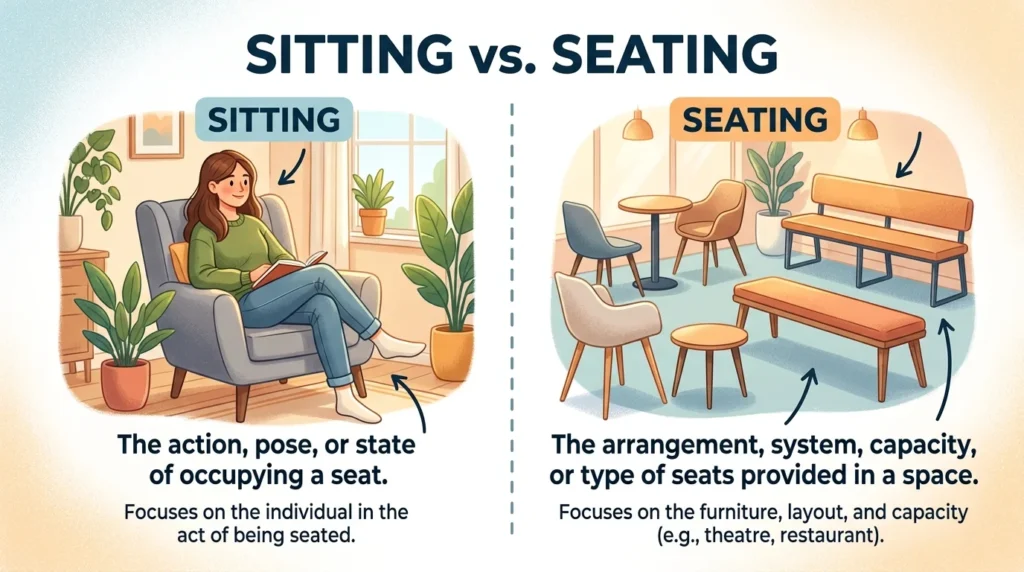
- Sitting = the act or state of being seated.
- Seating = arranging, assigning, or providing seats.
- Seating arrangement = the usual phrase for an organized arrangement of seats or people.
- Seating chart = the usual phrase for a chart showing assigned seats.
- Seating plan = the usual phrase for a plan showing where people should sit.
- I am sitting = correct when describing your own seated position.
- I am seating the guests = correct when you are assigning or placing guests in seats.
In short, sitting focuses on the person who is seated, while seating focuses on the seats, their arrangement, or the process of placing people in them.
What Does “Sitting” Mean?
Sitting is the present participle or gerund form of the verb sit.
It generally describes someone being in a seated position.
Examples of “Sitting”
- She is sitting in the living room.
- I have been sitting here for an hour.
- The children are sitting quietly.
- He was sitting beside the window.
In these examples, sitting describes an action or state involving a person or animal.
“Sitting” as a Noun
Sitting can also refer to a period spent seated or, in certain contexts, a session.
For example:
We had a long sitting during the meeting.
It can also refer to a session for a photograph:
The couple scheduled a sitting with the photographer.
🎯 Key Insight: When you are describing someone being seated, sitting is usually the correct word.
What Does “Seating” Mean?
Seating is formed from the verb seat and is commonly used as a noun meaning the arrangement or availability of seats.
Examples of “Seating”
- The restaurant offers outdoor seating.
- The stadium has seating for 50,000 people.
- There is limited seating available.
- The theater has comfortable seating.
Here, seating refers to seats or the way seats are arranged or provided.
“Seating” as an Action
Seating can also be the present participle of seat, meaning placing someone in a seat.
The hostess is seating the guests.
This means the hostess is showing guests to their seats or placing them in seats.
🎯 Key Insight: Seating is commonly connected with seats, arrangements, capacity, or placing people in seats.
Sitting vs Seating: Meaning and Difference
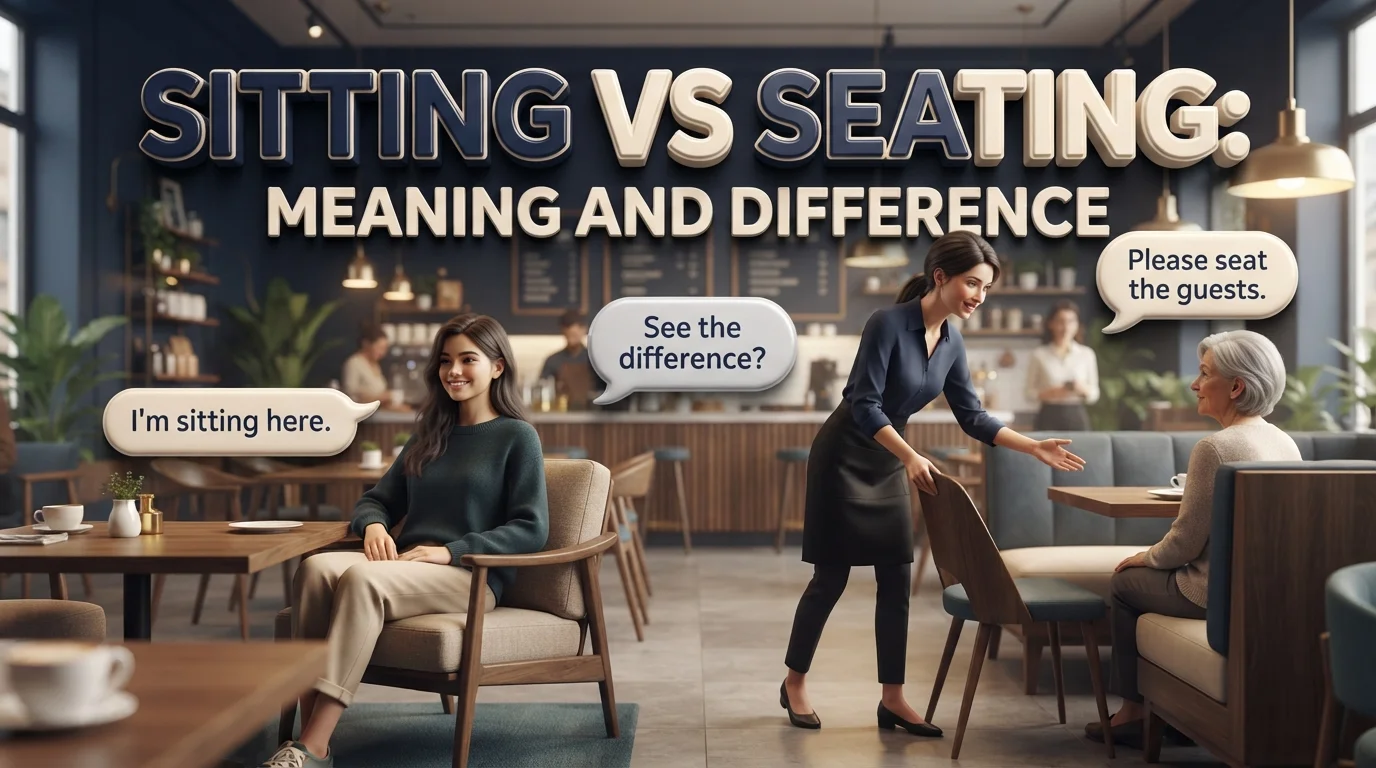
Sitting and seating are closely related because both come from the verb sit, but they are not interchangeable in every sentence. The easiest way to remember the difference is to focus on who is doing the action and what the action involves.
Sitting usually describes the act or state of being seated. Seating generally refers to providing, arranging, or assigning places for people to sit. For example, “I am sitting in the front row” describes a person’s position, while “The teacher is seating the students” describes the process of placing or assigning students to seats.
This distinction becomes especially useful in phrases such as seating arrangement, seating plan, classroom seating, committee seating, and seating for a meeting.
Sitting: Meaning and Usage
Sitting is the present participle of sit. It can describe someone who is currently in a seated position or the action of remaining in that position.
For example:
- I am sitting on the sofa.
- She is sitting near the window.
- The students are sitting quietly.
- We were sitting in the back row.
In these examples, sitting focuses on the people themselves and their position or activity.
It can also function as a noun in certain contexts, such as a long sitting of Parliament or a sitting of a court, where it refers to a session.
Seating: Meaning and Usage
Seating is commonly used when talking about places to sit, the arrangement of those places, or the process of putting people into particular seats.
For example:
- The theater has seating for 500 people.
- The teacher changed the seating arrangement.
- Please check the seating plan before entering the room.
- The event coordinator is responsible for seating the guests.
Here, seating is concerned with the organization or provision of seats rather than simply describing someone who is sitting.
Seating or Sitting Arrangement: Which Is Correct?
Seating arrangement is the more standard and natural phrase when you mean the way seats or people are organized in a room, classroom, meeting, event, or other setting.
For example:
- The teacher changed the seating arrangement in the classroom.
- The wedding planner finalized the seating arrangement.
- We need to discuss the seating arrangement before the meeting.
Sitting arrangement is also understandable and does occur, particularly in some varieties of English, but seating arrangement is generally the clearer choice when referring to an organized layout or assignment of seats.
The distinction is simple: sitting describes people being seated, whereas seating describes how seats or occupants are organized.
“I Am Sitting” or “I Am Seating”: Which Is Correct?
If you mean that you are currently in a seated position, use “I am sitting.”
- I am sitting in the living room. ✅
- I am seating in the living room. ❌
However, seating can be correct when it has an object and means placing or assigning someone to a seat.
- I am seating the guests now. ✅
- The hostess is seating the customers. ✅
So, “I am sitting” means I am in a seated position, while “I am seating someone” means I am putting or assigning someone to a seat.
Sitting vs Seating Chart
When a chart shows where people are supposed to sit, seating chart is the standard phrase.
For example:
- Please check the seating chart before the ceremony.
- The teacher posted a seating chart on the classroom door.
- Our names were listed on the seating chart.
Sitting chart is not normally used for this meaning. Although someone might understand what you mean from context, seating chart is the established expression.
Sitting or Seating Plan: Which Is Correct?
Seating plan is the conventional expression for a plan showing where people should sit.
For example:
- The wedding coordinator prepared a seating plan.
- Check the seating plan to find your table.
- The manager created a new seating plan for the office.
Sitting plan is much less common for this meaning. If you are describing an organized arrangement of seats or assigning particular people to particular places, seating plan is the better choice.
Committee Seating or Sitting: Which Is Correct?
The correct choice depends on what you want to describe.
Use committee seating when you are talking about where committee members sit or how their seats are arranged.
- The secretary prepared the committee seating plan.
- The committee seating arrangement was changed before the meeting.
Use committee sitting when you mean a formal session or meeting of the committee, although this expression is less common in everyday American English.
For example, in a formal context:
- The committee will hold a sitting tomorrow.
Therefore, seating relates to the physical arrangement of seats, while sitting can refer to the act of being seated or, in formal contexts, a session.
Seating or Sitting for a Meeting
For most workplace and event contexts, seating is the natural choice when discussing how participants will be positioned.
For example:
- We need to finalize the seating for the meeting.
- The meeting room has flexible seating.
- Please review the seating arrangement before the meeting.
- The conference organizer is responsible for seating the attendees.
On the other hand, use sitting when describing what a person is doing during the meeting:
- I will be sitting near the entrance.
- She is sitting beside the manager.
- Everyone was sitting around the conference table.
A useful shortcut is:
Sitting = being seated.
Seating = arranging, assigning, or providing seats.
Sitting vs Seating Examples
The difference becomes much clearer when the two words appear in similar situations:
| Situation | Natural choice | Example |
|---|---|---|
| Describing your position | Sitting | I am sitting in the front row. |
| Arranging seats | Seating | The staff arranged the seating. |
| Assigning people to seats | Seating | The host is seating the guests. |
| Describing someone currently seated | Sitting | She is sitting beside me. |
| Classroom layout | Seating | The teacher changed the seating arrangement. |
| Event layout | Seating | The wedding seating plan is ready. |
| A person remaining in a chair | Sitting | He is sitting at his desk. |
| Providing places for people | Seating | The stadium has seating for 20,000 fans. |
A Simple Way to Remember the Difference
Think of sitting as what a person does and seating as how seats are provided or organized.
If you can replace the word with “being seated,” sitting is probably what you need:
I am sitting at my desk.
→ I am being seated at my desk.
If you are talking about arranging seats, assigning seats, or making space for people, seating is usually the appropriate choice:
The organizer prepared the seating arrangement.
This small distinction explains why “I am sitting” is correct, but “I am seating” usually requires an object, such as “I am seating the guests.”
Sitting vs. Seating: The Main Difference
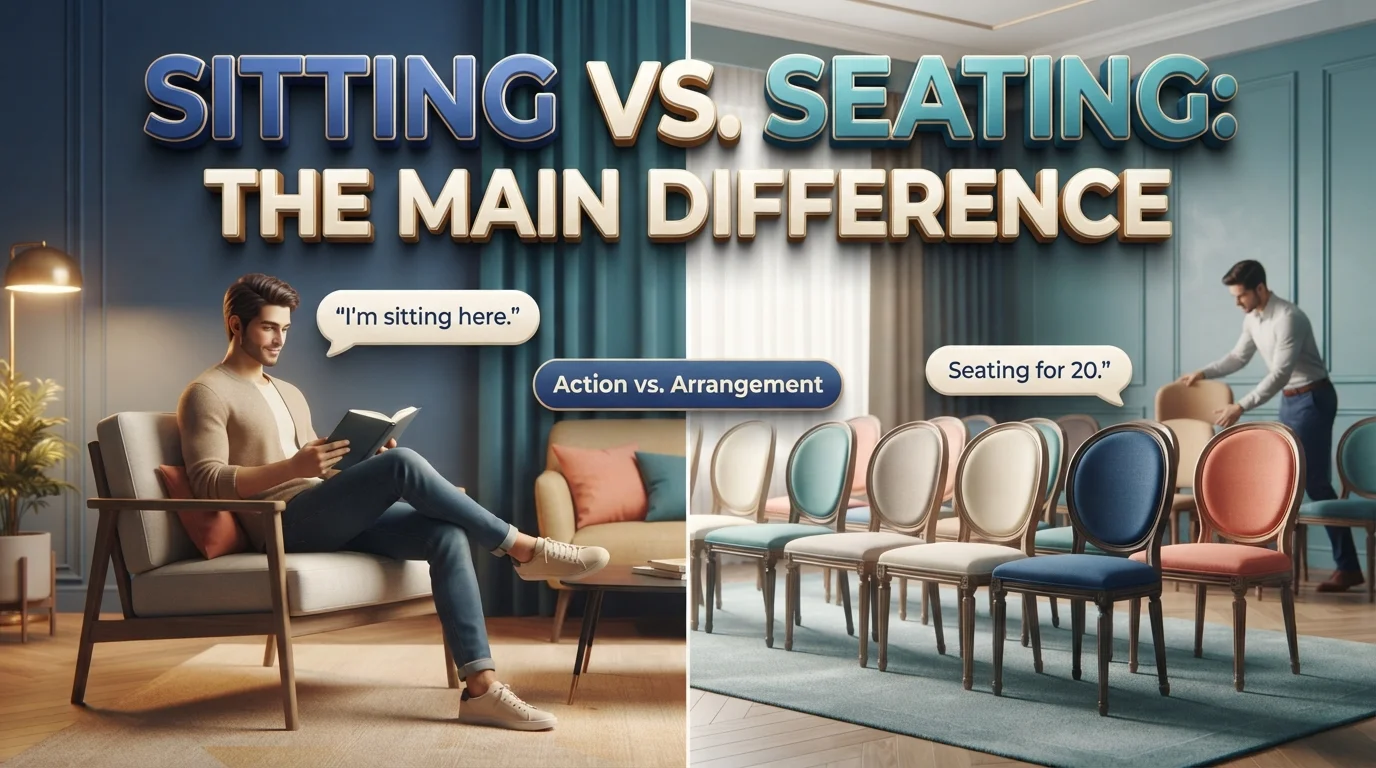
The simplest distinction is:
Sitting
Focuses on the person or action.
The guests are sitting at the table.
Seating
Focuses on the seats or arrangement.
The restaurant has seating for 100 guests.
Comparison Table
| Feature | Sitting | Seating |
|---|---|---|
| Basic word | Sit | Seat |
| Main meaning | Being in a seated position | Arrangement/provision of seats |
| Focus | Person or action | Seats or placement |
| Common context | Sitting on a chair | Seating capacity |
| Example | She is sitting there. | There is seating for 20 people. |
| Can be a verb form? | Yes | Yes |
| Memory clue | Someone sits | Someone seats people |
Sitting vs. Seating in Common Situations
1. Describing Someone in a Chair
Use sitting.
He is sitting in the chair.
Not:
❌ He is seating in the chair.
Why?
The person is performing the action of sitting, not seating.
2. Talking About Available Chairs
Use seating.
There is plenty of seating in the waiting room.
🎯 Lesson: You are talking about the availability of places to sit, so seating is correct.
3. Describing a Restaurant’s Capacity
Use seating.
The restaurant has seating for 80 people.
This means the restaurant has enough seats to accommodate 80 people.
4. Describing Guests at a Table
Use sitting.
The guests are sitting around the table.
You’re describing where the people are positioned.
5. A Restaurant Employee Placing Guests
Use seating.
The hostess is seating the customers.
Here, seating means placing or showing people to their seats.
Real-World Usage Scenarios
Scenario 1: At a Restaurant
Customer: Where can we wait?
Host: You can wait in the seating area.
🎯 Lesson: Seating area refers to an area designed for people to sit.
Scenario 2: Describing a Friend
Sarah is sitting by the window.
🎯 Lesson: Sitting describes Sarah’s position.
Scenario 3: Talking About an Event
The venue has seating for 500 guests.
🎯 Lesson: Seating refers to the venue’s capacity or arrangement of seats.
Scenario 4: A Host at a Restaurant
The hostess is seating the next group of customers.
🎯 Lesson: Here, seating is a verb form meaning placing customers at their tables.
Scenario 5: A Theater
The theater has stadium seating.
🎯 Lesson: Seating refers to the way seats are arranged.
Common Mistakes With Sitting and Seating
Mistake 1: “I am seating here”
❌ I am seating here.
✅ I am sitting here.
Why it happens:
Both words are associated with chairs, but sit describes your own position.
Mistake 2: “The restaurant has sitting for 100 people”
❌ The restaurant has sitting for 100 people.
✅ The restaurant has seating for 100 people.
Why it happens:
When talking about the number or availability of seats, use seating.
Mistake 3: “She is seating on the sofa”
❌ She is seating on the sofa.
✅ She is sitting on the sofa.
Why it happens:
Seat is normally transitive when it means putting someone somewhere:
The host seated her at the table.
You don’t normally say that a person is seating when they simply mean they are sitting down.
Mistake 4: “The waiter is sitting the guests”
❌ The waiter is sitting the guests.
✅ The waiter is seating the guests.
Why it happens:
When someone puts or directs other people into seats, the verb is seat.
Sit vs. Seat: The Grammar Behind the Difference
Understanding the base verbs makes this distinction much easier.
Sit
Sit describes the action of being or moving into a seated position.
Please sit down.
She sat beside me.
They are sitting outside.
Seat
Seat means to place someone in a seat.
The host seated the guests.
Please seat yourself.
Because seat generally takes an object when it means “place someone in a seat,” you can think of it as something you do to someone.
Compare:
I am sitting in the chair.
= I am in the chair.
The receptionist is seating the visitors.
= The receptionist is placing the visitors in their seats.
🎯 Key Insight: You sit; you seat someone.
Sitting vs. Seating: A Simple Grammar Test
Try putting “someone” after the word.
Sitting
I am sitting someone. ❌
That doesn’t work in the normal sense.
Seating
I am seating someone. ✅
That means you are placing someone in a seat.
This is a useful way to distinguish the verbs.
Memory Tricks: Sitting vs. Seating
🪑 Trick 1: You Sit
Remember:
People sit.
I am sitting in my chair.
👥 Trick 2: You Seat People
Remember:
You seat someone.
The waiter is seating the guests.
🏟️ Trick 3: Seating = Seats
The word seating is closely connected to seats.
Think:
Seating capacity
Seating arrangement
Seating area
Seating chart
⭐ One-Line Memory Trick
Sitting = being in a seat. Seating = providing or arranging seats, or putting someone in a seat.
Seating vs. Sitting in Common Expressions
Common Expressions With “Sitting”
- sitting down
- sitting on a chair
- sitting at a table
- sitting beside someone
- sitting quietly
- sitting room — traditionally, a room for sitting and relaxing
Examples:
We were sitting at the table.
She was sitting beside her mother.
Common Expressions With “Seating”
- seating area
- seating capacity
- seating arrangement
- seating chart
- seating plan
- stadium seating
- outdoor seating
- limited seating
Examples:
The restaurant has outdoor seating.
Please check the seating chart before entering.
The venue has limited seating.
Expert Insight: Why “Sitting” and “Seating” Are Confused
The confusion comes from the fact that sit and seat are closely related concepts but have different grammatical structures.
Sit is generally an intransitive verb, meaning it does not normally take a direct object when describing someone’s seated position:
She sat in the chair.
Seat is generally a transitive verb when it means to put someone into a seat:
She seated the child in the chair.
This distinction explains why these sentences differ:
The guests are sitting at the table.
The host is seating the guests at the table.
The first sentence describes the guests’ position.
The second describes the host’s action of placing them there.
A Note About “Seated”
Seated is another useful word in this family.
It can describe someone who is in a sitting position:
The guests were seated at the table.
It can also describe someone who has been placed in a seat:
The hostess seated the guests.
So you may see:
Please remain seated.
This means:
Please continue sitting.
Quick Test: Sitting or Seating?
Choose the correct word.
- She is ________ on the sofa.
- The restaurant has outdoor ________.
- The host is ________ the guests.
- We were ________ at the table.
- The stadium has ________ for 60,000 people.
- Please remain ________ until the show begins.
Answers
- sitting
- seating
- seating
- sitting
- seating
- seated
The Pattern
Sitting = being seated
Seating = arranging/providing seats or placing people in seats
Seated = already in a seat