
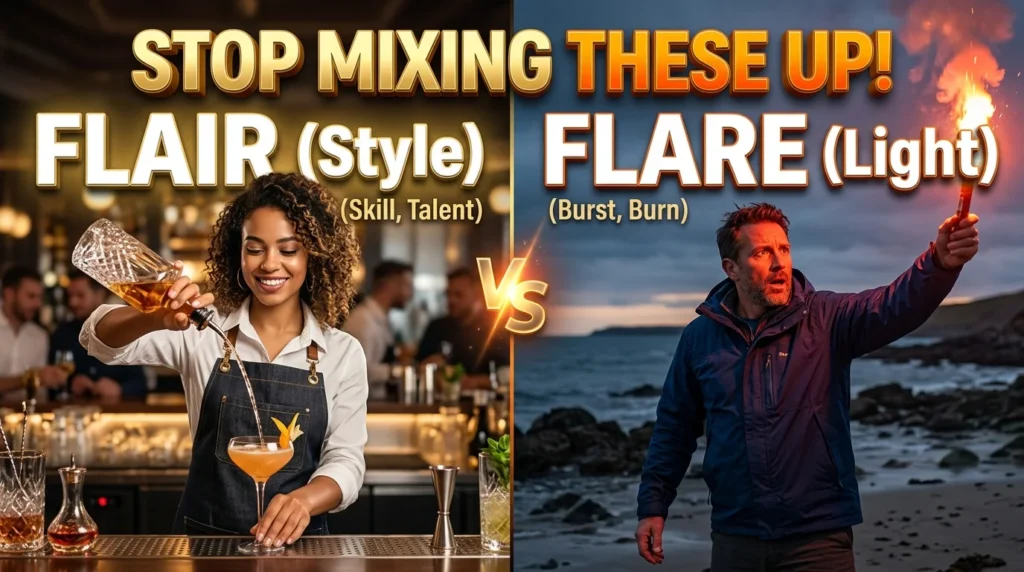
Flair vs flare is a common source of confusion because the two words are pronounced the same but have entirely different meanings. Although they look and sound similar, they serve completely different purposes in English.
Flair refers to natural talent, style, or a distinctive ability, while flare relates to fire, light, spreading outward, or a sudden increase in intensity. Choosing the wrong word can change the meaning of your sentence, especially in professional or academic writing.
This guide explains the difference between flair and flare, when to use each one, real-life examples, common mistakes, and simple memory tricks so you’ll never mix them up again.
Quick Answer
The difference between flair and flare is straightforward:
- Flair means natural talent, style, or a special ability.
- Flare means a burst of light or fire, a sudden increase, or something that spreads outward.
Example:
- She has a flair for interior design.
- The campfire began to flare in the wind.
Quick Rule: If you’re talking about talent or style, use flair. If you’re talking about fire, light, spreading, or a sudden outbreak, use flare.
What Does “Flair” Mean?
Flair is a noun that refers to a natural aptitude, special talent, or distinctive style.
Someone with flair performs a task with creativity, confidence, or elegance.
When to Use Flair
Use flair when referring to:
- Natural talent
- Creative ability
- Personal style
- A unique touch or sense of fashion
Examples
- She has a flair for writing engaging stories.
- His flair for leadership impressed the team.
- The restaurant is known for its chef’s culinary flair.
- Emma decorated the room with remarkable flair.
- He has a flair for solving difficult problems.
Key Insight
Flair is about ability, creativity, or style.
What Does “Flare” Mean?
Flare can be a noun or a verb.
As a noun, it often refers to a bright burst of light or fire. As a verb, it means to burn suddenly, spread outward, or become more intense.
Common Uses of Flare
- A burst of fire or light
- An emergency signaling device
- A sudden worsening of a condition
- A sudden emotional outburst
- Something widening outward
- Burning brightly
Examples
- The flames began to flare after more fuel was added.
- The rescue team fired a flare into the sky.
- Her allergies flared during spring.
- Tensions flared after the announcement.
- The dress has flare sleeves.
Key Insight
Flare is associated with fire, light, expansion, or sudden intensity.
Flair vs Flare: Key Differences
| Feature | Flair | Flare |
|---|---|---|
| Part of Speech | Noun | Noun and verb |
| Meaning | Talent or style | Fire, light, expansion, sudden increase |
| Used For | Creativity, ability, elegance | Flames, emotions, illnesses, shapes |
| Common Contexts | Art, fashion, leadership | Emergencies, medicine, weather, clothing |
| Example | She has flair for music. | The fire began to flare. |
Pronunciation
Both words are pronounced exactly the same.
Flair → /fler/
Flare → /fler/
Because they are homophones, many writers accidentally choose the wrong spelling.
Real-World Usage Scenarios
Example 1: Job Interview
❌ She has a flare for graphic design.
✅ She has a flair for graphic design.
🎯 Lesson: Talent or ability requires flair.
Example 2: Camping
❌ The fire began to flair after the wind picked up.
✅ The fire began to flare after the wind picked up.
🎯 Lesson: Burning brighter means flare.
Example 3: Fashion
❌ He dresses with great flare.
✅ He dresses with great flair.
🎯 Lesson: Style and elegance use flair.
Example 4: Health
❌ My arthritis had a flair last winter.
✅ My arthritis had a flare last winter.
🎯 Lesson: A sudden worsening of a medical condition is a flare or flare-up.
Example 5: Emergency
❌ The sailor fired a flair into the air.
✅ The sailor fired a flare into the air.
🎯 Lesson: Emergency signaling devices are called flares.
Common Mistakes
Mistake 1
Incorrect: She has a flare for painting.
Correct: She has a flair for painting.
Why? You’re describing natural talent.
Mistake 2
Incorrect: The flames flaired suddenly.
Correct: The flames flared suddenly.
Why? Burning more intensely uses the verb flare.
Mistake 3
Incorrect: His business flair up surprised everyone.
Correct: His business flared up unexpectedly.
Why? Flare up means to increase suddenly.
Memory Tricks
These simple tricks make the difference easy to remember:
- Flair = Talent to share. Both words relate to personal ability.
- Flare = Fire in the air. Think of emergency flares or flames.
- If you can replace the word with talent, choose flair.
- If you can replace it with burn, brighten, or suddenly increase, choose flare.
Expert Insight
Although flair and flare sound identical, their meanings come from different origins. Flair entered English through French and refers to an instinctive aptitude or distinctive style. Flare, by contrast, has long been associated with spreading outward, bright flames, and sudden intensification.
This distinction is especially important in professional writing. For example, a résumé might describe someone’s flair for marketing, while a medical report would discuss an asthma flare-up.
Frequently Asked Questions
Is it flair or flare for creativity?
The correct phrase is flair for creativity because it refers to natural talent or ability.
Is it a flare-up or a flair-up?
The correct term is flare-up, meaning a sudden worsening of a condition, emotion, or conflict.
Are flair and flare pronounced differently?
No. They are homophones, meaning they have the same pronunciation but different spellings and meanings.
Can flare be a verb?
Yes. Flare can be a verb meaning to burn brightly, spread outward, or increase suddenly.
Can flair be used as a verb?
No. Flair is almost always used as a noun.
Conclusion
The difference between flair and flare is easy to remember once you connect each word with its meaning.
- Use flair for talent, creativity, style, or natural ability.
- Use flare for fire, bright light, sudden increases, widening shapes, or emergency signals.
A simple memory trick is: Talent shows flair; flames flare. With this rule in mind, you’ll be able to use both words confidently in everyday conversations, professional writing, and academic work.