
Quick Answer: Title or Tittle?
Title is the correct word when you mean the name of a book, article, movie, song, person’s position, or other work or designation.
✅ What is the title of this book?
❌ What is the tittle of this book?
Tittle is a different word that means a small dot or mark, especially the dot above a lowercase i or j.
Quick rule: For the name of something, use title. For a tiny dot or mark, use tittle.
Title or Tittle Meaning
Title and tittle are two different English words, although they look and sound similar enough to cause confusion. Title is the word you usually need when referring to the name of a book, movie, article, song, position, or honor. Tittle is a much less common word that means a small dot or mark written above a letter, most famously the dot above a lowercase i or j.
For example:
- What is the title of that book? ✅
- The tittle above the “i” is missing. ✅
So, if you’re talking about the name of something, the correct word is title, not tittle.
Title vs Tittle
The main difference is their meaning and usage.
Title has several common meanings. It can refer to the name of a written, visual, or musical work, such as a book, movie, article, or song. It can also refer to a person’s official position or a formal designation, such as Dr., Professor, or President. In sports, title can also mean a championship or major achievement.
Tittle, on the other hand, is a specialized word for a small distinguishing mark or dot. In everyday English, its most familiar use is the dot over i and j.
| Word | Meaning | Example |
|---|---|---|
| Title | Name of a book, movie, article, song, etc. | The title of the book is interesting. |
| Title | Position, rank, or designation | Her title is Marketing Director. |
| Title | Championship or distinction | He won the heavyweight title. |
| Tittle | A small dot or mark | Don’t forget the tittle over the “i.” |
A useful way to remember the difference is:
Title = name or designation
Tittle = tiny mark or dot
Title or Tittle in a Sentence
When you’re talking about the name of something, use title.
What is the title of your new book?
I forgot the title of that movie.
The article has an interesting title.
What title did you give your presentation?
When you’re referring to a tiny mark over a letter, use tittle.
The tittle over the lowercase “i” makes the letter recognizable.
The printer made the tittle on the “j” look unclear.
Because tittle is uncommon in ordinary conversation, most people are much more likely to encounter title in everyday writing.
Title or Tittle Examples
Here are some simple examples that show the difference clearly:
Title:
The title of the novel is The Great Gatsby.
She earned the title of team captain.
What is the title of this song?
The movie has a very unusual title.
Tittle:
The tittle above the “i” was barely visible.
The designer carefully adjusted the tittle on the lowercase “j.”
The words are not interchangeable. Writing “What is the tittle of the book?” would be incorrect because the name of a book is its title.
Tittle or Title of a Book
When referring to the name of a book, title is always the correct word.
What is the title of the book? ✅
What is the tittle of the book? ❌
For example:
The title of the book is Pride and Prejudice.
Here, title identifies the name of the literary work.
Tittle has nothing to do with the name of a book. It refers to a small written mark, particularly the dot over i or j.
Tittle or Title of a Movie
The same rule applies to movies. The name of a movie is its title.
What is the title of the movie? ✅
I can’t remember the title of that film. ✅
The tittle of the movie is… ❌
For example:
The title of the movie is Interstellar.
Using tittle in this context is a spelling error because you’re referring to the movie’s name.
Tittle Pronunciation
Tittle is pronounced approximately TIT-uhl, with the first syllable sounding like tit and the second sounding like a quick, unstressed uhl.
Title is pronounced approximately TY-tuhl.
The pronunciation difference can be easy to miss, especially when people speak quickly.
A simple comparison is:
- title → TY-tuhl
- tittle → TIT-uhl
Their spellings differ by only one letter, but their meanings are completely different.
Title or Tittle Synonym
The appropriate synonym depends on which word you mean.
For title, possible synonyms include:
- name
- heading
- caption
- designation
- rank
- position
- label
For example:
What is the title of the article?
can often be expressed as:
What is the name of the article?
For tittle, common alternatives include:
- dot
- mark
- small mark
- diacritic — depending on the specific context
However, tittle is more precise when specifically referring to the small dot over a lowercase i or j.
Is It Title or Tittle?
If you’re unsure which spelling to use, think about what you’re describing.
Use title when you mean:
- the name of a book
- the name of a movie
- the name of an article
- the name of a song
- a job or professional designation
- a rank or honor
- a championship
Use tittle when you mean:
- a tiny dot or mark
- especially the dot over a lowercase i or j
So:
The title of the book is missing from the cover. ✅
But:
The tittle above the “i” is missing. ✅
The simplest memory trick is “title = name, tittle = tiny mark.”
What Does “Tittle” Mean?
Tittle is a real English word, but it is much less common.
It refers to a small dot, stroke, or distinguishing mark, particularly the dot above the lowercase letters i and j.
For example:
The letter i has a tittle.
The lowercase j also has a tittle.
The word can also appear in the expression “every jot and tittle,” which means every small detail or minor point.
Example
The lawyer examined every jot and tittle of the contract.
In everyday writing, however, most people rarely need the word tittle.
Key Insight
Tittle is not the normal spelling of title.
It is a separate word with a completely different meaning.
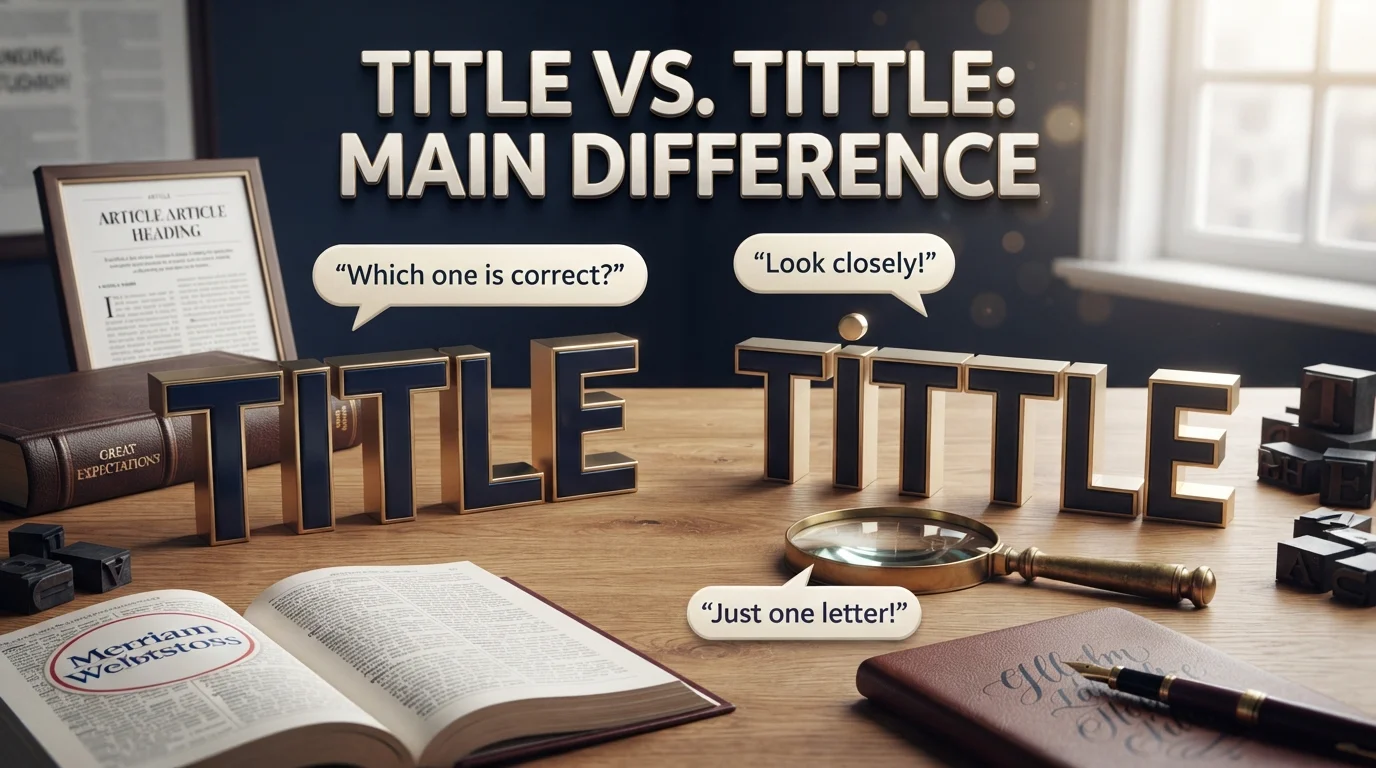
Title vs. Tittle: Main Difference
| Feature | Title | Tittle |
|---|---|---|
| Common usage | Very common | Uncommon |
| Main meaning | Name, position, rank, or championship | Small dot or mark |
| Used for books? | ✅ Yes | ❌ No |
| Used for articles? | ✅ Yes | ❌ No |
| Used for jobs/positions? | ✅ Yes | ❌ No |
| Used for dot above “i”? | ❌ No | ✅ Yes |
| Example | The title of the book | The tittle above the “i” |
The Simplest Difference
Title = name or designation
Tittle = tiny dot or mark
So if you are asking:
What is the title of this article?
you need title, not tittle.
Real-World Usage of “Title”
1. Book Titles
The title of the book is very memorable.
🎯 Lesson: Use title for the name of a book.
2. Article Titles
She wrote an interesting title for her blog post.
🎯 Lesson: A blog post or article has a title.
3. Movie Titles
What is the title of that movie?
🎯 Lesson: The name of a movie is its title.
4. Job Titles
Her job title is Marketing Manager.
🎯 Lesson: Title can describe someone’s professional position.
5. Championship Titles
The team won the championship title.
🎯 Lesson: Title can also refer to a championship or honor.
Real-World Usage of “Tittle”
Because tittle is uncommon, you are most likely to encounter it when discussing typography, writing systems, or the details of letters.
1. The Dot Above “i”
The tittle is the small dot above the lowercase i.
🎯 Lesson: A tittle can refer to the dot above a letter.
2. The Dot Above “j”
The lowercase j has a tittle above it.
🎯 Lesson: The dot above a lowercase j is also called a tittle.
3. “Every Jot and Tittle”
The editor checked every jot and tittle of the manuscript.
🎯 Lesson: This expression means every tiny detail.
Why Do People Confuse “Title” and “Tittle”?
The confusion is understandable because the words differ by only one letter:
TITLE
TITTLE
The pronunciation is also similar enough to cause uncertainty for some English learners.
Another reason is that tittle is a genuine English word. Therefore, spelling software or dictionaries may recognize it, which can make the mistake even more confusing.
However, the two words have completely different meanings.
Compare:
The title of the article is excellent.
vs.
The tittle is the dot above the “i.”
The context makes the difference clear.
Common Mistakes
Mistake 1: Using “Tittle” for a Book Name
❌ What is the tittle of this book?
✅ What is the title of this book?
Why It Happens
The two words look nearly identical, so writers sometimes accidentally insert an extra t.
Mistake 2: Using “Tittle” for an Article
❌ I need a good tittle for my article.
✅ I need a good title for my article.
Correct Pattern
article title
blog title
book title
movie title
Mistake 3: Thinking “Tittle” Is Always a Spelling Error
Interestingly, tittle is not always wrong.
It is a legitimate English word when referring to a small mark or dot, particularly the dot above i or j.
So:
The tittle is missing from the letter i.
is correct.
But:
❌ The tittle of my article is catchy.
is incorrect if you mean the article’s name.
Title or Tittle in SEO and Content Writing
For bloggers, writers, and SEO professionals, this distinction is especially important.
When discussing:
- SEO titles
- blog titles
- article titles
- page titles
- video titles
- book titles
- headlines
always use:
title
Examples
✅ Write an SEO-friendly title.
✅ The article title contains the primary keyword.
✅ Create a compelling blog title.
❌ Create a compelling blog tittle.
This is particularly important because title is a high-frequency word in digital marketing and content creation.
Title vs. Headline
These words are related but are not always identical.
Title
A title is the name of a work, such as:
The Great Gatsby
Headline
A headline is usually the prominent heading used for a news story, article, advertisement, or online content.
For example:
New Technology Changes the Future of Online Education
In many online contexts, people use title and headline somewhat interchangeably, but their traditional uses can differ.
Title vs. Caption
A title identifies a work or piece of content.
A caption usually provides information about an image, photograph, chart, or video.
For example:
Article title: How to Learn English Faster
Image caption: Students practicing English in a classroom
Knowing these related terms can help you use title more precisely.
Title as a Verb
Title can also be used as a verb.
It means to give something a title or to give someone a title or designation.
Examples
The author titled the book The Silent Garden.
The article is titled “How to Improve Your Writing.”
The past tense is:
titled
Not:
❌ tittled
This is another common spelling mistake.
Correct:
- title
- titles
- titled
- titling
Incorrect for this meaning:
- tittle
- tittled
- tittling
Memory Tricks
🧠 Trick 1: “Title Has One T in the Middle”
Remember the spelling:
T I T L E
There is only one T after the I.
If you are naming something, think:
Title = name
🧠 Trick 2: “Tittle Has a Tiny Dot”
This is a fun way to remember the uncommon word.
Think:
Tittle = tiny mark
The extra t can remind you that it refers to something small or tiny.
🧠 Trick 3: Ask Yourself the Meaning
Before writing the word, ask:
Am I talking about a name?
→ title
Am I talking about a tiny dot or mark?
→ tittle
This simple question eliminates almost every mistake.
Expert Insight: The Linguistic Difference
The two words have separate histories and meanings despite their similar spelling.
Title developed from a word associated with an inscription, label, or heading and eventually acquired its modern meanings involving names, designations, ranks, and distinctions.
Tittle refers to a small mark or dot. Its most familiar modern application is the dot above lowercase i and j.
This is a useful reminder that similar spelling does not necessarily mean related meaning.
English contains many such pairs that differ by only a letter or two but have completely different meanings.
Quick Grammar Reference
Use “Title” When Talking About:
✅ a book’s name
✅ an article’s name
✅ a movie’s name
✅ a song’s name
✅ a job position
✅ a championship
✅ a formal designation
✅ a page title
✅ an SEO title
Use “Tittle” When Talking About:
✅ the dot above i
✅ the dot above j
✅ a tiny distinguishing mark
✅ the expression “jot and tittle”