
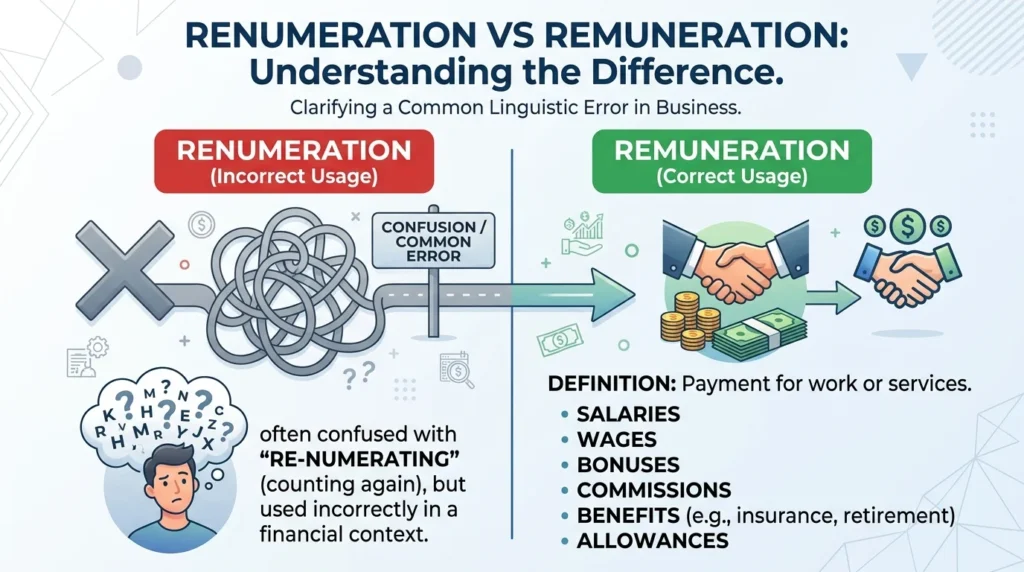
Renumeration and remuneration are commonly confused because they look almost identical and are pronounced similarly. However, when you mean payment or compensation for work, only one spelling is the standard choice.
The correct word is remuneration.
Remuneration means payment or compensation received for work, services, or employment. Renumeration is generally a misspelling or mistaken formation of remuneration when used with this meaning.
Although they look and sound similar, they serve completely different purposes.
If you’ve ever wondered whether to write renumeration or remuneration in a job contract, business email, résumé, or professional document, this guide will make the distinction clear.
Quick Answer: Renumeration vs. Remuneration
Remuneration is the correct standard spelling when you mean payment or compensation for work or services.
The employee received competitive remuneration for her work.
Renumeration is generally incorrect when used as a spelling of remuneration.
The easiest rule:
Payment for work = remuneration.
Remember the spelling:
RE-MU-NER-A-TION
Not:
❌ RE-NU-MER-A-TION
What Does “Remuneration” Mean?
Remuneration is a noun meaning money or other compensation given in exchange for work, services, or employment.
It can include more than just a basic salary.
Depending on the context, remuneration may include:
- Salary
- Wages
- Bonuses
- Commissions
- Professional fees
- Benefits
- Other forms of compensation
Examples of “Remuneration”
The company offers attractive remuneration and benefits.
The position provides competitive remuneration based on experience.
The contract specifies the employee’s annual remuneration.
Directors’ remuneration was discussed at the annual meeting.
🎯 Key Insight: Remuneration is a formal word for compensation or payment for work or services.
What Does “Renumeration” Mean?
When people write renumeration intending to mean payment or compensation, it is generally considered a misspelling of remuneration.
For example:
❌ The position offers excellent renumeration.
Correct:
✅ The position offers excellent remuneration.
The error is understandable because the spelling seems to connect the word with number or numerical calculation, but that is not the origin of remuneration.
Should You Use “Renumeration”?
In professional, academic, business, or formal writing, avoid renumeration when you mean compensation.
Use:
remuneration
instead.
Renumeration vs. Remuneration: Comparison Table
| Feature | Renumeration | Remuneration |
|---|---|---|
| Standard spelling for payment? | ❌ No | ✅ Yes |
| Meaning | Usually a misspelling | Payment or compensation |
| Part of speech | — | Noun |
| Common in professional writing? | Avoid | Yes |
| Example | ❌ Renumeration package | ✅ Remuneration package |
| Related terms | — | Salary, compensation, payment |
Bottom Line
If you’re talking about money or compensation received for work, always choose remuneration.
Remuneration in Real-World Contexts
1. Employment
The company offers competitive remuneration to qualified employees.
Here, remuneration refers to the overall compensation offered for employment.
2. Job Advertisements
The successful candidate will receive an attractive remuneration package.
This is common in formal employment language, particularly in job advertisements and contracts.
🎯 Lesson: In professional contexts, remuneration package can refer to salary plus additional compensation and benefits.
3. Professional Services
The consultant negotiated his remuneration before accepting the project.
Here, remuneration means the payment the consultant will receive for providing services.
4. Corporate Governance
The board reviewed executive remuneration.
In business and corporate contexts, executive remuneration refers to compensation provided to senior executives.
5. Legal or Contractual Writing
The agreement specifies the remuneration payable to the contractor.
This formal wording refers to the payment owed under the contract.
Common Mistakes With Renumeration and Remuneration
Mistake 1: Writing “Renumeration Package”
❌ The company offers a competitive renumeration package.
✅ The company offers a competitive remuneration package.
Why it happens:
The spelling renumeration may seem logical because the word looks as though it could be related to number or numerical calculation.
However, the standard spelling is remuneration.
Mistake 2: Writing “Renumerated”
❌ Employees are well renumerated.
✅ Employees are well remunerated.
The verb is:
remunerate
And the adjective/past participle is:
remunerated
For example:
The employees are fairly remunerated for their work.
Mistake 3: Confusing “Remuneration” With “Salary”
These words are related but aren’t always identical.
Salary usually refers to a fixed amount of money paid regularly to an employee.
Remuneration can be broader and may refer to the overall compensation received for work.
For example:
Her salary is $60,000 a year.
But:
Her remuneration includes salary, bonuses, and benefits.
🎯 Lesson: Salary can be part of remuneration.
Remuneration vs. Compensation
Remuneration and compensation are often interchangeable when discussing payment for work.
Remuneration
A more formal term for payment or compensation for work or services.
The position offers competitive remuneration.
Compensation
A broader and very common term for payment or benefits provided in exchange for work.
The company offers competitive compensation.
Both can be appropriate in professional contexts.
Remuneration vs. Reimbursement
These words should not be confused.
Remuneration
Payment for work or services.
The consultant received remuneration for her services.
Reimbursement
Money returned to someone for expenses they have already paid.
The company reimbursed him for his travel expenses.
🎯 Key Insight:
Remuneration = payment for work.
Reimbursement = repayment of expenses.
Remuneration vs. Renumeration: Real-World Examples
Example 1: Job Advertisement
❌ The role offers an attractive renumeration package.
✅ The role offers an attractive remuneration package.
🎯 Lesson: Use remuneration for employment compensation.
Example 2: Business Contract
❌ The consultant’s renumeration will be paid monthly.
✅ The consultant’s remuneration will be paid monthly.
🎯 Lesson: The standard spelling is remuneration.
Example 3: Employee Benefits
The company’s remuneration package includes a bonus and health benefits.
🎯 Lesson: Remuneration package can include multiple forms of compensation.
Example 4: Professional Services
The lawyer negotiated her remuneration before agreeing to the assignment.
🎯 Lesson: Remuneration can refer to payment for professional services, not just employment.
Example 5: Corporate Context
Executive remuneration has become an important topic for shareholders.
🎯 Lesson: Executive remuneration is a standard business expression.
How to Remember the Correct Spelling
🧠 Trick 1: Remember “REMU”
Break the word into:
RE-MU-NER-A-TION
The correct beginning is:
REMU
Not:
❌ RENU
💰 Trick 2: Think “Remuneration = Money for Work”
Whenever you see a salary, compensation, or payment for services, think:
Remuneration
🔤 Trick 3: Don’t Add “Number”
The spelling renumeration may look as though it contains number, but the word isn’t spelled that way.
Remember:
RE + MUNERATION = REMUNERATION
⭐ One-Line Memory Trick
If you mean payment for work, remember “REMU”: remuneration.
The Remunerate Word Family
Learning the complete word family can help prevent spelling mistakes.
Remunerate
Verb: to pay or compensate someone.
The company remunerates its employees fairly.
Remuneration
Noun: payment or compensation.
The position offers competitive remuneration.
Remunerated
Adjective/past participle: having been paid or compensated.
Workers should be fairly remunerated.
Quick Pattern
Remunerate → Remuneration → Remunerated
All use the remun- spelling.
Expert Insight: Why “Renumeration” Is Such a Common Mistake
The confusion is partly caused by the appearance of the word.
Remuneration is derived through a historical word family associated with reward or recompense, rather than being formed from the modern English word number.
Because renumeration visually resembles words involving number or numerical calculation, people sometimes create the spelling renumeration.
That makes the error understandable, but in standard professional English, remuneration is the established spelling for compensation.
The distinction is especially important in:
- Employment contracts
- Business writing
- HR documents
- Job advertisements
- Financial reports
- Corporate communications
- Academic writing
Quick Test: Renumeration or Remuneration?
Choose the correct spelling.
1. The company offers competitive ________.
Answer: remuneration
2. The employee negotiated her annual ________.
Answer: remuneration
3. The job includes an attractive ________ package.
Answer: remuneration
4. Employees should be fairly ________ for their work.
Answer: remunerated
5. The company ________ its staff according to experience.
Answer: remunerates
The Pattern
Remuneration = noun
Remunerate = verb
Remunerated = paid/compensated
Renumeration = avoid when you mean compensation
FAQs About Renumeration vs. Remuneration
Is “renumeration” a correct word?
Renumeration is generally not the standard spelling when you mean payment or compensation. It is usually a misspelling of remuneration.
What is the correct spelling: renumeration or remuneration?
The correct standard spelling is:
Remuneration
What does remuneration mean?
Remuneration means payment or compensation given in exchange for work, services, or employment.
Is remuneration the same as salary?
Not exactly. Salary is usually a fixed regular payment to an employee, while remuneration can refer more broadly to overall compensation, including salary, bonuses, and other benefits.
Is “remuneration package” correct?
Yes.
The company offers a competitive remuneration package.
This can refer to the overall compensation and benefits associated with a position.
Is “renumerated” correct?
When you mean paid or compensated, the standard form is:
remunerated
For example:
Employees are fairly remunerated for their work.
What is the difference between remuneration and compensation?
Both can refer to payment for work. Remuneration is often more formal, while compensation is a very common general term in employment and business English.
What is the easiest way to remember remuneration?
Remember:
Remuneration = money for work.
And memorize the spelling as:
RE-MU-NER-A-TION
Not RE-NU-MER-A-TION.
Conclusion
When you’re deciding between renumeration and remuneration, the correct choice is straightforward.
Remuneration is the standard word for payment or compensation for work or services:
The company offers competitive remuneration.
Renumeration is generally a misspelling when used with this meaning.
The same spelling applies to related forms:
Remunerate → Remuneration → Remunerated
Final memory trick:
Payment for work = REMUNERATION.
So whether you’re writing a job advertisement, employment contract, business report, or professional email, use remuneration, not renumeration.