
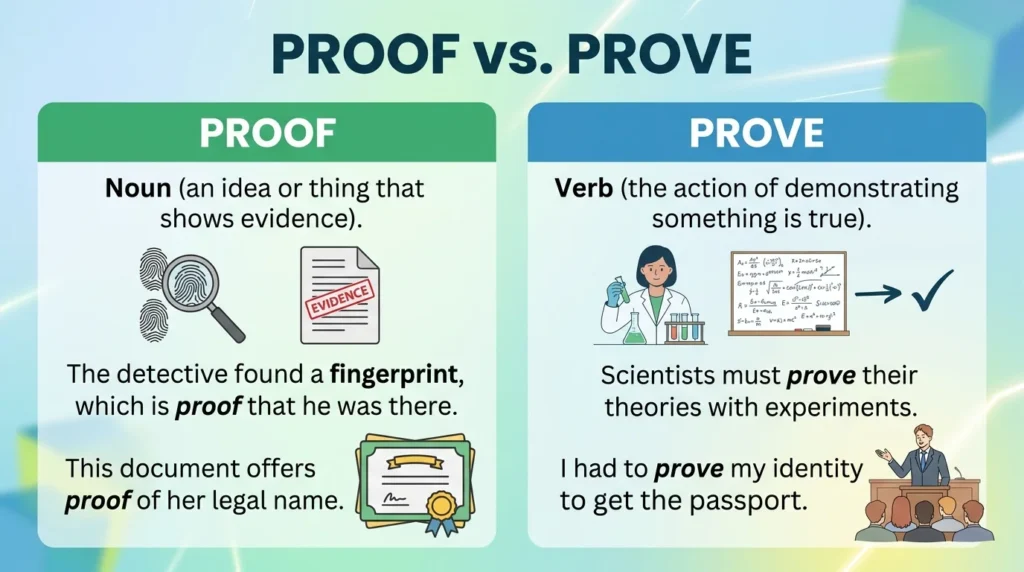
Proof and prove are closely related words, but they have different meanings and grammatical functions. The main difference is simple: proof is usually a noun, while prove is a verb.
Proof refers to evidence or information that demonstrates that something is true or correct.
Prove means to demonstrate or establish that something is true, correct, or valid.
Although they look and sound similar, they serve completely different purposes.
Understanding whether you need a thing (proof) or an action (prove) will help you choose the right word every time.
Quick Answer: Proof vs. Prove
Proof is a noun meaning evidence that shows something is true.
Do you have proof of your claim?
Prove is a verb meaning to demonstrate that something is true.
Can you prove your claim?
The easiest rule
Proof = evidence
Prove = demonstrate
Think of it this way:
You provide proof.
You prove something.
What Does “Proof” Mean?
Proof is primarily a noun. It refers to evidence, facts, information, or an argument that establishes the truth or validity of something.
Examples of “Proof”
The police found proof that he was at the scene.
Do you have proof of payment?
There was no proof that the accusation was true.
The photograph provided proof of what happened.
In each example, proof is a thing or evidence that supports a conclusion.
Common Expressions With “Proof”
You will often see proof in phrases such as:
- proof of identity
- proof of payment
- proof of ownership
- proof of purchase
- proof of address
- proof of wrongdoing
- mathematical proof
- scientific proof
For example:
Please provide proof of identity.
🎯 Key Insight: If you’re talking about evidence, use proof.
What Does “Prove” Mean?
Prove is a verb. It means to demonstrate, establish, or show that something is true, correct, or valid.
Examples of “Prove”
Can you prove that the statement is true?
The evidence proved his innocence.
She proved that she could handle the job.
The experiment helped prove the theory.
Here, prove describes an action.
Common Grammar Patterns
Prove + something
The evidence proved his claim.
Prove + that-clause
She proved that the theory was correct.
Prove + to be
The plan proved to be successful.
Prove + yourself
He worked hard to prove himself.
🎯 Key Insight: If you’re describing the act of demonstrating something, use prove.
Proof vs. Prove: Main Difference
The most important difference is their part of speech.
| Feature | Proof | Prove |
|---|---|---|
| Part of speech | Noun | Verb |
| Meaning | Evidence that something is true | Demonstrate that something is true |
| Focus | Evidence/result | Action |
| Example | I have proof. | I can prove it. |
| Common phrase | Proof of identity | Prove your identity |
| Memory clue | Evidence | Demonstrate |
Compare These Sentences
I have proof that he was there.
Here, proof is the evidence.
I can prove that he was there.
Here, prove is the action of demonstrating it.
🎯 Key Insight: Proof is what you have; prove is what you do.
Proof vs. Prove in Real-World Usage
At a Bank
The bank requested proof of identity.
🎯 Lesson: The bank wants evidence, so use proof.
But:
You must prove your identity before opening the account.
🎯 Lesson: Here, you’re describing the action of demonstrating identity, so use prove.
In an Argument
She had proof that the information was false.
She could prove that the information was false.
🎯 Lesson: Proof is the evidence; prove is the act of demonstrating the truth.
In Science
The researchers found proof supporting the theory.
The researchers conducted experiments to prove the theory.
🎯 Lesson: Scientific evidence can be proof, while researchers prove something through evidence and reasoning.
In Mathematics
The student wrote a mathematical proof.
The student used the theorem to prove the result.
🎯 Lesson: A proof is a formal argument; prove describes the act of establishing the result.
In Everyday Conversation
I don’t have proof that he took the money.
I can’t prove that he took the money.
🎯 Lesson: Both words can appear in the same situation, but they perform different grammatical roles.
Common Mistakes With Proof and Prove
Mistake 1: “I Need to Proof It”
❌ I need to proof it.
✅ I need to prove it.
Why it happens:
Because proof and prove are closely related, learners sometimes use the noun where a verb is required.
After to, you need the base form of a verb:
to prove
Not:
❌ to proof
Mistake 2: “I Have Prove”
❌ I have prove that he is right.
✅ I have proof that he is right.
Or:
✅ I can prove that he is right.
Why it happens:
The sentence requires either a noun (proof) or a correctly conjugated verb (prove/proved).
Mistake 3: “Can You Proof It?”
❌ Can you proof it?
✅ Can you prove it?
After can, use the base form of the verb:
can prove
Mistake 4: “I Have a Prove”
❌ I have a prove.
✅ I have proof.
Why it happens:
Proof is the noun. Prove is the verb.
Proof vs. Evidence
Proof and evidence are related, but they aren’t always completely interchangeable.
Evidence
Evidence is information, facts, objects, or observations that support a conclusion.
The police collected evidence from the scene.
Proof
Proof can mean evidence that is sufficiently convincing to establish something as true.
The documents provided proof of ownership.
In everyday English, people often use these words similarly, but proof can imply a stronger degree of certainty.
🎯 Key Insight: Evidence can support a claim; proof is evidence that establishes or demonstrates it.
Proof vs. Prove: Grammar Breakdown
Understanding the word forms makes the distinction much easier.
Proof
Noun
We need proof.
The photograph is proof.
Prove
Verb
We need to prove it.
The photograph helped prove the claim.
Proved
Past tense/past participle of prove
The evidence proved his claim.
Proven
Past participle commonly used as an adjective and, in many varieties of English, as a past participle
The method has been proven effective.
Word Family
prove → proved → proven → proof
Learning the word family can help prevent confusion.
Prove vs. Proof in Common Phrases
With “Proof”
- proof of identity
- proof of purchase
- proof of payment
- proof of address
- proof of ownership
- proof of concept
- proof of guilt
- proof of innocence
- mathematical proof
With “Prove”
- prove a point
- prove a claim
- prove a theory
- prove your identity
- prove your innocence
- prove someone wrong
- prove that something is true
- prove to be effective
Compare
proof of identity
but:
prove your identity
And:
proof of purchase
but:
prove that you purchased it
Memory Tricks: Proof vs. Prove
🧠 Trick 1: Proof = Evidence
Think:
Proof = something you can show.
I have proof.
🔨 Trick 2: Prove = Action
Think:
Prove = something you do.
I can prove it.
🔄 Trick 3: “Have” vs. “Do”
A very easy shortcut:
You have proof.
You prove something.
⭐ One-Line Memory Trick
Proof is the evidence; prove is the action of demonstrating it.
Expert Insight: Why Proof and Prove Are Confused
The two words belong to the same historical word family, which explains their similar spelling and meaning.
However, English has developed them into different grammatical forms.
Proof functions primarily as a noun:
The evidence was proof of his claim.
Prove functions as a verb:
The evidence helped prove his claim.
This distinction is similar to other related noun-and-verb pairs in English, although the spelling relationship isn’t always predictable.
The important point for modern English users is grammatical rather than historical:
Proof names the evidence. Prove describes the action.
Quick Test: Proof or Prove?
Choose the correct word.
- Can you ________ that the statement is true?
- Do you have ________ of your purchase?
- The documents ________ that he owned the property.
- We need ________ before making a final decision.
- She wants to ________ that she is capable of doing the job.
- The photograph was ________ of his presence at the location.
Answers
- prove
- proof
- proved
- proof
- prove
- proof
The Pattern
Proof = noun/evidence
Prove = verb/action
Proved = past tense
Proven = past participle/adjective
FAQs About Proof vs. Prove
Is proof and prove the same thing?
No. They are related but have different grammatical functions.
Proof is usually a noun meaning evidence.
Prove is a verb meaning to demonstrate that something is true.
Is it “prove it” or “proof it”?
The correct expression is:
Prove it.
For example:
If you think I’m wrong, prove it.
Is it “proof of” or “prove of”?
The correct phrase is:
proof of
For example:
Do you have proof of payment?
Prove of is not a standard English construction.
Is “proof” a noun or a verb?
Proof is primarily a noun in standard modern English.
We need proof.
There are some specialized uses of proof as a verb, particularly in technical contexts, but for ordinary writing, treat proof as a noun and prove as the verb.
Is “prove” a noun?
No. In standard everyday English, prove is a verb.
I can prove it.
The corresponding noun is proof.
What is the past tense of prove?
The standard past tense is:
proved
For example:
The evidence proved his claim.
Proven is also widely used as a past participle, particularly in certain constructions:
The method has proven effective.
What is the easiest way to remember proof vs. prove?
Remember:
Proof = evidence.
Prove = demonstrate.
Or:
You have proof; you prove something.
Conclusion
The difference between proof and prove is mainly a difference in grammar and function.
Proof is a noun that means evidence or information showing that something is true:
We have proof of his claim.
Prove is a verb meaning to demonstrate or establish that something is true:
We can prove his claim.
The simplest rule to remember is:
Proof = evidence.
Prove = demonstrate.
So if you’re talking about something you have, provide, or show as evidence, use proof. If you’re talking about the action of demonstrating something, use prove.