
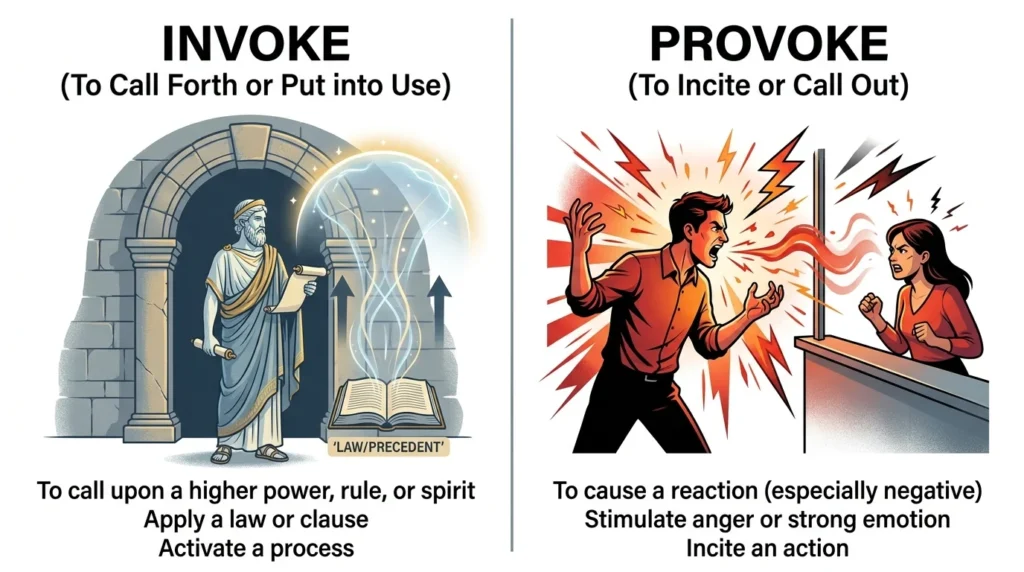
Quick Answer: Invoke vs. Provoke
Invoke means to call upon, appeal to, or bring something into use or effect.
She invoked her right to remain silent.
Provoke means to cause a reaction, especially anger or another strong emotion.
His remarks provoked an angry reaction.
The easiest rule
Invoke = call upon
Provoke = cause a reaction
Think:
INvoke → INvite something into action
PROvoke → PROduce a reaction
What Does “Invoke” Mean?
Invoke is a verb with several closely related meanings.
It can mean:
- To call upon a person, authority, principle, or power
- To appeal to a rule or law
- To put something into effect
- To mention something as support or justification
- To call forth a particular feeling, image, or idea
Example 1: Invoking a Right
The defendant invoked her right to remain silent.
Here, invoke means to formally exercise or rely on a right.
Example 2: Invoking a Law
The organization invoked the law to defend its position.
Here, invoke means to appeal to or cite the law as authority.
Example 3: Invoking an Image or Feeling
The painting invokes memories of childhood.
Here, invoke means to bring a feeling, memory, or idea to mind.
🎯 Key Insight: Invoke involves calling upon or bringing something forward, whether that thing is a rule, right, authority, memory, emotion, or idea.
What Does “Provoke” Mean?
Provoke means to cause something to happen, especially a reaction.
It is frequently associated with:
- Anger
- Irritation
- Arguments
- Emotional reactions
- Responses
- Thought
- Discussion
- Action
Example 1: Causing Anger
His rude comments provoked her anger.
Here, provoke means caused the anger.
Example 2: Causing a Reaction
The announcement provoked a strong reaction.
The announcement caused people to react strongly.
Example 3: Deliberately Irritating Someone
He kept teasing his brother to provoke him.
Here, provoke means deliberately trying to make someone react.
🎯 Key Insight: Provoke focuses on causing a reaction or response.
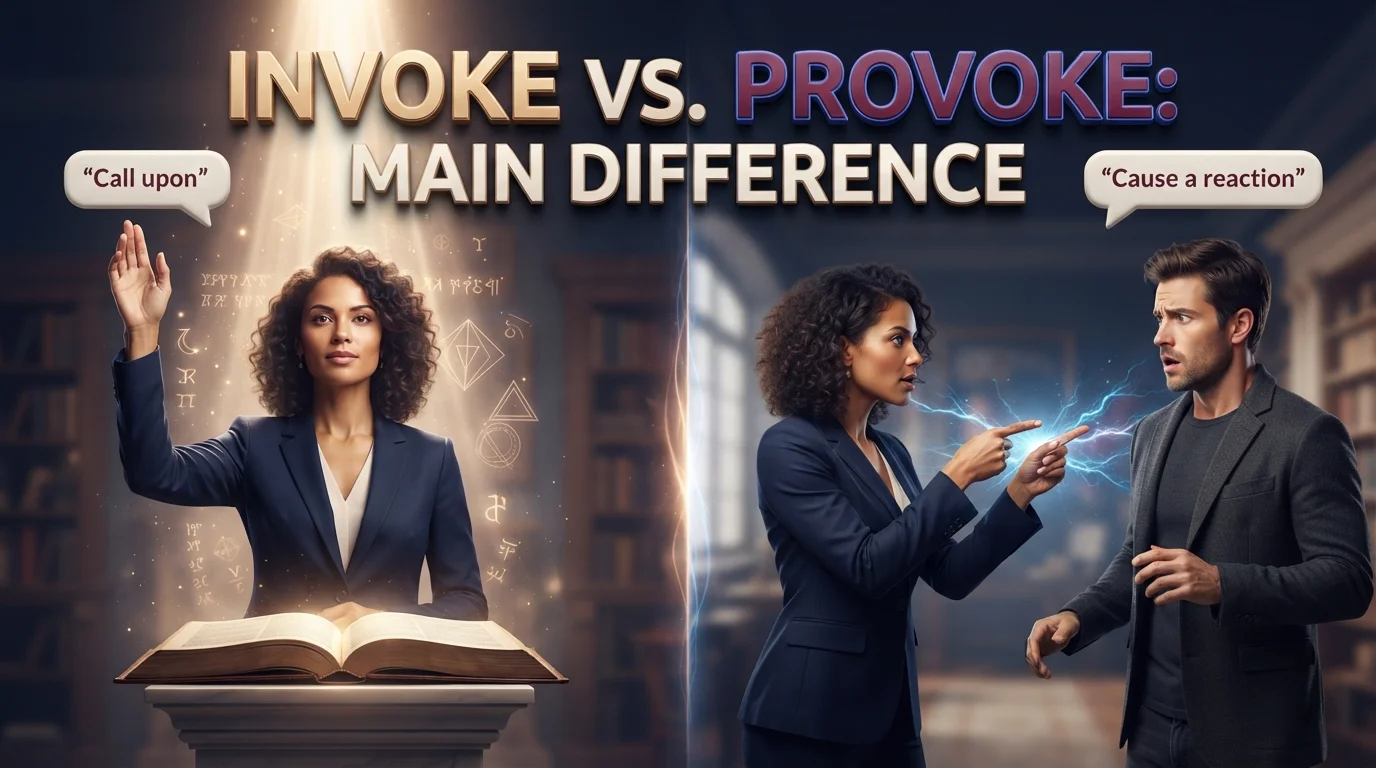
Invoke vs. Provoke: Main Difference
| Feature | Invoke | Provoke |
|---|---|---|
| Basic meaning | Call upon, appeal to, or bring into effect | Cause a reaction |
| Main idea | Calling something forth or relying on it | Triggering a response |
| Common objects | Laws, rights, authority, memories, principles | Anger, reactions, debate, conflict |
| Typical tone | Formal | Neutral to negative, depending on context |
| Example | She invoked her legal rights. | His remarks provoked anger. |
| Memory clue | Call upon | Cause a reaction |
Bottom Line
Invoke = call upon something.
Provoke = cause a reaction.
Invoke in Different Contexts
Invoking a Right
The employee invoked her right to privacy.
Meaning:
She formally relied on or exercised that right.
Invoking Authority
The official invoked his authority to stop the event.
Meaning:
He relied on his authority to take action.
Invoking a Rule
The referee invoked the rules to explain the decision.
Meaning:
The referee appealed to the rules.
Invoking a Memory
The song invoked memories of his childhood.
Meaning:
The song brought those memories to mind.
Invoking a Law
The company invoked the contract’s termination clause.
Meaning:
The company relied on that contractual provision.
🎯 Lesson: Invoke is often about bringing something into consideration, use, or effect.
Provoke in Different Contexts
Provoking Anger
His behavior provoked anger among the employees.
Meaning:
His behavior caused them to become angry.
Provoking a Reaction
The decision provoked a strong public reaction.
Meaning:
The decision caused people to react strongly.
Provoking a Debate
The article provoked an important debate.
Meaning:
The article caused people to discuss the issue.
Provoking Someone
Don’t provoke him.
Meaning:
Don’t deliberately make him angry or cause him to react.
Provoking Thought
The documentary provoked serious thought about the issue.
This demonstrates that provoke isn’t always negative.
It can mean stimulate or cause a response or mental activity.
🎯 Lesson: Provoke is broader than simply “make someone angry”; it means cause or stimulate a reaction.
Invoke vs. Provoke: Real-World Usage Scenarios
Scenario 1: Legal Rights
A: Why didn’t she answer the question?
B: She invoked her right to remain silent.
🎯 Lesson: Use invoke when someone formally relies on a right, law, rule, or authority.
Scenario 2: An Angry Reaction
A: Why was everyone upset?
B: His comments provoked an angry reaction.
🎯 Lesson: Use provoke when something causes a reaction.
Scenario 3: A Memory
A: Why does this song remind you of school?
B: It invokes memories of my childhood.
🎯 Lesson: Invoke can mean bring a memory, feeling, or image to mind.
Scenario 4: Deliberate Irritation
A: Why did you argue with him?
B: He was trying to provoke me.
🎯 Lesson: Provoke can mean deliberately trying to make someone react.
Scenario 5: A Debate
A: Why did the speech become controversial?
B: It provoked a heated debate.
🎯 Lesson: Provoke can describe something that stimulates discussion or debate, not just anger.
Invoke vs. Provoke in Legal English
The distinction is especially important in legal writing.
Invoke
Legal texts frequently use invoke with:
- Rights
- Laws
- Rules
- Clauses
- Privileges
- Powers
- Constitutional protections
Examples:
The defendant invoked her right to counsel.
The company invoked the arbitration clause.
The government invoked emergency powers.
In each case, something is being called upon or formally relied upon.
Provoke
Legal writing may use provoke when describing a reaction:
The statement provoked a legal dispute.
The incident provoked public criticism.
Here, something caused a response.
🎯 Key Insight: If you can replace the word with “appeal to” or “call upon,” use invoke. If you can replace it with “cause” or “trigger,” use provoke.
Invoke vs. Provoke: A Simple Substitution Test
This is one of the easiest ways to choose correctly.
If “call upon” works → INVOKE
She invoked her right to remain silent.
Try:
She called upon her right to remain silent.
The idea works.
If “cause” or “trigger” works → PROVOKE
His words provoked anger.
Try:
His words caused anger.
The meaning works.
Quick Formula
Invoke = call upon / appeal to
Provoke = cause / trigger / stimulate
Common Mistakes With Invoke and Provoke
Mistake 1: “He Provoked His Right”
❌ He provoked his right to remain silent.
Correct:
✅ He invoked his right to remain silent.
🎯 Why? A right is something you invoke, not something you provoke.
Mistake 2: “Her Comments Invoked Anger”
This sentence isn’t necessarily impossible, but it is usually the wrong word if you mean that her comments caused anger.
Better:
✅ Her comments provoked anger.
🎯 Why? The comments caused the anger.
Mistake 3: “The Law Provoked”
❌ The lawyer provoked the law.
Correct:
✅ The lawyer invoked the law.
The lawyer is appealing to or relying on the law.
Mistake 4: Thinking “Provoke” Always Means Anger
Not necessarily.
You can provoke:
- A reaction
- A response
- A debate
- Thought
- Discussion
- Curiosity
- Opposition
For example:
The question provoked considerable thought.
So provoke means more broadly cause or stimulate a response.
Invoke vs. Evoke vs. Provoke
A third word often causes confusion: evoke.
Invoke
Call upon or appeal to
The lawyer invoked the law.
Evoke
Bring a feeling, memory, image, or response to mind
The photograph evoked memories of childhood.
Provoke
Cause or stimulate a reaction
The speech provoked an angry response.
Simple Comparison
| Word | Core Idea | Example |
|---|---|---|
| Invoke | Call upon | She invoked her rights. |
| Evoke | Bring to mind | The smell evoked memories. |
| Provoke | Cause a reaction | His words provoked anger. |
🎯 Memory Trick:
Invoke = call upon
Evoke = bring to mind
Provoke = cause a reaction
Memory Tricks: Invoke vs. Provoke
🧠 Trick 1: “Invoke” = Invite In
Think:
INvoke → invite something in
You’re calling upon or bringing something into use.
invoke a law
invoke a right
🔥 Trick 2: “Provoke” = Produce a Reaction
Think:
PROvoke → produce a reaction
provoke anger
provoke debate
provoke a response
⭐ One-Line Memory Trick
Invoke something; provoke someone or a reaction.
This isn’t an absolute grammar rule, but it’s an excellent memory aid.
Expert Insight: The Shared “-voke” Root
The similarity between invoke, provoke, and evoke isn’t accidental.
They are related through the Latin root vocare, meaning “to call.”
The prefixes change the direction or sense of that calling.
- invoke → call upon
- provoke → call forth or bring about
- evoke → call out/from and bring to mind
This explains why the words look similar while developing distinct meanings in modern English.
Understanding the underlying concept of “calling forth” can make the vocabulary much easier to remember.
Quick Test: Invoke or Provoke?
1. The lawyer ________ the client’s constitutional rights.
Answer: invoked
The lawyer called upon/referred to the rights.
2. His comments ________ an angry response.
Answer: provoked
His comments caused the response.
3. The photograph ________ memories of her childhood.
Answer: invoked can be used, but evoked is generally more natural for this meaning.
4. The company ________ the contract’s arbitration clause.
Answer: invoked
The company relied on the clause.
5. The controversial decision ________ widespread criticism.
Answer: provoked
The decision caused the criticism.
6. The official ________ emergency powers.
Answer: invoked
The official called upon or exercised those powers.