
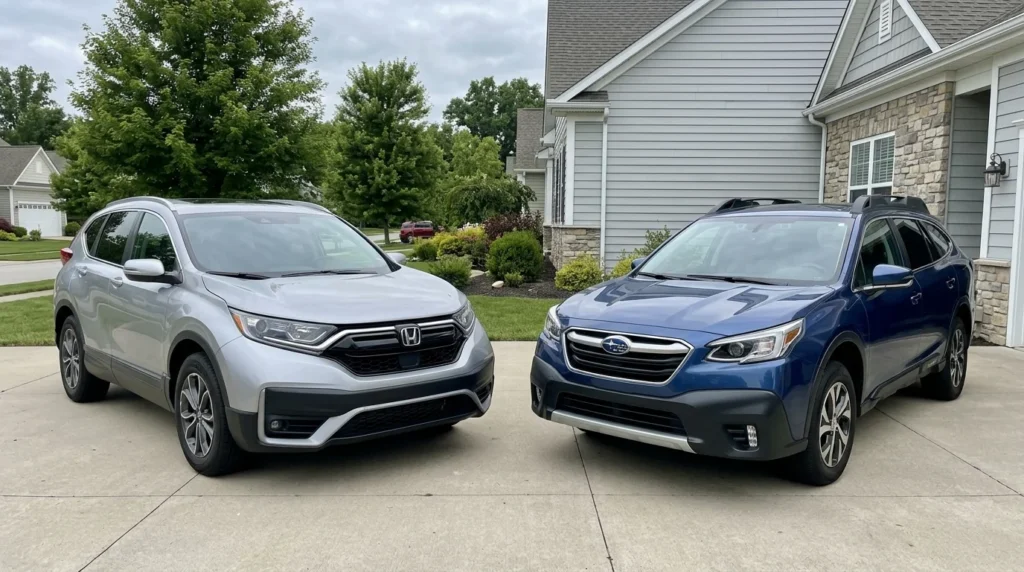
Quick Answer: Honda vs. Subaru
Honda is generally the better choice for drivers who prioritize fuel economy, refined everyday driving, practicality, and a broad vehicle lineup. Subaru is often the better choice for drivers who want standard AWD, strong traction, and an outdoors-oriented vehicle.
The best choice ultimately depends on the specific model and your driving needs.
Simple rule:
Choose Honda for efficient everyday practicality. Choose Subaru for all-weather traction and adventure-focused driving.
Honda vs. Subaru: At a Glance
| Feature | Honda | Subaru |
|---|---|---|
| Brand origin | Japan | Japan |
| Best known for | Practicality, efficiency, engines | AWD, safety, outdoors capability |
| AWD availability | Available on selected models | Standard on most models |
| Fuel economy | Generally strong | Competitive, varies by model |
| Reliability | Strong overall reputation | Strong overall reputation |
| Safety | Strong | Strong |
| Driving feel | Smooth and practical | Stable and traction-focused |
| SUV selection | Broad | Strong |
| Hybrid options | Available in several models | More limited depending on market/model |
| Off-road ability | Model dependent | Stronger overall lineup |
| Maintenance | Generally manageable | Model dependent |
| Best for | Daily drivers and families | AWD and outdoor-focused drivers |
What Is Honda Known For?
Honda is a Japanese automaker with a long history of producing passenger cars, SUVs, motorcycles, and other products.
In the automotive market, Honda has built a reputation around efficient powertrains, practical vehicle design, reliability, and strong everyday usability.
Popular Honda models include:
- Civic
- Accord
- CR-V
- HR-V
- Pilot
- Passport
- Ridgeline
- Odyssey
Honda’s lineup gives shoppers several choices, from compact cars to three-row SUVs and pickup trucks.
Honda’s biggest strengths
1. Fuel efficiency
Honda has traditionally placed a strong emphasis on efficient powertrains.
2. Practical interiors
Honda vehicles often make good use of interior space, which can be valuable for families.
3. Everyday driving
Many Honda models are designed primarily around comfortable, predictable daily transportation.
4. Broad lineup
Honda gives buyers more choices across different vehicle categories.
Honda’s potential drawbacks
Honda isn’t necessarily the best choice for every driver.
If you frequently deal with snow, muddy roads, gravel, or outdoor trails, Subaru’s standard AWD approach may be more appealing.
And just like Subaru, Honda reliability varies by model, engine, transmission, year, maintenance history, and usage.
What Is Subaru Known For?
Subaru is another Japanese automaker, but its vehicle philosophy is somewhat different.
Subaru is particularly known for its Symmetrical All-Wheel Drive system, boxer engines, safety technology, and vehicles designed with outdoor lifestyles in mind.
Its lineup includes:
- Impreza
- Crosstrek
- Forester
- Outback
- Legacy
- Ascent
- WRX
- BRZ
One of Subaru’s most important differentiators is that AWD is standard on most of its mainstream models, rather than being an optional upgrade across much of the lineup.
Subaru’s biggest strengths
1. All-wheel drive
Subaru’s AWD system is a major reason buyers choose the brand.
2. All-weather confidence
Drivers who regularly encounter snow, rain, or slippery roads may appreciate Subaru’s traction-focused design.
3. Outdoor capability
Models such as the Outback and Forester are particularly popular among drivers who enjoy camping, hiking, and road trips.
4. Safety focus
Subaru has invested heavily in driver-assistance and crash-avoidance technologies.
Subaru’s potential drawbacks
AWD can add weight and mechanical complexity, which can affect fuel economy and maintenance compared with some two-wheel-drive alternatives.
Subaru’s lineup is also more concentrated around SUVs, crossovers, and practical outdoor-oriented vehicles.
Honda vs. Subaru: Reliability
Reliability is one of the biggest reasons people search for Honda vs. Subaru.
Both brands have strong reputations, but it is dangerous to say that every Honda is more reliable than every Subaru—or vice versa.
Honda reliability
Honda has a long-standing reputation for durable engines and vehicles that can provide many years of service when properly maintained.
However, reliability depends on:
- Model year
- Engine
- Transmission
- Maintenance
- Driving conditions
- Previous ownership
- Manufacturing changes
Subaru reliability
Subaru also has a strong reputation for long-term ownership.
Its boxer-engine layout and AWD system are distinctive engineering choices, but they also mean buyers should pay attention to the maintenance requirements of the specific vehicle.
Reliability winner?
Honda gets a slight advantage if your priority is straightforward, efficient everyday ownership.
But a well-maintained Subaru can also be an excellent long-term vehicle.
The exact model and model year matter more than the badge on the hood.
Honda vs. Subaru: AWD
This is where Subaru has one of its clearest advantages.
Honda
Honda offers AWD on selected vehicles and trims.
For example, AWD is available on various Honda SUVs, but not every Honda comes with it.
If you want AWD, you must select the appropriate model and configuration.
Subaru
Subaru has made AWD one of the central features of its mainstream lineup.
That means shoppers don’t generally have to move up to a special premium trim simply to get all-wheel drive.
Winner: AWD
Subaru wins.
If AWD is one of your top priorities, Subaru is usually the simpler choice.
Honda vs. Subaru: Snow and Winter Driving
If you live somewhere with frequent snow, the Honda vs. Subaru decision becomes more interesting.
Subaru’s standard AWD system provides an obvious advantage in slippery conditions.
However, AWD does not replace good winter tires.
A vehicle’s winter performance depends on:
- Tires
- AWD system
- Ground clearance
- Vehicle weight
- Stability control
- Driver behavior
- Road conditions
A front-wheel-drive Honda equipped with excellent winter tires can perform very well in many winter conditions.
Still, if you regularly drive through snow-covered roads, Subaru’s AWD-focused lineup can provide an attractive advantage.
Winter winner?
Subaru, especially for drivers who regularly encounter snow and slippery roads.
Honda vs. Subaru: Fuel Economy
Fuel economy is another major consideration.
Honda has historically been strong in fuel-efficient vehicles, particularly compact cars and hybrid models.
Subaru’s AWD-focused lineup can carry additional weight and drivetrain components, which can affect efficiency.
However, fuel economy varies dramatically between individual models.
For example:
- A compact Honda may be much more efficient than a larger Subaru SUV.
- A Honda hybrid may outperform a conventional Subaru in fuel consumption.
- A smaller Subaru may be more efficient than a larger Honda SUV.
Fuel economy winner?
Honda generally has the advantage, particularly when comparing similarly sized efficient models.
But always compare the EPA-rated figures for the exact vehicles you’re considering.
Honda vs. Subaru: Safety
Both Honda and Subaru place significant emphasis on vehicle safety.
Modern vehicles from both manufacturers can include technologies such as:
- Automatic emergency braking
- Lane-departure warning
- Adaptive cruise control
- Blind-spot monitoring
- Rear cross-traffic alert
- Driver-assistance systems
Subaru’s EyeSight driver-assistance technology is a major part of the brand’s safety strategy.
Honda also offers its Honda Sensing suite of safety and driver-assistance technologies on many vehicles.
Safety winner?
It’s essentially a model-by-model comparison.
Instead of asking whether Honda or Subaru is safer as a brand, compare the exact vehicles using current independent crash-test results and available safety features.
Honda vs. Subaru: Performance
Neither brand is focused exclusively on high-performance vehicles, but both have performance-oriented options.
Honda
Honda’s performance reputation is particularly strong around models such as the Civic Type R and Si.
These vehicles emphasize:
- Responsive handling
- Sporty driving
- Strong acceleration
- Driver engagement
Subaru
Subaru offers the WRX for drivers seeking rally-inspired performance and all-wheel-drive traction.
The BRZ provides a different experience, emphasizing lightweight rear-wheel-drive sports-car dynamics.
Performance winner?
It depends on what you mean by performance.
- Want front-wheel-drive performance? Honda
- Want AWD performance? Subaru
- Want lightweight rear-wheel-drive sports-car dynamics? Subaru BRZ
- Want practical performance? Both have strong options
Honda vs. Subaru: Comfort and Interior
Honda generally has an advantage in interior practicality and everyday usability.
Honda vehicles often focus on:
- Useful storage
- Flexible seating
- Passenger space
- Easy controls
- Family-friendly layouts
Subaru also builds practical interiors, particularly in vehicles such as the Forester and Outback.
Subaru’s interiors tend to complement the brand’s outdoor-oriented personality.
Comfort winner?
Honda has a slight advantage for conventional everyday practicality, while Subaru is excellent for active lifestyles and adventure-oriented use.
Honda vs. Subaru: Maintenance Costs
Maintenance costs depend heavily on the exact vehicle.
Factors include:
- Engine design
- AWD system
- Transmission
- Parts prices
- Labor rates
- Driving conditions
- Maintenance schedule
- Vehicle age
Because most mainstream Subaru vehicles use AWD, there are additional drivetrain components compared with a basic front-wheel-drive vehicle.
Honda’s simpler front-wheel-drive models can therefore be attractive to buyers who want straightforward transportation.
However, many Honda SUVs also offer AWD, so the comparison isn’t always one-to-one.
Maintenance winner?
Honda may have an advantage for simple front-wheel-drive ownership, but there is no universal winner.
Honda vs. Subaru: Resale Value
Resale value depends on:
- Model popularity
- Condition
- Mileage
- Region
- Demand
- Vehicle history
- Equipment
- Market conditions
Both Honda and Subaru can hold value well.
Subaru’s strong reputation in regions with harsh winters can support demand for certain models.
Honda’s broad popularity also helps maintain demand for models such as the Civic and CR-V.
Resale winner?
Too close to call universally.
Compare the specific models rather than assuming one brand always retains more value.
Honda vs. Subaru: Price and Value
Price isn’t simply the number on the window sticker.
Consider the total cost of ownership, including:
- Purchase price
- Fuel
- Insurance
- Maintenance
- Tires
- Repairs
- Depreciation
- Financing
A cheaper car that consumes more fuel may not actually cost less over several years.
Likewise, paying extra for AWD may be worthwhile if it gives you the capability you genuinely need.
Best value?
Honda often makes sense for efficiency-focused buyers, while Subaru can deliver strong value for drivers who would otherwise need to pay extra for AWD.
Honda vs. Subaru Comparison Table
| Feature | Honda | Subaru |
|---|---|---|
| Reliability | Strong | Strong |
| Fuel economy | Generally better | Generally competitive |
| AWD | Available on selected models | Standard on most mainstream models |
| Snow performance | Good with proper tires/AWD | Excellent choice for AWD-focused buyers |
| Safety | Excellent | Excellent |
| Interior practicality | Excellent | Very good |
| Outdoor capability | Model dependent | Excellent |
| Hybrid availability | Stronger lineup | More limited |
| Performance options | Strong | Strong |
| Maintenance | Often straightforward | Model dependent |
| Resale value | Strong | Strong |
| Best for families | Excellent | Excellent |
| Best for outdoor lifestyles | Good | Excellent |
| Best for efficiency | Excellent | Good |
| Overall winner | Depends on needs | Depends on needs |
Honda vs. Subaru Reliability
When comparing Honda vs. Subaru reliability, both brands have strong reputations for building dependable vehicles. However, reliability can vary depending on the model, model year, engine, transmission, and maintenance history.
Honda is known for practical vehicles such as the Civic, Accord, and CR-V. These models appeal to drivers who want dependable transportation, good fuel economy, and manageable ownership costs. Subaru also offers reliable options, including the Impreza, Crosstrek, and Forester, particularly for drivers who value all-wheel-drive capability.
Subaru performed better than Honda in Consumer Reports’ December 2025 predicted reliability rankings for new vehicles. Subaru ranked second with a score of 63 out of 100, while Honda ranked fourth with 59. These results reflect predicted brand-level reliability rather than the performance of every individual vehicle.
For example, someone choosing between a Honda Civic and a Subaru Impreza should consider the specific model years, reported mechanical issues, and service records. A well-maintained Honda may prove more dependable than a neglected Subaru, regardless of their overall rankings.
Honda is a strong option for everyday driving and practical ownership. Subaru is worth considering if you need all-wheel drive and regularly encounter challenging weather conditions.
Verdict: Subaru had the higher predicted reliability score in the cited 2025 survey, but the specific model and its maintenance history remain essential factors.
Honda vs. Subaru Safety
Honda vs. Subaru safety is an important comparison for families, commuters, and drivers who spend considerable time on the road. Both manufacturers offer modern safety technologies, including automatic emergency braking, adaptive cruise control, and lane-keeping assistance on many models and trims.
Subaru stands out because most of its lineup includes standard all-wheel drive. This system can improve traction when accelerating on wet, snowy, or slippery roads. However, all-wheel drive does not automatically prevent skidding or shorten braking distances.
Honda also offers competitive safety features. Depending on the model and trim, its driver-assistance systems can help drivers maintain following distances, stay within lane markings, and respond to potential frontal collisions.
When comparing safety, consider these factors:
Crash-test performance: Check the ratings for the exact model year you plan to buy.
Collision avoidance: Compare automatic emergency braking, pedestrian detection, and lane-support features.
Visibility: Consider blind spots, rear visibility, headlights, and camera systems.
Weather capability: Subaru’s standard all-wheel drive on most models can be useful in snow and rain.
Vehicle design: Size alone does not determine how well a vehicle protects its occupants in a crash.
For example, the Honda CR-V and Subaru Forester are both worth considering as family SUVs. Compare their crash-test results, available safety equipment, and performance for the specific model year rather than assuming one brand is always safer.
Verdict: Both brands offer strong safety options. Subaru has a traction advantage in many slippery conditions, but crash protection and model-specific safety ratings are more important than the brand name alone.
Honda vs. Subaru Reddit
People searching for Honda vs. Subaru Reddit discussions often want to learn about real-world ownership experiences. They may be interested in unexpected repairs, winter performance, fuel economy, maintenance expenses, and long-term durability.
Several common themes are worth considering when evaluating owner experiences.
Honda ownership: Drivers may appreciate practical interiors, efficient engines, everyday comfort, and the availability of replacement parts and repair services.
Subaru ownership: Owners may value all-wheel-drive capability, confidence in poor weather, and the usefulness of models such as the Outback and Crosstrek for outdoor activities.
Maintenance experiences: Repair bills vary according to the vehicle, mileage, local labor rates, and service history.
Long-term durability: Both brands have owners who keep their vehicles for many years, but individual experiences do not establish which brand is universally more reliable.
Driving conditions: Someone who regularly drives on snowy mountain roads may benefit more from Subaru’s all-wheel drive than someone who mainly commutes on dry city streets.
When reading owner discussions, focus on the same model year and powertrain you are considering. A comparison between an older Subaru and a new Honda hybrid may not provide a meaningful assessment of current vehicles.
It is also important to distinguish between routine maintenance, an isolated repair, and a recurring mechanical problem. Owner experiences can help identify issues worth investigating, but they should not replace reliability surveys, recall checks, and an independent inspection.
Verdict: Reddit discussions can provide useful ownership insights, but consider the full context behind each experience instead of relying on individual positive or negative comments.
Honda vs. Subaru SUV
Honda vs. Subaru SUV comparisons are useful because both manufacturers offer practical vehicles for families, commuters, and road trips. The best option depends on whether you prioritize fuel economy, passenger comfort, cargo space, or all-weather capability.
Honda CR-V: The CR-V is a practical choice for everyday driving, family errands, and long-distance travel. It offers generous cargo space, a comfortable cabin, and hybrid options for drivers who want better fuel economy.
Subaru Forester: The Forester appeals to drivers who want standard all-wheel drive, useful ground clearance, and a practical interior. It is particularly suitable for people who regularly travel on snowy roads, gravel routes, or outdoor recreation trips.
Honda HR-V: The HR-V is a smaller SUV designed for urban driving, commuting, and parking in tighter spaces. It is worth considering if you want a compact vehicle with everyday practicality.
Subaru Outback: The Outback combines wagon-like practicality with SUV-style utility. Its spacious cargo area and all-wheel-drive capability make it appealing for road trips, camping, and outdoor activities.
The Honda CR-V and Subaru Forester are especially useful comparisons for buyers seeking a family SUV. Honda emphasizes comfort, efficiency, and hybrid availability, while Subaru emphasizes all-wheel-drive capability and versatility.
For buyers who want to compare compact SUVs, the Honda HR-V and Subaru Crosstrek are also worth considering. Their dimensions, ground clearance, fuel economy, and available equipment differ, so compare the specific trims rather than relying on general brand descriptions.
Verdict: Choose the Honda CR-V if fuel economy, comfort, and hybrid availability are priorities. Consider the Subaru Forester if standard all-wheel drive and regular travel in poor weather matter more.
Honda vs. Subaru vs. Toyota
When comparing Honda vs. Subaru vs. Toyota, all three manufacturers offer vehicles with strong reliability reputations, but each has different advantages.
Consumer Reports’ December 2025 predicted reliability rankings placed Toyota first with a score of 66 out of 100, Subaru second with 63, and Honda fourth with 59. These figures represent predicted brand-level reliability for new vehicles, not a ranking of every individual model.
Category | Honda | Subaru | Toyota |
|---|---|---|---|
Reliability | Strong overall reputation | Ranked highly in recent survey | Highest score in the cited survey |
All-wheel drive | Available on many models | Standard on most models | Available on selected models |
Hybrid selection | Established hybrid cars and SUVs | Expanding hybrid lineup | Broad hybrid selection |
Everyday practicality | Strong | Strong | Strong |
Outdoor and winter use | Depends on model and drivetrain | Particularly appealing | Depends on model and drivetrain |
Long-term ownership | Good option | Good option | Good option |
Honda is worth considering if you want a practical commuter, family sedan, or efficient hybrid SUV. Subaru makes sense for buyers who value traction and outdoor versatility. Toyota is particularly attractive to people seeking a broad range of hybrid vehicles and a strong reliability record.
For example, the Honda CR-V Hybrid, Subaru Forester Hybrid, and Toyota RAV4 Hybrid are alternatives for shoppers comparing compact hybrid SUVs. Consider their fuel economy, interior comfort, cargo space, safety ratings, and maintenance expenses.
A high brand reliability score does not guarantee a trouble-free experience with every vehicle. New designs, complex powertrains, and individual maintenance histories can significantly affect ownership.
Verdict: Toyota leads in the cited predicted reliability survey, Subaru offers a compelling all-wheel-drive lineup, and Honda remains a strong all-around choice. Your needs and the specific vehicle should determine the final decision.
Honda vs. Subaru Hybrid
Honda vs. Subaru hybrid comparisons are increasingly relevant for drivers who want to reduce fuel consumption without switching to a fully electric vehicle.
Honda has an established hybrid lineup that includes the Civic Hybrid, Accord Hybrid, and CR-V Hybrid. These vehicles combine a gasoline engine with an electric motor system to improve fuel efficiency, particularly in city driving.
Subaru has expanded its hybrid offering as well. The Forester Hybrid gives buyers another option in the compact SUV segment. Both manufacturers combine gasoline power with electric assistance, although their hybrid systems and driving characteristics differ.
Here are the main factors to consider:
Fuel economy: Compare official fuel economy ratings for the exact trim and drivetrain.
All-wheel drive: Subaru emphasizes all-wheel drive throughout its lineup. Honda also offers all-wheel-drive hybrid SUVs, but availability varies by model.
Purchase price: A hybrid may cost more upfront than a comparable gasoline model, so consider whether potential fuel savings justify the difference.
Maintenance: Hybrid vehicles still require scheduled servicing, although their maintenance needs vary by powertrain.
Reliability: Examine model-specific reliability information for the exact hybrid generation rather than assuming conventional and hybrid versions perform identically.
If most of your driving involves city traffic, either brand’s hybrid SUV may provide meaningful fuel savings. If you frequently travel on snow-covered roads, compare the all-wheel-drive systems and tires alongside fuel economy.
Verdict: Honda offers a broader established selection of hybrid cars and SUVs, while the Subaru Forester Hybrid is worth considering if you want a hybrid with Subaru’s all-wheel-drive focus.
Subaru vs. Honda Maintenance Cost
Subaru vs. Honda maintenance cost is an important consideration if you plan to keep your vehicle for many years. Routine servicing, replacement parts, tires, and unexpected repairs all contribute to the total cost of ownership.
Consumer Reports’ 2025 ownership-cost analysis, published in December 2025, ranked Honda 11th and Subaru 20th among 29 brands for estimated maintenance and repair costs over ten years. Honda had the more favorable cost ranking in that analysis.
This illustrates an important distinction: reliability and maintenance cost are not the same thing. A vehicle can experience relatively few problems but still cost more to service when maintenance or repairs are needed.
Honda maintenance expenses typically include oil changes, filters, tires, brake components, transmission servicing, and other scheduled work. Subaru owners face similar expenses, but all-wheel-drive models may require particular attention to tire matching and drivetrain maintenance.
Several factors influence the final bill:
Routine servicing: Oil changes, filters, fluid checks, and scheduled inspections are necessary for both brands.
Tires: Subaru’s all-wheel-drive systems make appropriately matched tires particularly important. Following tire maintenance recommendations helps protect drivetrain components.
Parts and labor: Costs vary by model, engine, location, and whether you use a dealership or independent repair shop.
Age and mileage: Older vehicles may need suspension work, cooling-system repairs, battery replacements, and other age-related maintenance.
Hybrid components: Hybrid models have additional electrical components, although their overall maintenance needs depend on the specific system.
For a used-car buyer, service records are often more useful than a general brand ranking. A well-maintained Subaru with documented servicing may be a better purchase than a Honda with neglected maintenance and unresolved mechanical issues.
Verdict: Honda has the advantage in the cited ten-year maintenance and repair cost ranking. Subaru can still be a sensible purchase, particularly if its all-wheel-drive capability is valuable for your driving conditions.
Subaru vs. Honda Longevity
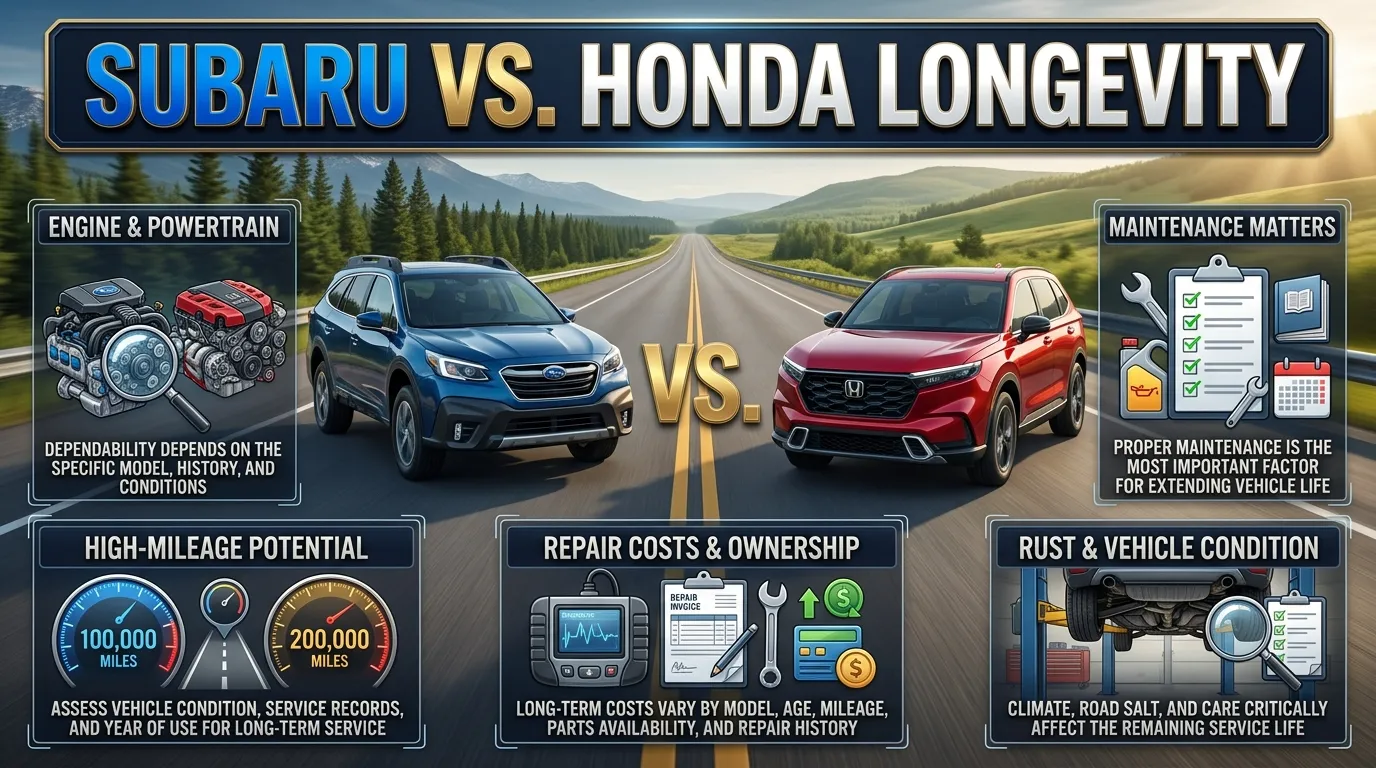
Subaru vs. Honda longevity refers to how long vehicles can remain dependable and usable before major repairs or replacement become necessary.
Both brands have vehicles that can serve their owners for many years. However, reaching high mileage depends on more than the manufacturer’s reputation. Driving habits, maintenance, climate, road conditions, and the specific engine and transmission all play important roles.
Honda vehicles such as the Civic, Accord, and CR-V are popular choices for long-term ownership because of their practical designs and established service networks. Subaru models such as the Impreza, Forester, and Outback can also be long-lasting when properly maintained.
Consider these factors when estimating a vehicle’s lifespan:
Maintenance history: Regular oil changes and timely servicing help prevent avoidable damage.
Engine and transmission condition: Check for leaks, unusual noises, warning lights, overheating, or shifting problems.
Driving conditions: Frequent short trips, heavy traffic, extreme temperatures, and rough roads can increase wear.
Rust and corrosion: The condition of the underbody is especially important for vehicles driven in regions that use road salt.
Repair history: A vehicle with documented repairs is not necessarily a poor choice, but recurring major problems deserve careful investigation.
Neither brand can guarantee a specific mileage figure. Some vehicles from both manufacturers exceed 200,000 miles, while others require substantial repairs much earlier. High mileage alone does not tell the full story.
For example, if you are choosing between a used Honda CR-V and a Subaru Forester with similar mileage, examine the maintenance records, transmission condition, accident history, and results of a professional pre-purchase inspection. These details may matter more than a small difference in brand reliability scores.
Verdict: Both Honda and Subaru can be good long-term ownership choices. Honda’s favorable maintenance-cost ranking may appeal to budget-conscious buyers, while Subaru offers the additional benefit of standard all-wheel drive on most models. The individual vehicle’s condition should guide a used-car purchase.
Real-World Honda vs. Subaru Scenarios
1. The City Commuter
Mike: “I drive to work every day and rarely see snow. I care about fuel economy.”
Better fit: Honda.
🎯 Lesson: If AWD isn’t important, an efficient Honda can make more sense.
2. The Snow-Belt Driver
Sarah: “My area gets heavy snow every winter.”
Better fit: Subaru.
🎯 Lesson: Standard AWD can be a major advantage when winter traction is a priority.
3. The Weekend Adventurer
Jake: “I spend my weekends camping, hiking, and exploring gravel roads.”
Better fit: Subaru.
🎯 Lesson: Subaru’s AWD-focused lineup and outdoor-oriented models are particularly well suited to this lifestyle.
4. The Family Buyer
Emily: “I need a comfortable SUV with lots of useful space for my family.”
Better fit: Compare the Honda CR-V, Pilot, and comparable Subaru models such as the Forester and Ascent.
🎯 Lesson: Family buyers should compare seating, cargo capacity, fuel economy, safety features, and price—not just brand reputation.
5. The Performance Enthusiast
Ryan: “I want something fun to drive but still practical.”
Better fit: Consider Honda’s sporty Civic models or Subaru’s WRX, depending on the driving experience you want.
🎯 Lesson: Decide whether you prefer front-wheel-drive agility or AWD traction before choosing.
Common Mistakes When Comparing Honda vs. Subaru
Mistake 1: “Honda Is Always More Reliable”
That’s too broad.
Reliability varies by model, year, engine, transmission, maintenance, and ownership history.
Better approach: Research the exact vehicle.
Mistake 2: “AWD Means You Can’t Lose Traction”
AWD helps distribute engine power, but it doesn’t magically create grip.
Better approach: Remember that tires are critical, especially in snow and ice.
Mistake 3: Comparing Different Vehicle Sizes
Comparing a compact Honda sedan with a large Subaru SUV isn’t useful.
Better approach: Compare vehicles in the same class.
Mistake 4: Ignoring Fuel Costs
A vehicle that costs slightly less upfront can become more expensive if you drive thousands of miles every year.
Better approach: Estimate fuel costs over several years.
Mistake 5: Choosing a Brand Instead of a Model
This is the biggest mistake.
A Honda Civic and Honda Pilot have completely different strengths.
A Subaru Impreza and Subaru Ascent are equally different.
Better approach: Pick your requirements first, then select the model.
Memory Trick: Honda vs. Subaru
Need an easy way to remember the difference?
🚗 Honda = Everyday Efficiency
Think:
Honda → Practical → Efficient → Everyday
🏔️ Subaru = All-Weather Adventure
Think:
Subaru → AWD → Snow → Outdoors
So remember:
Honda for the road. Subaru for the road less traveled.
It’s not an absolute rule, but it’s a useful starting point.
Expert Insight: Why Honda and Subaru Feel Different
The difference between Honda and Subaru isn’t simply about branding.
It comes from engineering priorities.
Honda’s broad lineup allows the company to target efficiency, practicality, performance, and family transportation across several vehicle types.
Subaru has historically built much of its identity around AWD, boxer engines, traction, safety, and outdoor-oriented utility.
That creates a different ownership proposition.
For example, if you rarely encounter snow and primarily commute on paved roads, Subaru’s AWD system may not provide enough additional value to justify choosing it over an equally suitable Honda.
But if you live in a snowy region or regularly travel on unpaved roads, Subaru’s AWD-focused lineup becomes much more compelling.
The smartest comparison therefore isn’t:
“Which company makes better cars?”
It’s:
“Which engineering philosophy fits my driving life?”
Honda vs. Subaru: Which Should You Buy?
Choose Honda if you prioritize:
- Fuel economy
- Everyday commuting
- Practical interiors
- Hybrid options
- Broad model selection
- Smooth daily driving
- Family-friendly transportation
Choose Subaru if you prioritize:
- Standard AWD
- Snow and slippery roads
- Outdoor adventures
- Ground clearance
- Gravel-road capability
- All-weather confidence
- Adventure-focused SUVs
Choose Honda when:
You want efficient, practical transportation for mostly paved-road driving.
Choose Subaru when:
You want AWD-focused capability for changing weather and outdoor adventures.