
Quick Answer: Anyone vs. Anybody
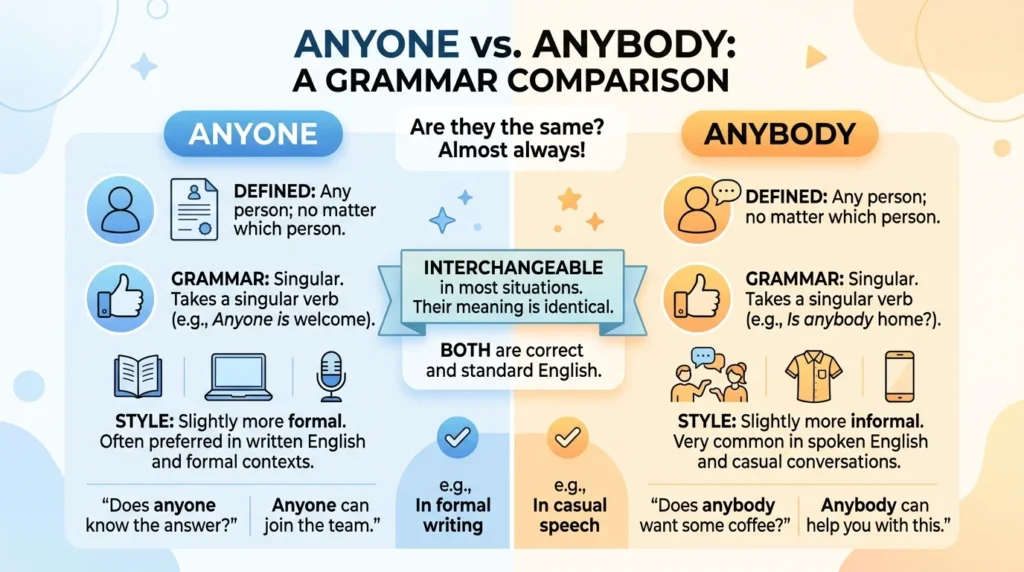
Anyone and anybody are generally interchangeable.
Both mean:
any person
For example:
Does anyone know the answer?
and
Does anybody know the answer?
Both sentences are correct and have essentially the same meaning.
The easiest rule:
Anyone = anybody
Use either one in most everyday situations.
What Does “Anyone” Mean?
Anyone is an indefinite pronoun referring to any person, without identifying a particular individual.
It is commonly used in questions, negative statements, and conditional sentences.
Examples
Does anyone know where she went?
I don’t know anyone here.
Anyone can learn this skill with practice.
If anyone calls, please take a message.
In each case, anyone refers to an unspecified person or any person in general.
“Anyone” in Questions
Is anyone home?
This asks whether there is any person at home.
“Anyone” in Negative Statements
I didn’t see anyone at the station.
This means I saw no person at the station.
“Anyone” in General Statements
Anyone can make a mistake.
Here, anyone means any person at all.
🎯 Key Insight: Anyone is a standard, neutral indefinite pronoun meaning any person.
What Does “Anybody” Mean?
Anybody has essentially the same meaning as anyone.
It also means any person or any person at all.
Examples
Does anybody know the answer?
I don’t think anybody saw us.
Anybody can join the club.
If anybody asks, tell them I’m busy.
These sentences can generally use anyone instead without changing the meaning.
Anyone vs. Anybody: Main Difference
There is no significant difference in basic meaning.
Both are indefinite pronouns and can refer to an unspecified person.
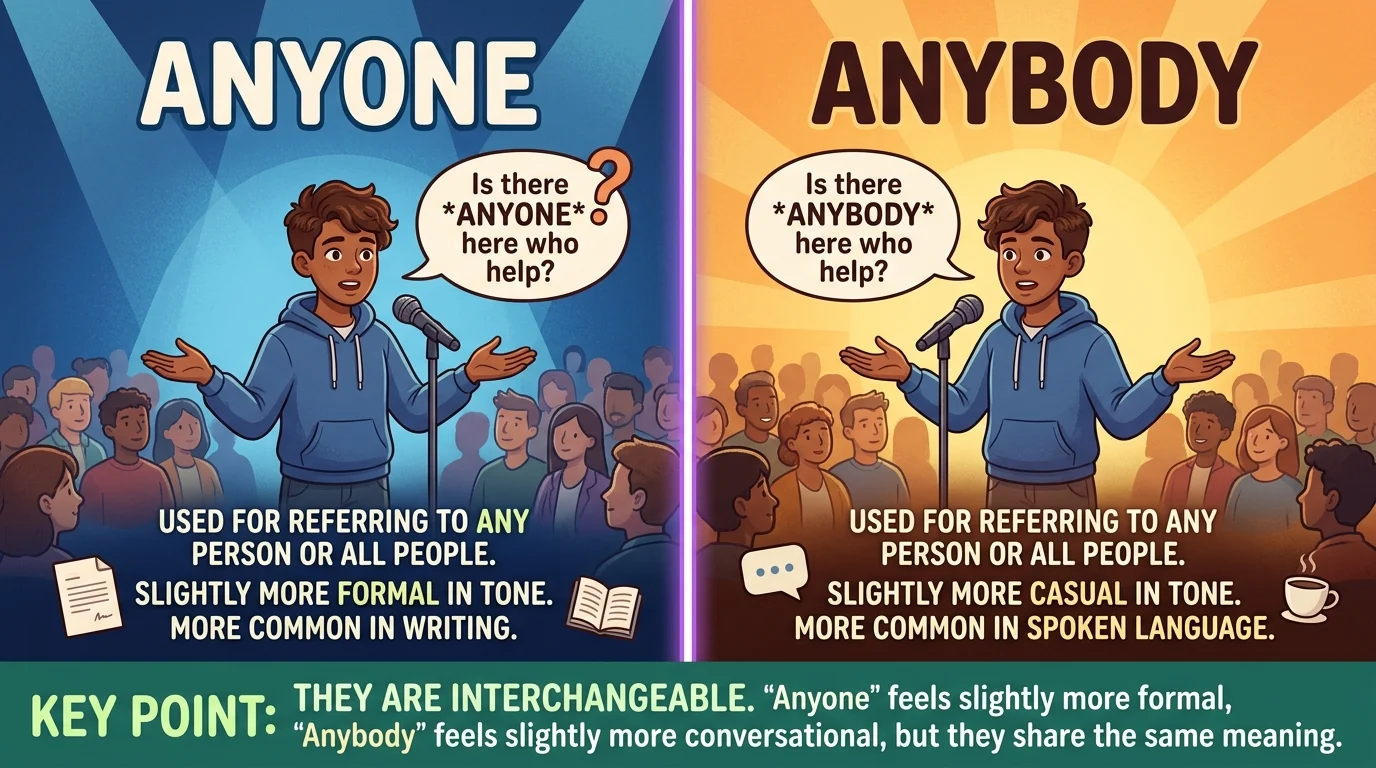
The main distinction is tone and preference.
| Feature | Anyone | Anybody |
|---|---|---|
| Meaning | Any person | Any person |
| Part of speech | Indefinite pronoun | Indefinite pronoun |
| Grammar | Correct | Correct |
| Formal writing | Often slightly preferred | Also correct |
| Everyday speech | Very common | Very common |
| Meaning difference | Essentially none | Essentially none |
| Memory clue | Any + one | Any + body |
Bottom Line
Anyone and anybody are normally interchangeable.
Anyone vs. Anybody in Different Contexts
1. Asking a Question
Both are correct:
Does anyone need help?
Does anybody need help?
There is essentially no difference in meaning.
🎯 Lesson: Either word works naturally in questions.
2. Negative Sentences
Both are correct:
I didn’t tell anyone.
I didn’t tell anybody.
Both mean that you didn’t tell any person.
3. Conditional Statements
Both are correct:
If anyone calls, let me know.
If anybody calls, let me know.
The meaning is the same.
4. General Statements
Both work:
Anyone can become a better writer.
Anybody can become a better writer.
However, anyone can sound slightly more polished or neutral in formal writing.
Anyone vs. Anybody: Real-World Usage Scenarios
Scenario 1: At School
Teacher: Does anyone have a question?
Student: I do.
You could also say:
Does anybody have a question?
🎯 Lesson: Both are grammatically correct.
Scenario 2: At Home
Is anybody home?
This sounds very natural in conversation.
You could also say:
Is anyone home?
🎯 Lesson: Anybody can have a slightly more conversational feel.
Scenario 3: Professional Writing
Anyone interested in applying should submit an application by Friday.
This sounds natural and professional.
You could write:
Anybody interested in applying should submit an application by Friday.
That is also grammatically correct, but anyone may sound slightly more formal or polished.
🎯 Lesson: In formal writing, anyone is often a comfortable default.
Scenario 4: Warning Someone
If anyone sees my keys, please let me know.
Or:
If anybody sees my keys, please let me know.
🎯 Lesson: The choice doesn’t change the meaning.
Scenario 5: Encouragement
Anyone can learn a new language.
Or:
Anybody can learn a new language.
Both mean that any person has the ability to do so.
Common Mistakes With Anyone and Anybody
Mistake 1: Thinking “Anybody” Is Incorrect
❌ Anybody is grammatically wrong.
This is false.
✅ Anybody is a standard English word.
For example:
Does anybody know the answer?
is completely correct.
Mistake 2: Thinking “Anyone” Is More Correct
Anyone is not inherently more grammatically correct than anybody.
Both are standard.
The choice is usually based on style, tone, rhythm, and personal preference.
Mistake 3: Using a Plural Verb
Because anyone and anybody can refer to many possible people, learners sometimes incorrectly use a plural verb.
❌ Anybody are welcome.
✅ Anybody is welcome.
Why?
Because anybody is grammatically singular.
The same applies to anyone:
Anyone is welcome.
Not:
❌ Anyone are welcome.
Anyone and Anybody Take Singular Verbs
This is an important grammar rule.
Although anyone and anybody can refer to any person in a group, grammatically they are singular indefinite pronouns.
Correct
Anyone is allowed to participate.
Anybody knows that? — grammatically possible, though unnatural in many contexts.
More naturally:
Does anybody know the answer?
Incorrect
❌ Anyone are allowed to participate.
❌ Anybody have a question?
Instead:
✅ Does anybody have a question?
🎯 Key Insight: Anyone and anybody are grammatically singular.
Anyone vs. Anybody With “Anyone Else” and “Anybody Else”
Both forms are correct.
Does anyone else want coffee?
Does anybody else want coffee?
Both mean:
Does any other person want coffee?
Likewise:
I don’t know anyone else here.
I don’t know anybody else here.
Both are natural.
Anyone vs. Anybody in Formal Writing
Both words are acceptable in formal English.
However, anyone is sometimes preferred in formal, academic, or professional writing because it can sound slightly more neutral and concise.
Formal/neutral
Anyone wishing to attend must register in advance.
More conversational
Anybody who wants to come can register in advance.
Neither is grammatically wrong.
🎯 Important: This is a style preference, not a strict grammar rule.
Anyone vs. Anybody in American and British English
Both anyone and anybody are widely used in both American English and British English.
There is no major US-versus-UK grammar rule requiring one over the other.
You can safely use either in standard English.
Memory Tricks: Anyone vs. Anybody
🧠 Trick 1: Same Meaning
Remember:
Anyone = Anybody = Any person
That’s the most important rule.
👤 Trick 2: “One” and “Body” Both Refer to a Person
Think:
any + one → anyone
any + body → anybody
Both constructions point to a person.
🎯 Trick 3: Formal vs. Conversational
A useful style shortcut is:
Anyone → slightly more neutral/formal
Anybody → slightly more conversational
But remember: both are correct.
⭐ One-Line Memory Trick
Anyone and anybody mean the same thing; choose based on style, not grammar.
Anyone vs. Somebody vs. Someone
This is another useful distinction.
Anyone / Anybody
Usually means any person, especially in questions, negatives, or general statements.
Does anyone need help?
Someone / Somebody
Usually means an unspecified but particular person.
Someone left a phone on the table.
Compare:
Did anyone call?
= Was there any person who called?
Someone called.
= An unspecified person called.
Quick Comparison
| Word | Basic Meaning | Example |
|---|---|---|
| Anyone | Any person | Does anyone know? |
| Anybody | Any person | Does anybody know? |
| Someone | An unspecified person | Someone called. |
| Somebody | An unspecified person | Somebody called. |
Anyone vs. Any One
There is one spelling distinction worth knowing.
Anyone
One word:
Anyone can participate.
Means:
Any person
Any one
Two words:
You can choose any one of these options.
Here, one means a single item or person from a group.
Compare:
Anyone can apply.
= Any person can apply.
You can choose any one of these three options.
= Choose one option from the three.
🎯 Key Insight: Anyone = any person. Any one = one particular item/person from a group.
Expert Insight: Why Anyone and Anybody Are So Similar
Anyone and anybody are compound indefinite pronouns formed from any + one and any + body.
English has several parallel pairs:
- someone / somebody
- everyone / everybody
- no one / nobody
- anyone / anybody
These pairs generally have the same grammatical function and nearly identical meanings.
The choice between them is primarily stylistic.
For example:
Everyone enjoyed the event.
and:
Everybody enjoyed the event.
Both are correct.
The same principle applies to anyone and anybody.
Quick Test: Anyone or Anybody?
Choose the better word. In most cases, both answers are acceptable.
1. Does ________ know where she went?
Answer: anyone / anybody
2. I don’t know ________ here.
Answer: anyone / anybody
3. If ________ calls, tell them I’ll call back.
Answer: anyone / anybody
4. ________ can make mistakes.
Answer: anyone / anybody
5. Is ________ home?
Answer: anyone / anybody
The Pattern
In all five examples, both words work.
The difference is mainly one of style and tone, not meaning.