

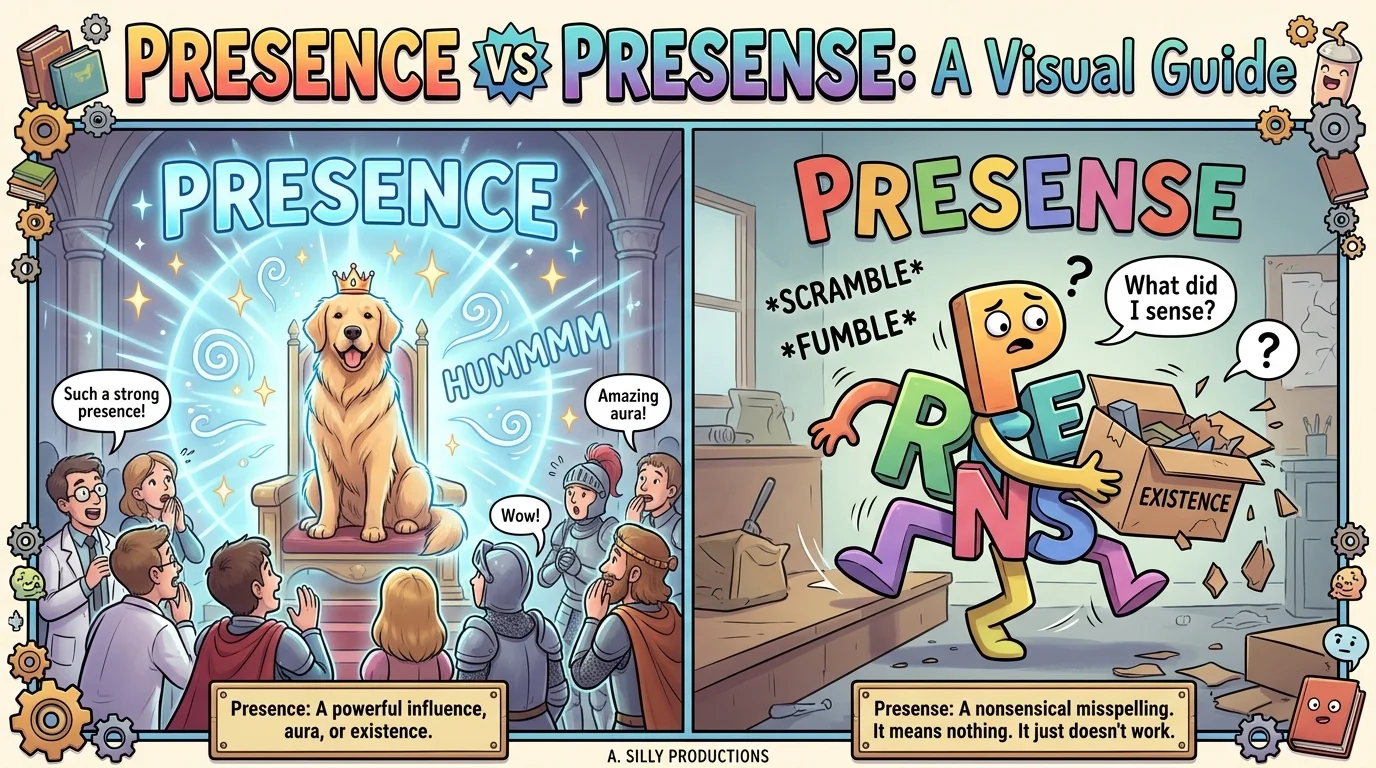
Quick Answer: Presence vs Presense
- Presence is the correct spelling.
- Presense is incorrect and should not be used.
Quick Examples
✅ Her presence changed the entire atmosphere of the room.
❌ Her presense changed the entire atmosphere of the room.
What Does “Presence” Mean?
Presence is a noun that refers to:
- Being physically in a place
- Influence or impact in a situation
- A noticeable quality or aura someone has
- The existence of something in a specific area
When to Use Presence
Use presence when talking about:
- Someone being in a room or location
- Strong personality or influence
- Awareness or existence of something
Examples
- His presence was felt immediately in the meeting.
- The teacher’s presence kept the class disciplined.
- Police presence increased in the area.
- She has a strong stage presence.
Key Insight
Whenever you mean “being there” or “influence felt,” the correct spelling is presence.
What Does “Presense” Mean?
Presense is not a recognized English word.
It is a common misspelling caused by phonetic confusion.
Why Does This Mistake Happen?
Many English words ending in -ence sound like they could be spelled with -ense, such as:
- Sense
- Expense
- Defense
So writers sometimes incorrectly assume:
Presence → Presense ❌
However, the correct ending is always -ence, not -ense.
Examples
Incorrect:
- His presense was important.
- The presense of security was noticeable.
Correct:
- His presence was important.
- The presence of security was noticeable.
Key Insight
If you see presense, it should always be corrected to presence.
Presence vs Presense: Key Differences
Quick Comparison
- Presence = Correct spelling
- Presense = Misspelling
Comparison Table
| Feature | Presence | Presense |
|---|---|---|
| Correct English Spelling | Yes | No |
| Dictionary Recognition | Yes | No |
| Means Being There or Influence | Yes | No |
| Accepted in Formal Writing | Yes | No |
| Example | Strong presence | ❌ Strong presense |
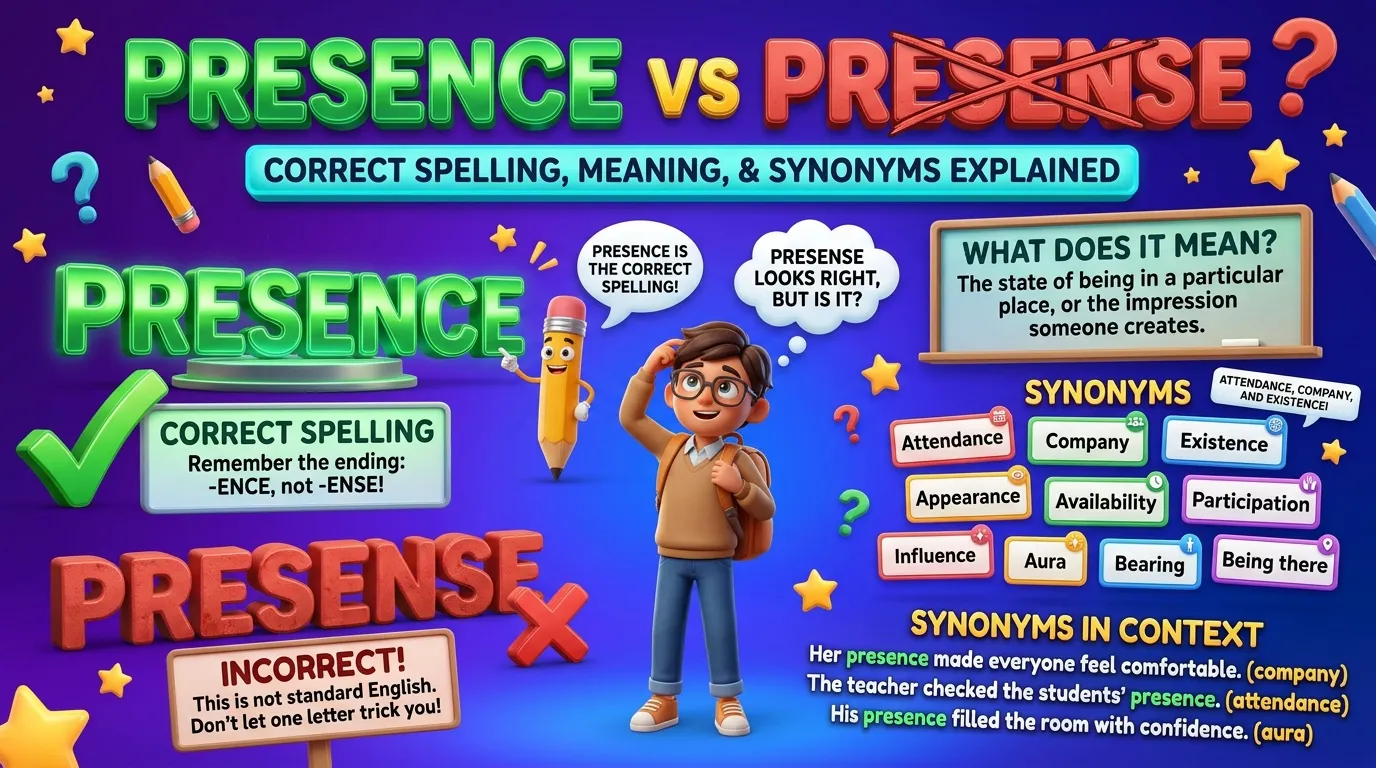
Presence vs Presense Synonym
Since presence is the correct word, you should look for its synonyms rather than treating presense as a separate vocabulary word. The best synonym depends on the context in which you use it.
Here are some useful synonyms for presence:
Attendance: Being present at an event, meeting, or gathering.
Existence: The state of being real or existing.
Appearance: The act of arriving or becoming visible.
Availability: The state of being accessible or ready.
Company: The state of being with another person.
Proximity: The condition of being physically near someone or something.
Occupancy: The state of occupying a particular place.
Influence: The effect someone has on other people.
Aura: A distinctive atmosphere or quality associated with someone.
Bearing: The way someone carries or presents themselves.
Examples of synonyms in sentences:
Her attendance at the meeting was important.
The existence of ancient buildings attracts tourists.
His appearance surprised everyone.
Your company makes long journeys enjoyable.
Her aura makes her stand out in a crowd.
Not every synonym works in every sentence. For example, attendance is suitable for meetings, while aura describes someone’s distinctive personality or impression.
Presence vs Presense in a Sentence
The easiest way to understand the spelling difference is to see how the correct word works in everyday sentences.
Correct sentences using presence:
Your presence makes this celebration more special.
The teacher appreciated everyone’s presence in class.
His presence brought confidence to the entire team.
I noticed her presence at the family gathering.
The manager requested my presence at the office.
The presence of flowers made the room look beautiful.
Incorrect sentences using presense:
Your presense makes this celebration more special.
The teacher appreciated everyone’s presense in class.
His presense brought confidence to the entire team.
In each incorrect example, replace presense with presence. The meaning remains unchanged, but the spelling becomes correct.
Presence vs Presense Examples
Here are additional examples that show how to use presence naturally in different situations.
Everyday conversation:
I enjoy your presence because you always make me smile.
Her presence makes the house feel lively.
We missed your presence at dinner.
Professional communication:
Your presence is required at tomorrow’s meeting.
The director requested the presence of all department heads.
His professional presence impressed the interview panel.
Academic writing:
The presence of several errors affected the final result.
Researchers discovered the presence of harmful substances.
The presence of students improved classroom participation.
Social situations:
Her presence made the wedding unforgettable.
Everyone appreciated his presence at the celebration.
I feel peaceful in the presence of my family.
These examples show that presence can describe someone’s attendance, physical existence, or influence in a particular situation.
Presence Spelling UK: Is There a British English Difference?
The spelling presence is correct in both British and American English. There is no regional spelling variation between the two forms.
English variety | |
|---|---|
British English | Presence |
American English | Presence |
Australian English | Presence |
Canadian English | Presence |
Unlike words such as colour and color or centre and center, presence does not change its spelling across these English varieties.
Therefore, whether you are writing for a British or American audience, always use presence.
Presence Correct Spelling: How Do You Remember It?
The correct spelling is P-R-E-S-E-N-C-E (presence).
A common mistake is writing presense because the ending sounds similar when spoken. However, the word ends with -ence, not -ense.
A simple way to remember it is to associate presence with present. Both words share the same spelling pattern at the beginning:
Present
Presence
Presentation
Example: I am happy with your presence at the event.
Remember this spelling whenever you write about someone’s attendance, existence, or influence. If you are unsure, choose presence rather than presense.
Your Presence Meaning: What Does It Mean?
Your presence means that you are physically or socially present somewhere, or that your personality and influence make a noticeable difference to others.
The exact meaning depends on the context. It can express appreciation, affection, importance, or simply someone’s attendance.
For example, when someone says, “Your presence means a lot to me,” they are expressing that having you around is valuable and meaningful.
Here are some common uses:
Your presence is important: Your attendance or participation matters.
Your presence makes me happy: Having you around brings happiness.
Thank you for your presence: Thank you for attending or being there.
I miss your presence: I miss having you around.
Your presence brings peace: Your company or personality creates a peaceful feeling.
In your presence: When you are nearby or with someone.
The expression your presence is often used in invitations, appreciation messages, personal conversations, and formal communication.
Real-World Usage Scenarios
Example 1
❌ The teacher’s presense controlled the classroom.
✅ The teacher’s presence controlled the classroom.
🎯 Lesson: Influence or authority is expressed as presence.
Example 2
❌ There was a heavy police presense at the event.
✅ There was a heavy police presence at the event.
🎯 Lesson: Security deployment uses presence.
Example 3
Friend: Why was everyone so quiet?
Friend: Because her presence was intimidating.
🎯 Lesson: Emotional impact = presence.
Example 4
❌ The presense of water was detected.
✅ The presence of water was detected.
🎯 Lesson: Scientific or factual existence uses presence.
Example 5
❌ He has a strong stage presense.
✅ He has a strong stage presence.
🎯 Lesson: Performance impact is called stage presence.
Common Mistakes People Make
Mistake 1: Using -ense Instead of -ence
Incorrect:
- Presense
Correct:
- Presence
Why It Happens
Words like “sense” and “defense” confuse learners into thinking the same pattern applies.
Mistake 2: Phonetic Spelling Errors
Incorrect:
- Presense (based on sound)
Correct:
- Presence (correct orthography)
Why It Happens
English spelling does not always match pronunciation.
Mistake 3: Using Presense in Formal Writing
Incorrect:
- The presense of experts improved the discussion.
Correct:
- The presence of experts improved the discussion.
Why It Matters
Spelling errors reduce clarity and professionalism.
Memory Tricks to Remember the Difference
Trick 1: Think of “Presence = Present”
Presence comes from the idea of being “present.”
So remember:
Presence = Present + -ce
Trick 2: Visual Pattern
Correct:
Presence
Incorrect:
Presense
Always end with -ence, not -ense.
Trick 3: Compare with Similar Words
- Presence
- Experience
- Confidence
All end in -ence.
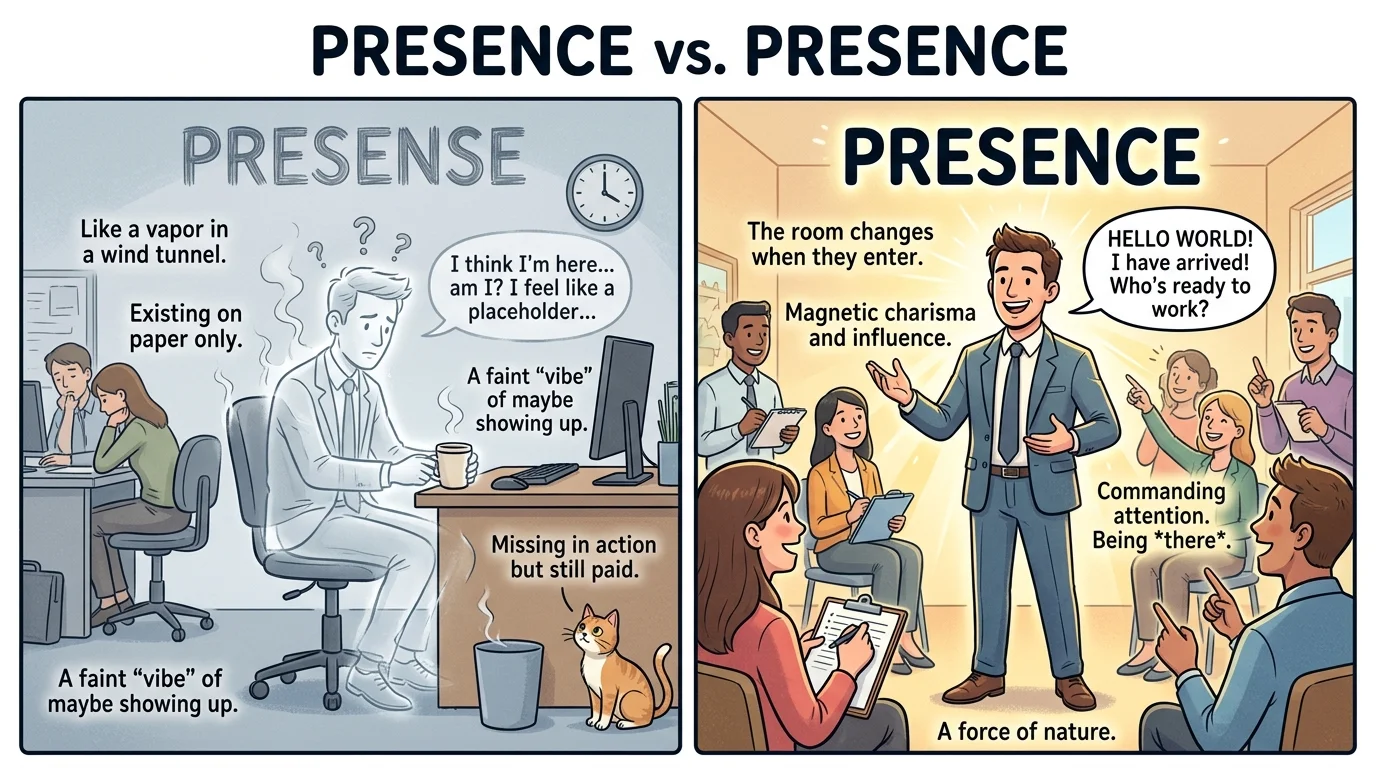
Expert Insight: Why “Presence” Uses -ence
The word presence comes from Latin roots related to “being in front of” or “existing in a place.”
Many English words derived from Latin use the suffix -ence, especially nouns that describe states or conditions.
Examples include:
- Presence
- Difference
- Importance
- Independence
Because of this linguistic origin, presence is standardized with -ence, and presense is not recognized in modern English.