
Quick Answer
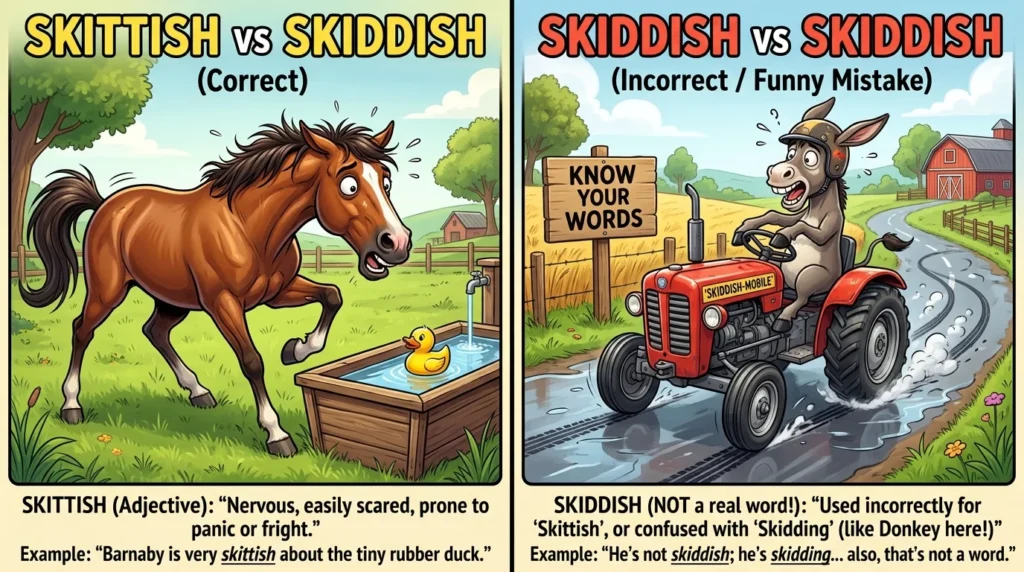
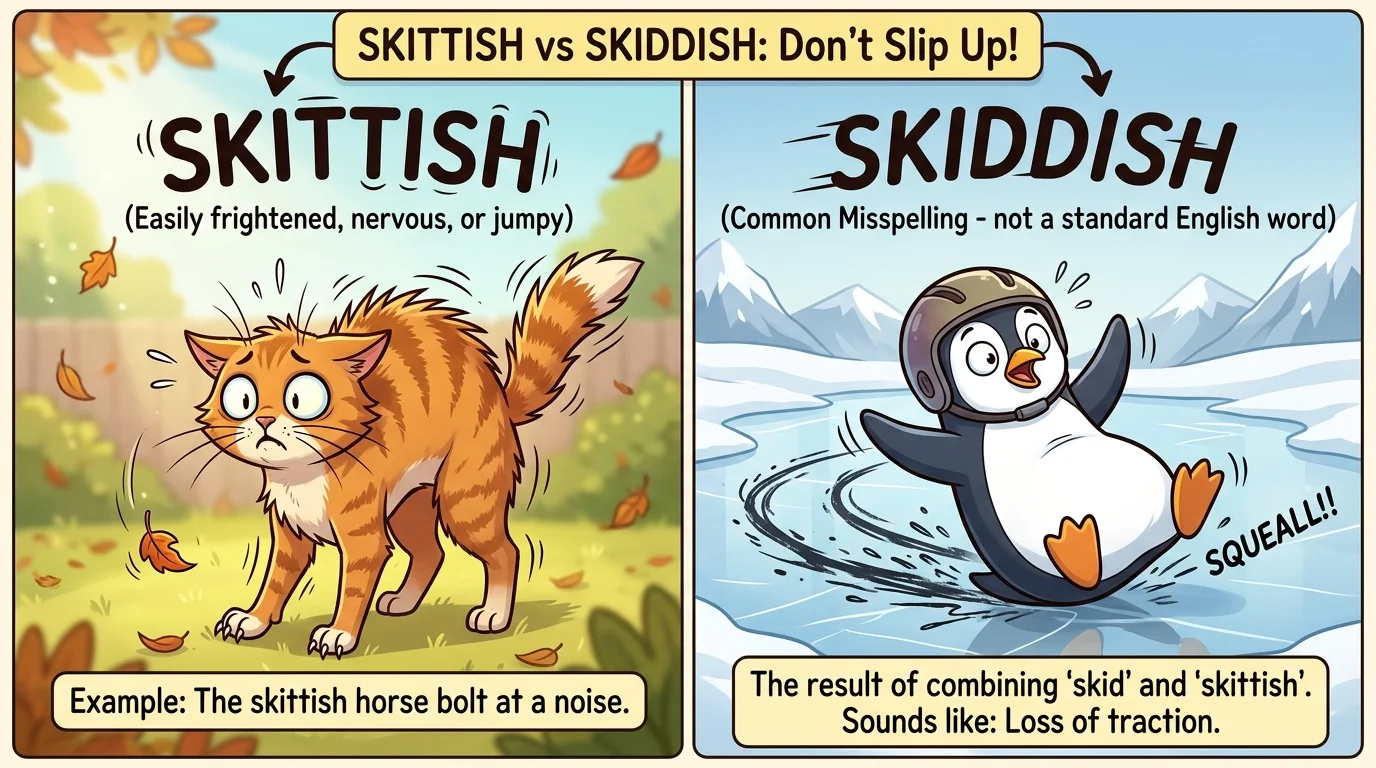
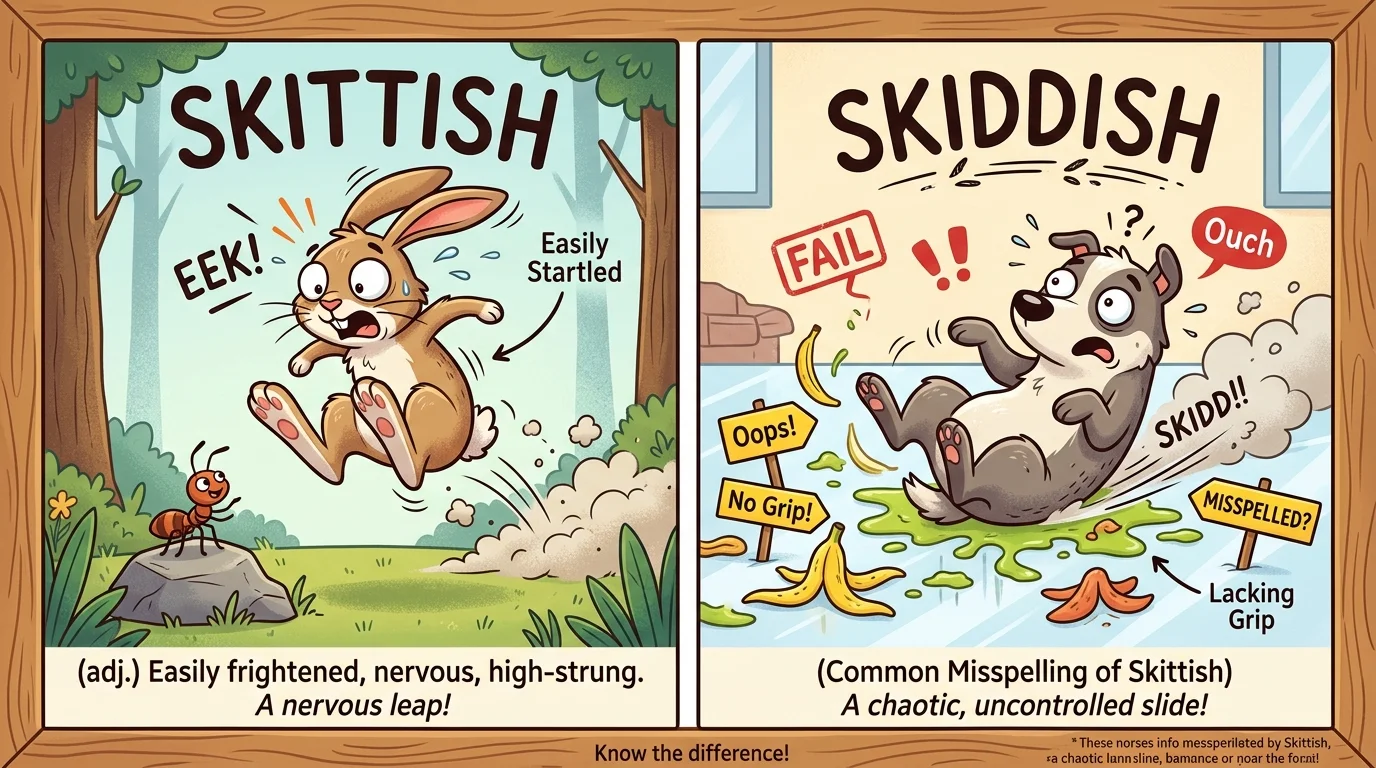
Skittish is the correct English word. It means easily frightened, nervous, jumpy, or reluctant to commit.
Skiddish is not recognized as a standard English word and is usually considered a misspelling of skittish.
If you’re writing in professional, academic, or standard English, use skittish.
What Does “Skiddish” Mean?
Definition
Skiddish is a nonstandard spelling that some people use when they mean skittish.
It appears occasionally in:
- Informal speech
- Social media posts
- Online comments
- Regional dialects
However, most dictionaries do not recognize it as the standard spelling.
Usage Rules
There are no official grammar rules for skiddish because it is not considered standard English.
Examples
Incorrect examples:
- ❌ The horse seemed skiddish around strangers.
- ❌ She became skiddish after the incident.
- ❌ Investors were skiddish about the market.
Correct versions:
- ✅ The horse seemed skittish around strangers.
- ✅ She became skittish after the incident.
- ✅ Investors were skittish about the market.
Key Insight
In formal writing, skiddish should almost always be replaced with skittish.
What Does “Skittish” Mean?
Definition
Skittish is an adjective that describes someone or something that is:
- Easily frightened
- Nervous or jumpy
- Easily startled
- Hesitant or reluctant
- Unpredictable due to nervousness
Usage Rules
Use skittish when referring to:
- Horses and animals
- Nervous people
- Uncertain investors
- Cautious buyers
- Situations involving anxiety or hesitation
Examples
- The horse became skittish during the storm.
- She felt skittish about making a large investment.
- The dog was skittish around unfamiliar people.
- Consumers remained skittish despite lower prices.
- He appeared skittish during the interview.
Key Insight
Skittish is widely used in everyday conversation, journalism, business reporting, and literature.
Skiddish vs Skittish: Key Differences
Bullet Point Differences
- Skittish is the correct spelling.
- Skiddish is a nonstandard spelling.
- Skittish appears in dictionaries.
- Skiddish is usually considered a misspelling.
- Skittish is accepted in professional writing.
- Skiddish should generally be avoided.
Comparison Table
| Feature | Skiddish | Skittish |
|---|---|---|
| Standard English Word | No | Yes |
| Dictionary Recognition | Limited | Yes |
| Professional Writing | Incorrect | Correct |
| Meaning | Informal variant | Nervous or easily frightened |
| Academic Usage | Avoid | Recommended |
| Example | Skiddish horse | Skittish horse |
Real-World Usage Scenarios
Scenario 1
❌ The horse became skiddish during the parade.
✅ The horse became skittish during the parade.
🎯 Lesson: Animals that are easily startled are described as skittish.
Scenario 2
❌ Investors are feeling skiddish about the economy.
✅ Investors are feeling skittish about the economy.
🎯 Lesson: Financial news commonly uses skittish to describe uncertainty.
Scenario 3
❌ She seemed skiddish after hearing the noise.
✅ She seemed skittish after hearing the noise.
🎯 Lesson: Use skittish when describing nervous reactions.
Scenario 4
❌ The puppy was skiddish around visitors.
✅ The puppy was skittish around visitors.
🎯 Lesson: The standard spelling is always skittish.
Scenario 5
❌ Buyers became skiddish as prices increased.
✅ Buyers became skittish as prices increased.
🎯 Lesson: Business and economic writing favor skittish.
Common Mistakes
Mistake 1: Spelling the Word Based on Pronunciation
Many people write skiddish because that’s how the word sounds to them.
Why It Happens
The pronunciation can make the middle consonants difficult to distinguish.
Correction
Remember that the dictionary spelling is skittish.
Mistake 2: Assuming Skiddish Is an Accepted Variant
Some writers believe both spellings are equally correct.
Why It Happens
Nonstandard spellings often spread through social media and casual conversation.
Correction
Use skittish in all formal and professional contexts.
Mistake 3: Copying Informal Online Usage
Writers sometimes adopt spellings they frequently see online.
Why It Happens
Internet language often ignores standard spelling rules.
Correction
Follow dictionary-recognized spelling when writing professionally.
Memory Tricks
Trick 1
Think:
Skittish = Jitters
Both words relate to nervousness.
Trick 2
Remember:
A skittish horse might “skip” around nervously.
The double “t” can remind you of quick, jumpy movements.
Trick 3
If you’re describing someone nervous or easily startled, choose the spelling with two t’s:
Skittish
Expert Insight
The word skittish has been part of English for centuries and is traditionally associated with nervous horses that react quickly to unexpected sights or sounds. Over time, its meaning expanded to include people, investors, consumers, and anyone showing signs of hesitation or anxiety.
The spelling skiddish emerged largely through spoken-language influence. Because many people hear the word before seeing it written, they attempt to spell it phonetically. However, dictionaries, editors, educators, and style guides overwhelmingly recognize skittish as the standard form.