
Quick Answer
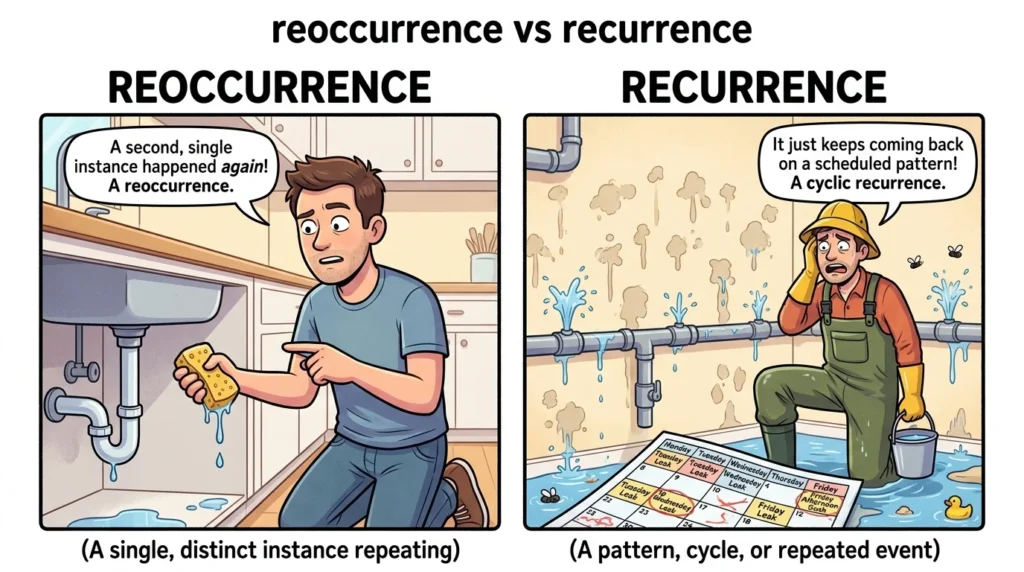
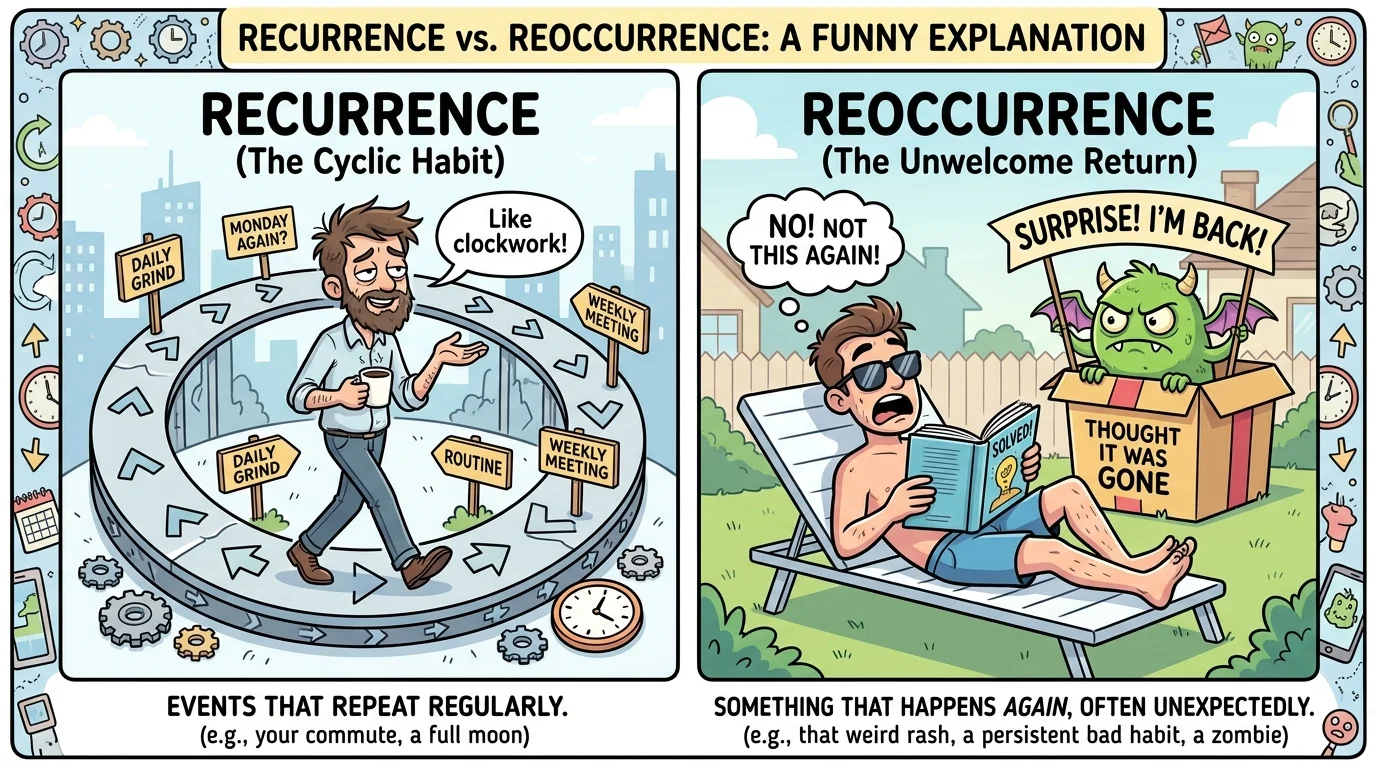
Both reoccurrence and recurrence are correct English words that describe something happening again.
However, recurrence is the preferred and more widely accepted term in most contexts, especially in medicine, science, business, and formal writing.
If you’re unsure which word to use, choose recurrence.
What Does “Reoccurrence” Mean?
Definition
Reoccurrence refers to something occurring again after it has happened before.
The word emphasizes the idea of an event literally “occurring again.”
Usage Rules
Use reoccurrence when you want to highlight:
- A repeated event
- Something happening again
- A second or subsequent occurrence
Examples
- The reoccurrence of technical issues frustrated customers.
- Researchers studied the reoccurrence of the phenomenon.
- The reoccurrence of flooding caused concern among residents.
Key Insight
While correct, reoccurrence is less common than recurrence and may sound more formal or repetitive to some readers.
What Does “Recurrence” Mean?
Definition
Recurrence refers to the return, repetition, or happening again of an event, condition, problem, or situation.
Usage Rules
Use recurrence when discussing:
- Medical conditions
- Repeated events
- Returning problems
- Cyclical situations
- Statistical or scientific observations
Examples
- Doctors monitored the recurrence of the disease.
- The recurrence of power outages affected the community.
- Measures were taken to prevent the recurrence of the error.
- The recurrence of drought remains a serious concern.
Key Insight
Recurrence is the preferred term in most dictionaries, style guides, and professional publications.
Reoccurrence vs Recurrence: Key Differences
Bullet Point Differences
- Both words are grammatically correct.
- Both describe something happening again.
- Recurrence is much more common.
- Recurrence is preferred in formal writing.
- Reoccurrence emphasizes the idea of occurring again.
- Most professionals choose recurrence for clarity and simplicity.
Comparison Table
| Feature | Reoccurrence | Recurrence |
|---|---|---|
| Valid English Word | Yes | Yes |
| Meaning | Occurring again | Returning or happening again |
| Frequency of Use | Less Common | More Common |
| Professional Writing | Acceptable | Preferred |
| Medical Usage | Rare | Very Common |
| Example | Reoccurrence of issues | Recurrence of issues |
Recurrence or Reoccurrence Cancer
When discussing cancer returning after treatment or a period of improvement, “cancer recurrence” is the standard and preferred medical expression.
Cancer recurrence means that cancer has returned after treatment and a period when it could no longer be detected or was under control. It may return in the same location, near the original site, or in another part of the body.
For example:
The patient is undergoing regular checkups to monitor cancer recurrence.
The doctor explained the possible risk of breast cancer recurrence.
Early follow-up appointments help monitor for signs of recurrence.
The family was concerned about the possibility of cancer returning.
The research examined factors associated with cancer recurrence.
Although cancer reoccurrence is understandable, it is less conventional in medical writing. Doctors, researchers, and healthcare professionals generally use recurrence when describing cancer that returns.
It is also important to distinguish cancer recurrence from a new primary cancer. Recurrence refers to the return of the original cancer, whereas a new primary cancer is a separate cancer that develops independently.
The exact meaning and medical classification depend on the patient’s diagnosis and clinical findings. These terms describe medical concepts, not a prediction that cancer will return.
Reoccurrence vs. Recurrence vs. Reoccurring
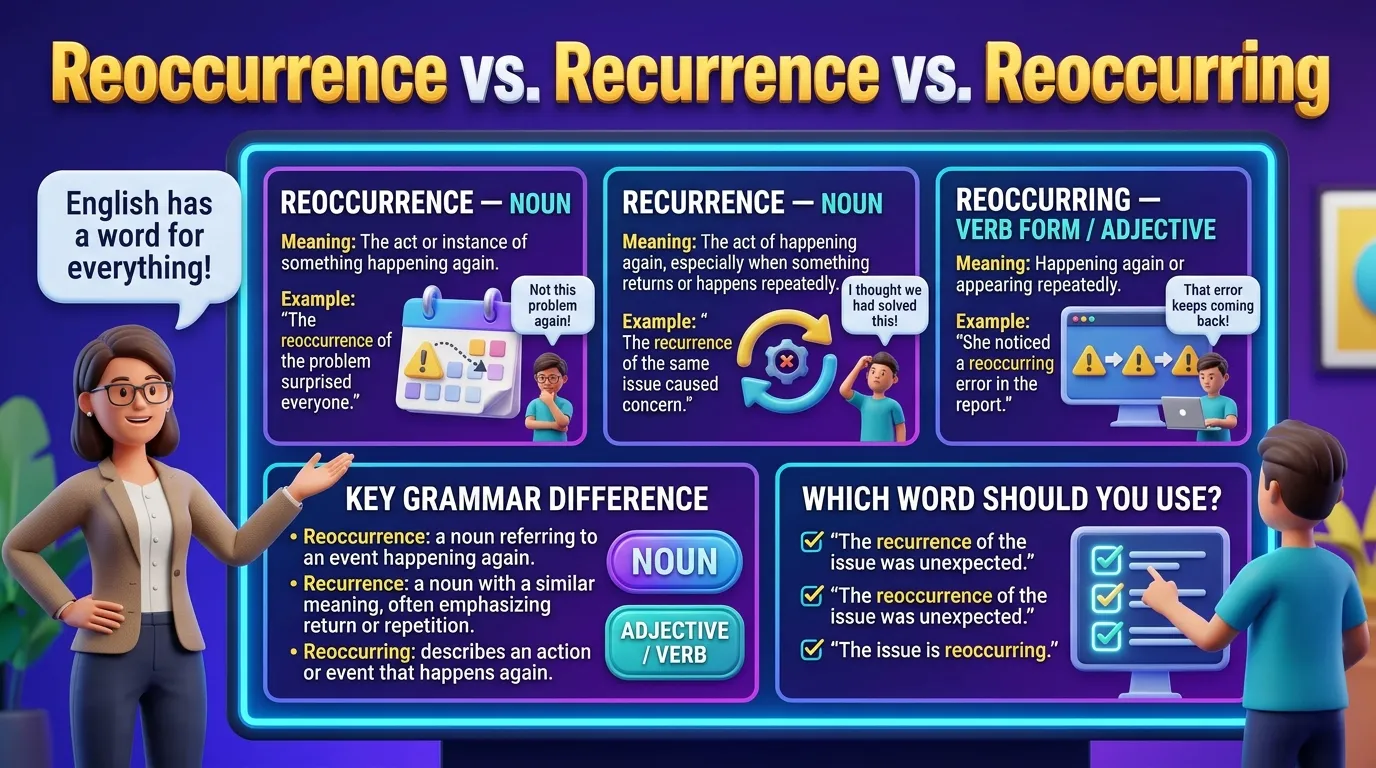
These three terms are related because they describe something happening again, but they have different grammatical functions.
Recurrence is a noun that describes the return or repetition of something. It is commonly used in formal, medical, and professional writing.
Reoccurrence is also a noun. It describes something happening again, often emphasizing another occurrence of an earlier event.
Reoccurring is an adjective or the present participle of the verb reoccur. It describes something that happens repeatedly or happens again.
Examples:
Recurrence: The recurrence of the problem affected the entire department.
Reoccurrence: The team developed a new system to prevent the reoccurrence of errors.
Reoccurring: We continue to experience a reoccurring problem with the software.
Here are a few more examples:
The recurrence of headaches concerned the patient.
The reoccurrence of the error delayed the project.
A reoccurring issue needs to be investigated.
One useful distinction is that recurrence and reoccurrence name an event, while reoccurring describes an event or situation that happens again.
Also, do not confuse reoccurring with recurring. Both are correct forms, but recurring is generally more common and often the more natural choice.
Reoccurrence vs. Recurrence Reddit
When people discuss the difference between recurrence and reoccurrence in English-language discussions, the main question is usually whether both words are grammatically correct or whether one is preferable.
The answer is that both are correct, but recurrence is generally more common and preferred in formal English.
For example, someone writing about a medical condition would normally choose recurrence. Someone describing an event happening another time could use reoccurrence, although recurrence would often sound more natural.
Consider these sentences:
The recurrence of the issue surprised everyone.
The reoccurrence of the issue surprised everyone.
Both sentences communicate that the issue happened again. However, the first is generally the more concise and conventional choice.
In everyday writing, readers will understand both words. The choice usually comes down to context, established terminology, and natural usage rather than a strict grammatical rule.
Reoccurrence vs. Recurrence Examples
The easiest way to understand these words is to compare them in similar sentences. Both can describe the return of an earlier event, situation, or problem.
Examples using recurrence:
The recurrence of the disease required further medical evaluation.
The company investigated the recurrence of technical errors.
Regular inspections can help reduce the recurrence of equipment failures.
The recurrence of heavy rainfall caused flooding in the area.
Researchers studied the recurrence of symptoms among participants.
The recurrence of the same mistake affected the team’s performance.
The doctor discussed the risk of cancer recurrence.
The recurrence of an old memory brought back childhood feelings.
Examples using reoccurrence:
The company introduced new procedures to prevent the reoccurrence of errors.
The reoccurrence of the problem caused another delay.
The manager wanted to avoid the reoccurrence of the same situation.
Regular maintenance may reduce the reoccurrence of equipment problems.
The reoccurrence of the power failure affected nearby businesses.
The team investigated the reoccurrence of the technical issue.
Everyone hoped for no reoccurrence of the disagreement.
The reoccurrence of the event surprised the organizers.
Notice that both words can fit similar contexts. However, recurrence is generally more established and natural, particularly in formal writing.
Reoccurrence vs. Recurrence Synonym
Recurrence and reoccurrence share several synonyms because both describe something happening again. However, the best alternative depends on the sentence and the meaning you want to communicate.
Here are some useful synonyms:
Synonym | Meaning |
|---|---|
Repetition | Something happening or being done again |
Return | Something coming back after being absent |
Renewal | Something beginning or becoming active again |
Resurgence | A renewed increase or return of something |
Revival | Something becoming active or popular again |
Reappearance | Something becoming visible or present again |
Repetition of an event | Another occurrence of an earlier event |
Comeback | An informal return after an absence |
Examples in sentences:
The repetition of the same error caused frustration.
The return of the symptoms concerned the patient.
The resurgence of the disease raised public health concerns.
The reappearance of the problem surprised the team.
The revival of the old tradition brought the community together.
Not every synonym works in every situation. For example, resurgence often suggests an increase in activity or intensity, while return is a simpler and broader alternative.
For medical writing, recurrence is usually preferable to replacing it with a general synonym.
Recurrence or Reoccurrence UK
In British English, both recurrence and reoccurrence are recognized and correctly spelled words. There is no major British-versus-American spelling difference between them.
However, recurrence is generally the more common and conventional choice in British English, particularly in medical, academic, and professional writing.
Examples:
The doctor discussed the risk of cancer recurrence.
The recurrence of the problem affected the project.
The researchers examined the recurrence of certain symptoms.
The organisation introduced measures to prevent the reoccurrence of the issue.
You may encounter reoccurrence in British publications, but that does not make it the preferred choice.
One important point is that British English commonly uses spellings such as organisation and behaviour, while American English uses organization and behavior. This spelling difference does not apply to recurrence or reoccurrence.
If you are writing for a British audience, you can confidently use recurrence when discussing a returning medical condition, repeated problem, or recurring event.
Recurrence vs. Relapse
“Recurrence” and “relapse” are related terms, particularly in medical contexts, but they do not always mean the same thing. Both can describe a condition returning, yet they emphasize different aspects of the situation.
Recurrence generally means that a disease, condition, or problem has returned after a period when it was absent, controlled, or undetectable.
Relapse usually refers to a return or worsening of a disease or its symptoms after a period of improvement or remission.
For example, cancer recurrence describes cancer returning after treatment. Relapse is also used in some medical contexts, but its meaning depends on the particular disease and clinical terminology.
Examples of recurrence:
The patient underwent regular monitoring for cancer recurrence.
The doctor explained the possibility of disease recurrence.
The recurrence of the infection required additional treatment.
Researchers investigated factors associated with cancer recurrence.
Examples of relapse:
The patient experienced a relapse after several months of remission.
The doctor monitored the patient for signs of relapse.
The disease went into remission, but the patient later experienced a relapse.
The treatment plan aimed to reduce the risk of relapse.
The main distinction is that recurrence emphasizes the return of a condition, while relapse often emphasizes a return after improvement or remission.
In cancer-related discussions, the terminology can overlap, but recurrence is the standard general term for cancer returning. The appropriate term depends on the specific disease and medical context.
Real-World Usage Scenarios
Scenario 1
✅ The reoccurrence of system failures worried engineers.
✅ The recurrence of system failures worried engineers.
🎯 Lesson: Both are correct, but recurrence sounds more natural.
Scenario 2
✅ Doctors monitored the recurrence of cancer.
❌ Doctors monitored the reoccurrence of cancer. (Less common)
🎯 Lesson: Medical professionals overwhelmingly prefer recurrence.
Scenario 3
✅ The recurrence of customer complaints required attention.
🎯 Lesson: Business writing typically favors recurrence.
Scenario 4
✅ Scientists studied the reoccurrence of volcanic activity.
✅ Scientists studied the recurrence of volcanic activity.
🎯 Lesson: Both can work, though recurrence remains more common.
Scenario 5
✅ Preventing the recurrence of mistakes improves performance.
🎯 Lesson: Recurrence is often the smoother and more concise option.
Common Mistakes
Mistake 1: Assuming One Word Is Incorrect
Many people think reoccurrence is a misspelling.
Why It Happens
Recurrence is far more common and appears more frequently in dictionaries and publications.
Correction
Understand that both words are valid, though recurrence is generally preferred.
Mistake 2: Using Reoccurrence Excessively
Some writers believe the longer word sounds more formal.
Why It Happens
Longer words are sometimes perceived as more sophisticated.
Correction
Use recurrence unless you specifically want to emphasize the act of occurring again.
Mistake 3: Ignoring Industry Preferences
Different industries have established terminology.
Why It Happens
Writers may not realize that certain fields favor one term.
Correction
In medicine, science, law, and business, recurrence is usually the standard choice.
Memory Tricks
Trick 1
Think:
Recurrence = Recommended
Both start with R.
Trick 2
Remember:
Most professionals prefer recurrence.
When in doubt, choose recurrence.
Trick 3
If something returns repeatedly, think:
Recurring → Recurrence
This connection makes the preferred word easier to remember.
Expert Insight
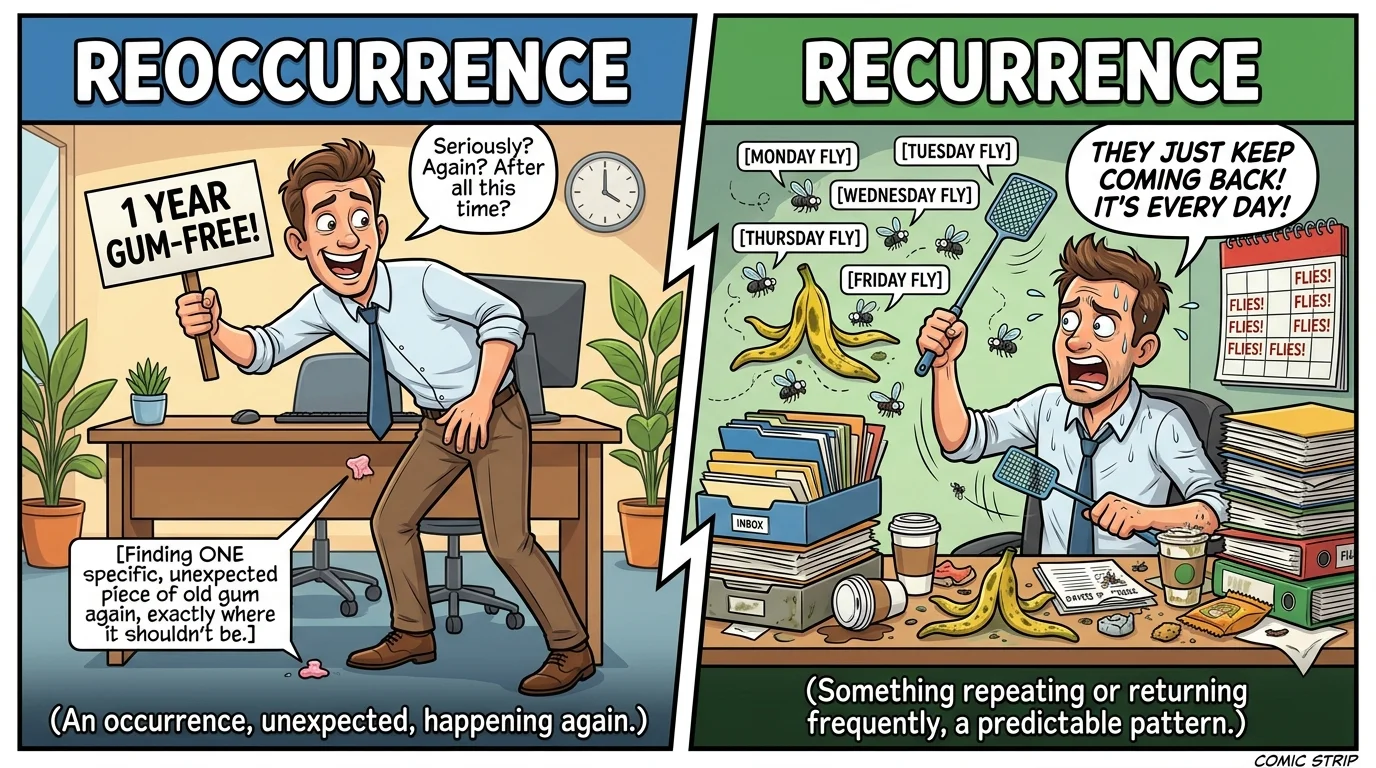
Although both words share similar meanings, usage patterns reveal an important distinction. Recurrence has become the dominant term across professional fields because it is shorter, more concise, and more widely recognized.
In medical literature, phrases such as “disease recurrence,” “cancer recurrence,” and “symptom recurrence” are standard. Similarly, business reports often refer to the recurrence of problems, errors, or trends.
The word reoccurrence remains grammatically correct, but its lower frequency means some readers may perceive it as awkward or unnecessarily wordy. As a result, editors frequently replace reoccurrence with recurrence for readability and consistency.