
Quick Answer
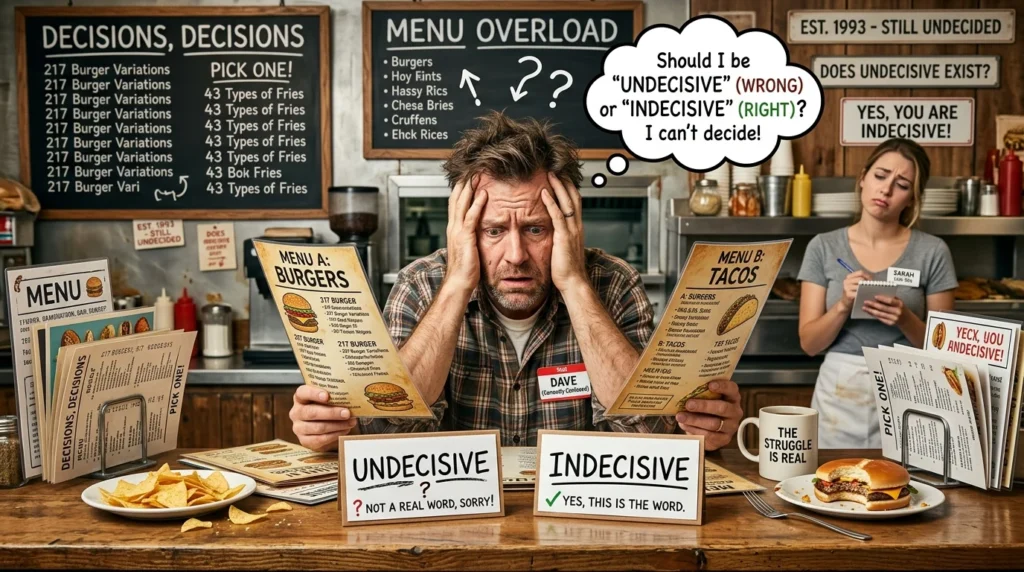
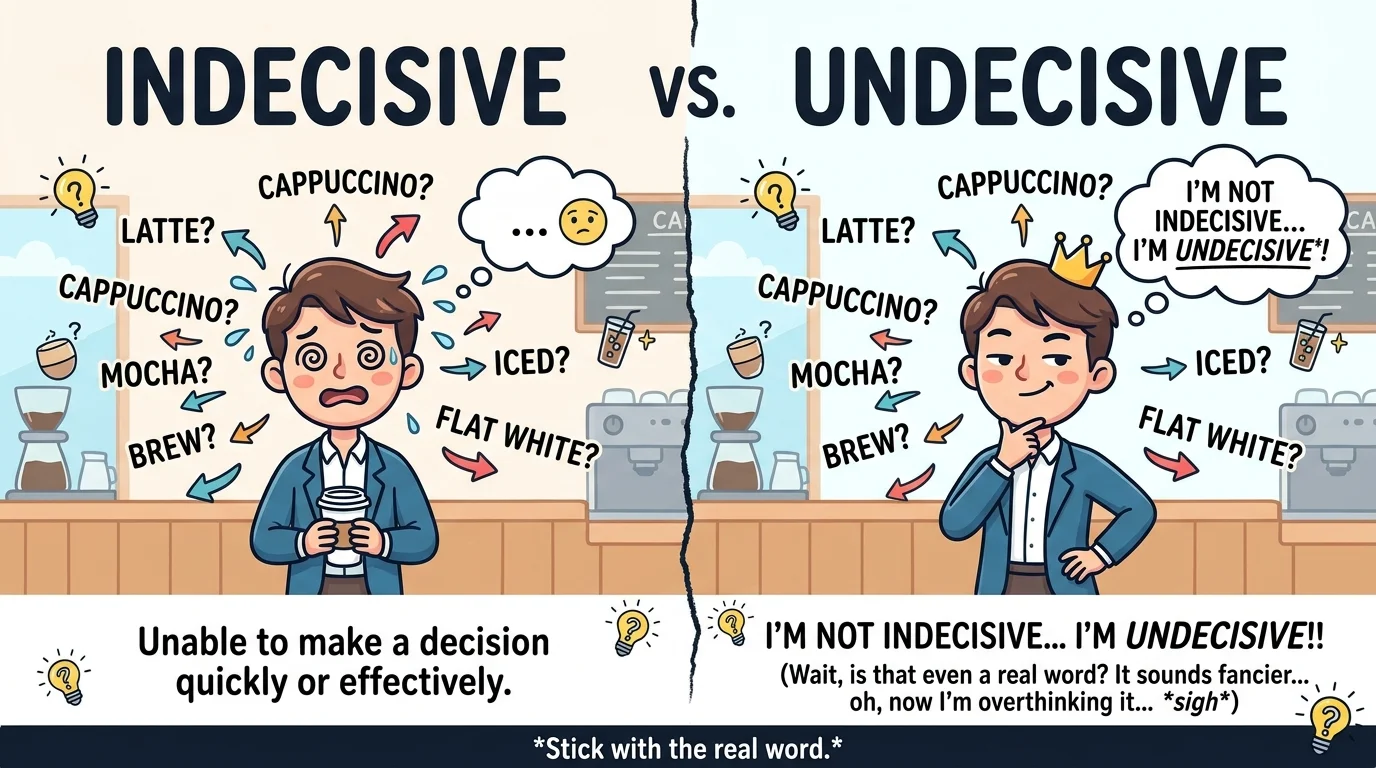
Indecisive is the correct and standard adjective. It describes someone who has difficulty making decisions or cannot choose between options.
Undecisive is generally considered nonstandard and should usually be avoided in formal writing.
Examples:
- Correct: She is very indecisive when choosing restaurants.
- Nonstandard: She is very undecisive when choosing restaurants.
Deep Explanation: Undecisive
Undecisive occasionally appears in informal speech and online writing, but it is not the preferred term in standard English.
Many dictionaries either do not include it or label it as nonstandard.
Why Do People Use “Undecisive”?
People often create or use undecisive because:
- Many English adjectives use the prefix un-, such as:
- Unhappy
- Unclear
- Uncertain
- It seems logical to form the opposite of decisive by adding un-.
However, English developed a different standard word: indecisive.
Examples of Nonstandard Usage
⚠️ She is undecisive about her career.
⚠️ He becomes undecisive under pressure.
⚠️ The committee seemed undecisive.
Although some people may understand these sentences, professional and academic writing almost always prefers indecisive.
Key Insight
Using undecisive may make your writing appear less polished because it is not the widely accepted standard form.
Deep Explanation: Indecisive
Indecisive is the correct and widely accepted adjective.
It describes a person who:
- Has difficulty making choices
- Changes their mind frequently
- Hesitates when making decisions
- Cannot easily commit to one option
Common Uses of Indecisive
Indecisive often describes:
- Personal decisions
- Career choices
- Purchasing decisions
- Leadership styles
- Group discussions
Correct Examples
✅ She is indecisive about which university to attend.
✅ He was too indecisive to choose a vacation destination.
✅ The manager appeared indecisive during the meeting.
Key Insight
Being indecisive does not necessarily mean someone lacks intelligence. It often means the person is carefully weighing multiple options or fears making the wrong choice.
Undecisive vs Indecisive: Key Differences
Quick Differences
- Indecisive is correct and standard.
- Undecisive is generally considered nonstandard.
- Indecisive is widely accepted in professional and academic writing.
- Undecisive may sound understandable but is rarely preferred.
| Feature | Undecisive | Indecisive |
|---|---|---|
| Meaning | Nonstandard alternative | Unable to make decisions easily |
| Grammar | Generally nonstandard | Correct and standard |
| Usage | Rare and informal | Standard English |
| Dictionary Recognition | Limited | Widely recognized |
| Example | She is undecisive. ⚠️ | She is indecisive. ✅ |
Real-World Usage Scenarios
Example 1
Person A: Where should we eat?
Person B: I don’t know. I’m so indecisive.
🎯 Lesson: Use indecisive when someone struggles to make choices.
Example 2
Manager:
The team’s indecisive leadership delayed the project.
🎯 Lesson: Indecisive commonly describes hesitant leadership.
Example 3
Student:
I’m indecisive about which major to choose.
🎯 Lesson: The word often appears in discussions about life decisions.
Example 4
Nonstandard:
She is undecisive about moving abroad.
Preferred:
She is indecisive about moving abroad.
🎯 Lesson: Standard English strongly favors indecisive.
Common Mistakes
Mistake 1: Assuming “Undecisive” Is the Standard Opposite
❌ He is undecisive.
✅ He is indecisive.
Why it happens: The prefix un- is extremely common in English.
Mistake 2: Using “Undecisive” in Professional Writing
❌ The candidate appeared undecisive.
✅ The candidate appeared indecisive.
Why it happens: The spelling looks logical, so writers assume it is correct.
Mistake 3: Thinking Indecisive Means Unintelligent
❌ Indecisive people are unintelligent.
✅ Indecisive people may simply need more time or information before deciding.
Why it happens: Hesitation is often mistaken for incompetence.
Memory Tricks
Remember this simple phrase:
Indecisive people can’t decide.
Notice the connection:
- Inability to decide
- Indecisive
Another easy trick:
Think of the prefix in- as meaning not.
Indecisive = Not decisive
This makes the correct spelling easier to remember.
Expert Insight
The adjective indecisive comes from the noun decision and the adjective decisive, both of which trace back to Latin roots related to cutting off possibilities and settling on a choice.
English adopted indecisive as the standard opposite of decisive, even though the prefix un- might seem equally logical.
Because language evolves through usage rather than strict logic, dictionaries, educational institutions, publishers, and professional style guides overwhelmingly recognize indecisive as the preferred form.
While undecisive occasionally appears in informal writing, it remains uncommon and is generally avoided in standard English.