
Quick Answer: Inclusivity vs. Inclusiveness
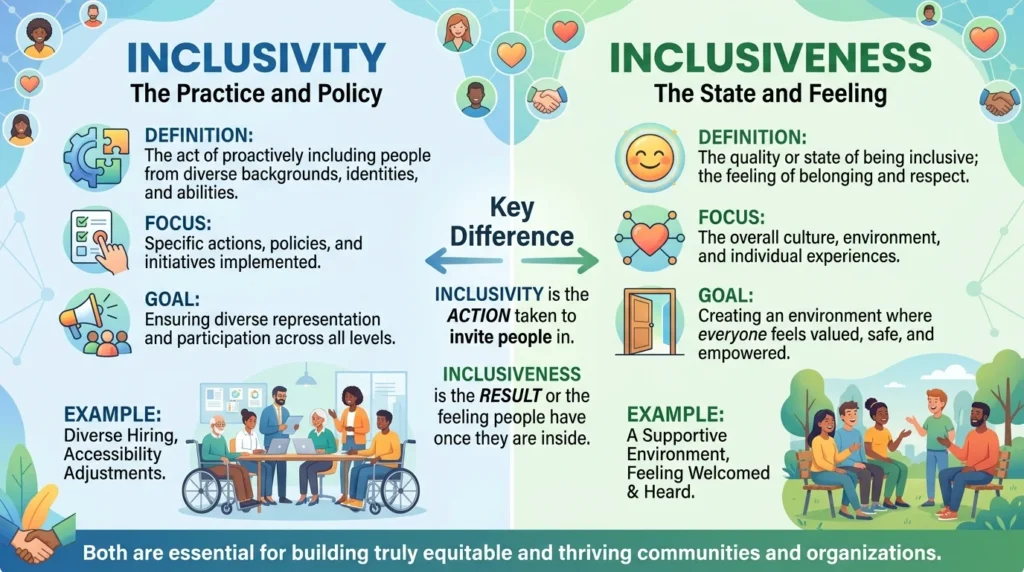
Inclusivity means the practice, policy, or active quality of including people who might otherwise be excluded.
Inclusiveness means the quality or characteristic of being inclusive and welcoming to different people or groups.
The easiest rule
Inclusivity = inclusion as a practice or principle
Inclusiveness = the quality of being inclusive
In many contexts, they are interchangeable, but inclusivity is especially common in modern discussions about workplaces, education, society, accessibility, and diversity.
What Does “Inclusivity” Mean?
Inclusivity is a noun meaning the practice or principle of including people and ensuring that different groups can participate or feel represented.
It is especially common in modern discussions about:
- Diversity
- Equality
- Accessibility
- Education
- Workplaces
- Public policy
- Culture
- Representation
Examples
The company has made inclusivity a central part of its workplace policies.
The school promotes inclusivity by making activities accessible to all students.
Inclusivity should be considered when designing public spaces.
The organization is committed to greater inclusivity.
🎯 Key Insight: Inclusivity often focuses on what an organization, community, or system does to include people.
What Does “Inclusiveness” Mean?
Inclusiveness means the quality or state of being inclusive.
It describes how welcoming, open, or accommodating something is toward different people or perspectives.
Examples
The inclusiveness of the program attracted participants from different backgrounds.
The inclusiveness of the community made newcomers feel welcome.
We were impressed by the inclusiveness of the discussion.
The policy was praised for its inclusiveness.
🎯 Key Insight: Inclusiveness often describes a characteristic or quality.
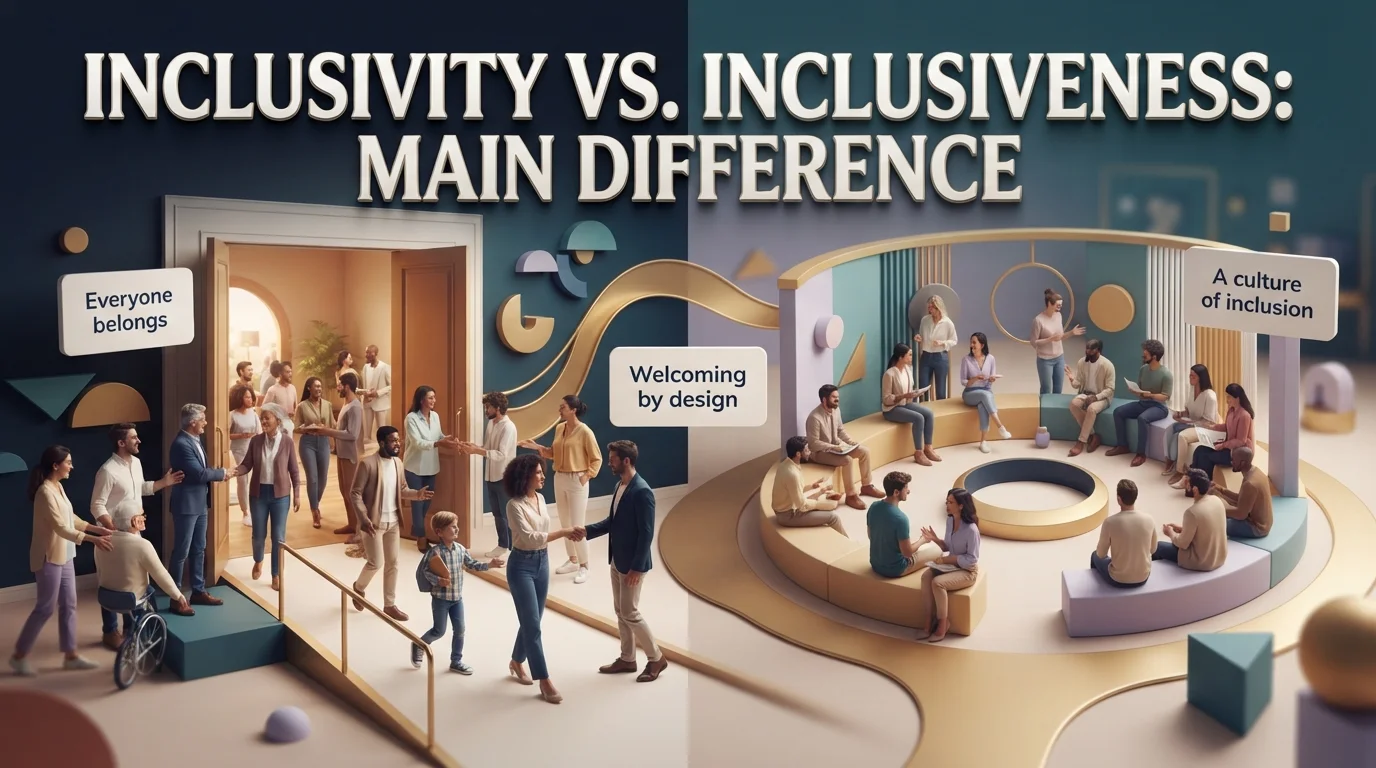
Inclusivity vs. Inclusiveness: Main Difference
| Feature | Inclusivity | Inclusiveness |
|---|---|---|
| Basic meaning | Practice or principle of including people | Quality or state of being inclusive |
| Main emphasis | Active inclusion | Characteristic of being inclusive |
| Common context | Policies, organizations, initiatives, social issues | Describing people, environments, policies, or qualities |
| Tone | Modern, institutional, policy-oriented | Descriptive, general, sometimes more traditional |
| Example | The company promotes inclusivity. | The company’s inclusiveness is admirable. |
| Memory clue | Inclusion in action | Quality of being inclusive |
Bottom Line
Inclusivity emphasizes inclusion as a practice or goal.
Inclusiveness emphasizes the quality of being inclusive.
The difference is often subtle rather than absolute.
Inclusivity in the Workplace
Inclusivity is particularly common in workplace and organizational language.
Examples
The company is developing new strategies to improve inclusivity.
Inclusivity is an important part of our hiring process.
The organization has created an inclusivity training program.
Here, inclusivity refers to a deliberate organizational goal or practice.
Why “Inclusivity” Sounds Natural Here
Workplace language often discusses inclusion as something that organizations can:
- Promote
- Improve
- Measure
- Encourage
- Build
- Strengthen
For example:
The company wants to improve inclusivity in leadership.
This sounds very natural in modern professional English.
🎯 Lesson: Use inclusivity when discussing initiatives, goals, policies, or efforts to include people.
Inclusiveness as a Quality
Inclusiveness is often used when describing how inclusive something is.
Examples
The inclusiveness of the classroom encouraged students to participate.
The inclusiveness of the policy was widely praised.
The group’s inclusiveness made everyone feel comfortable.
Here, the word functions much like:
openness
fairness
friendliness
accessibility
🎯 Lesson: Use inclusiveness when emphasizing the quality or characteristic of being inclusive.
Can Inclusivity and Inclusiveness Be Interchanged?
Often, yes.
Consider:
The organization values inclusivity.
and:
The organization values inclusiveness.
Both are grammatically correct.
However, inclusivity may sound more natural when discussing a deliberate principle, initiative, or organizational objective.
Meanwhile:
The inclusiveness of the organization was impressive.
sounds natural when describing a characteristic.
Compare
We need greater inclusivity in the workplace.
This sounds like a goal or objective.
The inclusiveness of the workplace impressed new employees.
This describes a characteristic of the workplace.
🎯 Key Insight: The difference is usually about emphasis and collocation, not a strict grammatical rule.
Inclusivity vs. Inclusiveness: Real-World Usage Scenarios
Scenario 1: Workplace Policy
The company introduced new policies to promote inclusivity.
The company is taking action to include people.
🎯 Lesson: Inclusivity works well for organizational goals and policies.
Scenario 2: Describing a Community
The inclusiveness of the community made visitors feel welcome.
The sentence describes a quality of the community.
🎯 Lesson: Inclusiveness naturally describes a characteristic.
Scenario 3: Education
The school is committed to inclusivity in the classroom.
This refers to an educational principle and practice.
🎯 Lesson: Inclusivity is common in institutional contexts.
Scenario 4: A Group’s Attitude
The inclusiveness of the group encouraged open discussion.
The focus is on the group’s welcoming quality.
🎯 Lesson: Inclusiveness works naturally when describing an existing characteristic.
Scenario 5: Accessibility
The organization is reviewing its website to improve inclusivity.
The goal is to make participation easier for a wider range of people.
🎯 Lesson: Inclusivity often appears when discussing deliberate improvements.
Common Mistakes With Inclusivity and Inclusiveness
Mistake 1: Thinking One Word Is Always Correct
It is not accurate to say that inclusivity is always correct and inclusiveness is always wrong.
Both are legitimate English nouns.
The better choice depends on context and intended emphasis.
Mistake 2: Assuming They Have Completely Different Meanings
Their meanings overlap significantly.
Inclusivity and inclusiveness both relate to the quality or practice of including people.
The distinction is mainly one of usage and emphasis.
Mistake 3: Using “Inclusiveness” for Every Policy Statement
This isn’t necessarily grammatically wrong, but modern professional English often favors inclusivity in expressions involving goals and initiatives.
Compare:
The company is committed to inclusivity. ✅
The company is committed to inclusiveness. ✅
Both work, but the first may sound more natural in contemporary organizational writing.
Mistake 4: Assuming “Inclusivity” Is Always More Modern
Inclusivity is especially common in contemporary institutional and social discussions, but inclusiveness remains standard and useful.
The choice should be based on clarity and natural phrasing, not simply on which word sounds newer.
Inclusivity vs. Inclusion
Another important distinction is between inclusivity and inclusion.
Inclusion
Inclusion is the broader and often more direct word for the act or process of including someone or something.
The policy promotes inclusion.
Inclusivity
Inclusivity emphasizes the quality or principle of being inclusive.
The policy promotes inclusivity.
Both can work, but inclusion is often simpler and more direct.
🎯 Expert Tip: If you’re unsure between inclusion and inclusivity, inclusion is frequently the clearer choice.
Inclusivity vs. Inclusiveness in Formal Writing
Both words are appropriate in formal English.
Use “Inclusivity” for:
- Organizational strategies
- Diversity initiatives
- Accessibility policies
- Workplace goals
- Educational programs
- Social policy
The university is committed to inclusivity.
Use “Inclusiveness” for:
- Describing a quality
- Evaluating an environment
- Describing a group’s character
- Discussing how welcoming something is
The inclusiveness of the university community is one of its strengths.
Memory Tricks: Inclusivity vs. Inclusiveness
🎯 Trick 1: Inclusivity = Initiative
Both words can be associated with an active goal:
Inclusivity → initiative
Think about organizations promoting or improving inclusivity.
🏠 Trick 2: Inclusiveness = Quality
Think:
Inclusiveness → the quality of being welcoming
For example:
The inclusiveness of the community impressed us.
⭐ One-Line Memory Trick
Inclusivity = inclusion as a goal or practice.
Inclusiveness = the quality of being inclusive.
Expert Insight: Why Both Words Exist
Both nouns are derived from inclusive, but their suffixes give them slightly different semantic tendencies.
The suffix -ity often forms nouns describing a quality, condition, or concept:
equality
accessibility
inclusivity
The suffix -ness commonly forms nouns referring to a state or quality:
kindness
openness
friendliness
inclusiveness
Because both suffixes can express qualities, their meanings naturally overlap.
This is why English speakers can use both inclusivity and inclusiveness without necessarily creating a grammatical error.
The distinction is primarily shaped by modern usage, collocation, and context.
Quick Test: Inclusivity or Inclusiveness?
1. The company is committed to greater ________.
Answer: inclusivity
This is a goal or organizational principle.
2. The ________ of the community impressed visitors.
Answer: inclusiveness
This describes a characteristic.
3. The school promotes ________ in the classroom.
Answer: inclusivity
This describes an educational principle or practice.
4. The ________ of the program makes it accessible to everyone.
Answer: inclusiveness
This describes the quality of the program.
5. The organization launched an ________ initiative.
Answer: inclusivity
This is a deliberate organizational initiative.
6. The policy was praised for its ________.
Answer: inclusiveness
This focuses on the policy’s quality, although inclusivity could also work depending on context.