

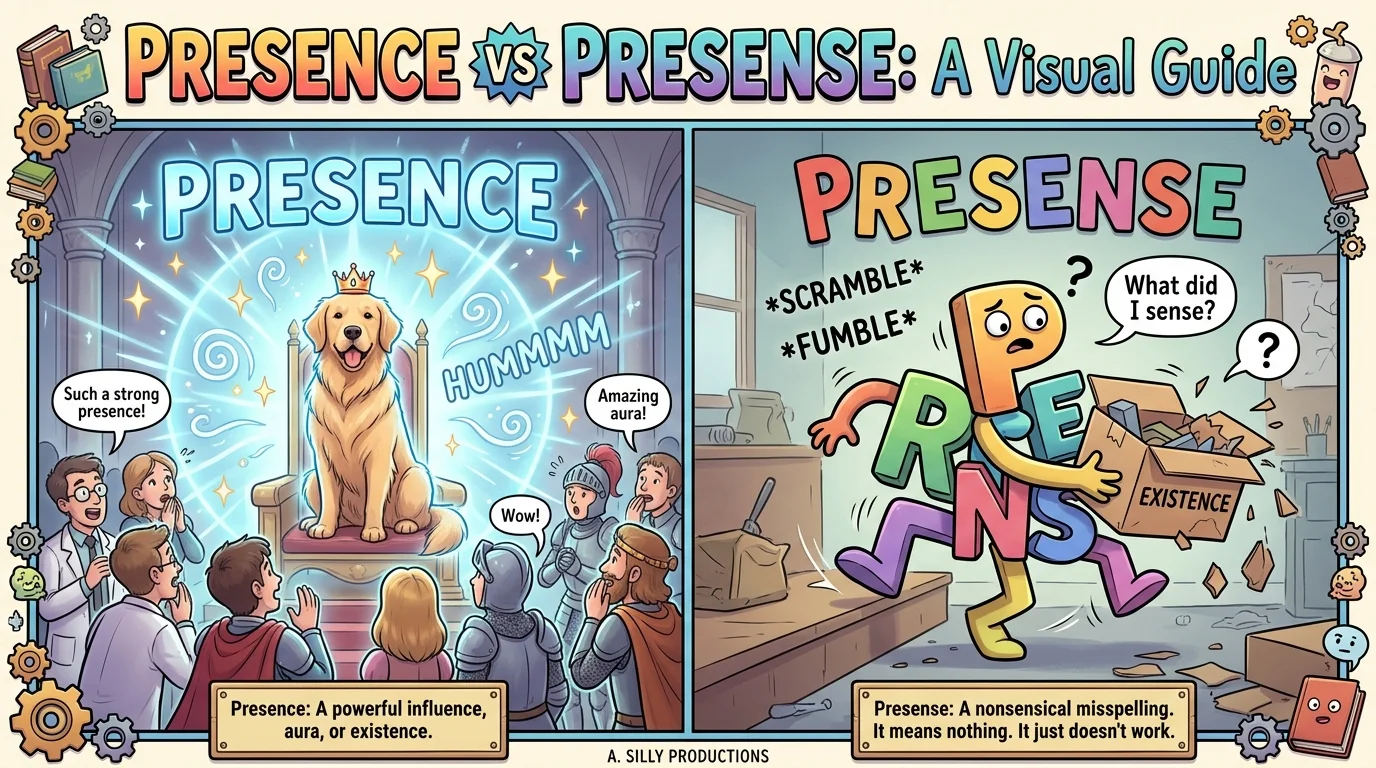
Quick Answer: Presence vs Presense
- Presence is the correct spelling.
- Presense is incorrect and should not be used.
Quick Examples
✅ Her presence changed the entire atmosphere of the room.
❌ Her presense changed the entire atmosphere of the room.
What Does “Presence” Mean?
Presence is a noun that refers to:
- Being physically in a place
- Influence or impact in a situation
- A noticeable quality or aura someone has
- The existence of something in a specific area
When to Use Presence
Use presence when talking about:
- Someone being in a room or location
- Strong personality or influence
- Awareness or existence of something
Examples
- His presence was felt immediately in the meeting.
- The teacher’s presence kept the class disciplined.
- Police presence increased in the area.
- She has a strong stage presence.
Key Insight
Whenever you mean “being there” or “influence felt,” the correct spelling is presence.
What Does “Presense” Mean?
Presense is not a recognized English word.
It is a common misspelling caused by phonetic confusion.
Why Does This Mistake Happen?
Many English words ending in -ence sound like they could be spelled with -ense, such as:
- Sense
- Expense
- Defense
So writers sometimes incorrectly assume:
Presence → Presense ❌
However, the correct ending is always -ence, not -ense.
Examples
Incorrect:
- His presense was important.
- The presense of security was noticeable.
Correct:
- His presence was important.
- The presence of security was noticeable.
Key Insight
If you see presense, it should always be corrected to presence.
Presence vs Presense: Key Differences
Quick Comparison
- Presence = Correct spelling
- Presense = Misspelling
Comparison Table
| Feature | Presence | Presense |
|---|---|---|
| Correct English Spelling | Yes | No |
| Dictionary Recognition | Yes | No |
| Means Being There or Influence | Yes | No |
| Accepted in Formal Writing | Yes | No |
| Example | Strong presence | ❌ Strong presense |
Real-World Usage Scenarios
Example 1
❌ The teacher’s presense controlled the classroom.
✅ The teacher’s presence controlled the classroom.
🎯 Lesson: Influence or authority is expressed as presence.
Example 2
❌ There was a heavy police presense at the event.
✅ There was a heavy police presence at the event.
🎯 Lesson: Security deployment uses presence.
Example 3
Friend: Why was everyone so quiet?
Friend: Because her presence was intimidating.
🎯 Lesson: Emotional impact = presence.
Example 4
❌ The presense of water was detected.
✅ The presence of water was detected.
🎯 Lesson: Scientific or factual existence uses presence.
Example 5
❌ He has a strong stage presense.
✅ He has a strong stage presence.
🎯 Lesson: Performance impact is called stage presence.
Common Mistakes People Make
Mistake 1: Using -ense Instead of -ence
Incorrect:
- Presense
Correct:
- Presence
Why It Happens
Words like “sense” and “defense” confuse learners into thinking the same pattern applies.
Mistake 2: Phonetic Spelling Errors
Incorrect:
- Presense (based on sound)
Correct:
- Presence (correct orthography)
Why It Happens
English spelling does not always match pronunciation.
Mistake 3: Using Presense in Formal Writing
Incorrect:
- The presense of experts improved the discussion.
Correct:
- The presence of experts improved the discussion.
Why It Matters
Spelling errors reduce clarity and professionalism.
Memory Tricks to Remember the Difference
Trick 1: Think of “Presence = Present”
Presence comes from the idea of being “present.”
So remember:
Presence = Present + -ce
Trick 2: Visual Pattern
Correct:
Presence
Incorrect:
Presense
Always end with -ence, not -ense.
Trick 3: Compare with Similar Words
- Presence
- Experience
- Confidence
All end in -ence.
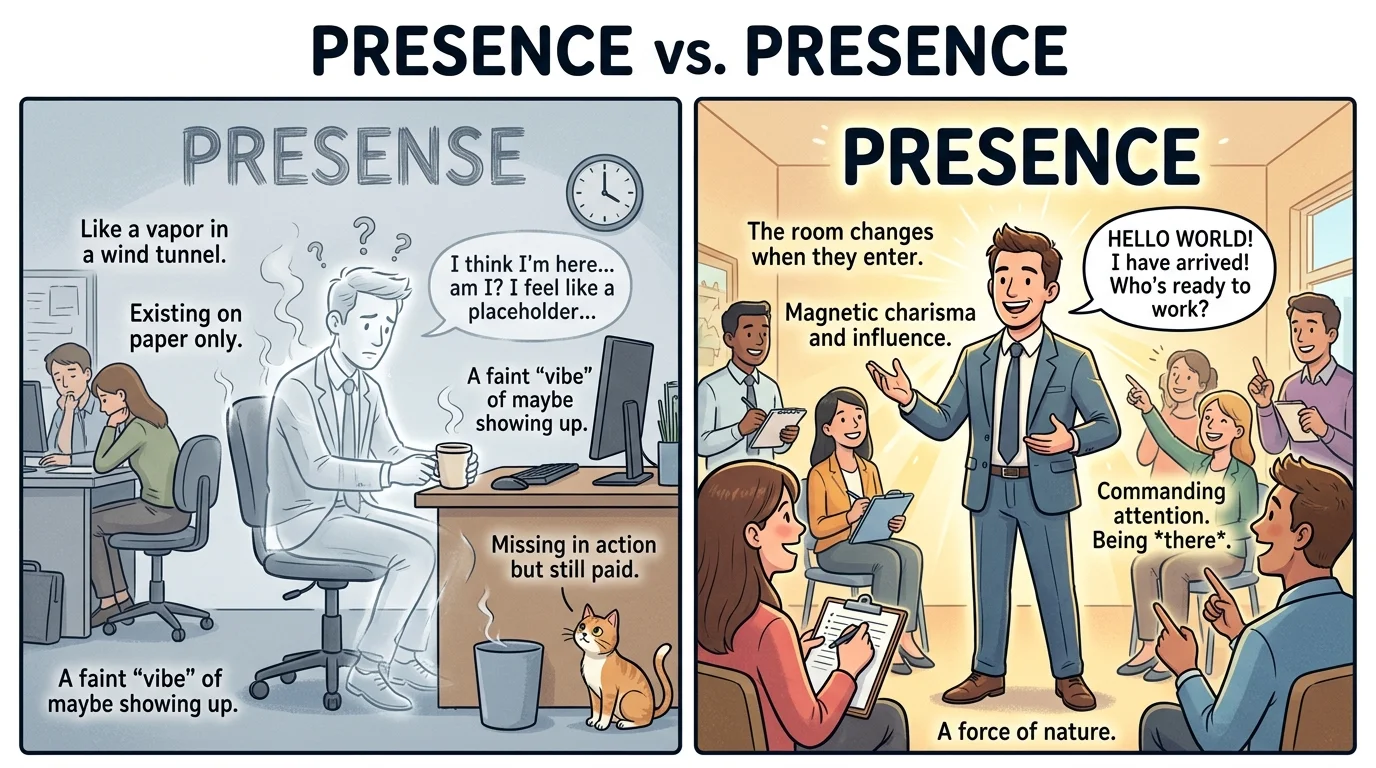
Expert Insight: Why “Presence” Uses -ence
The word presence comes from Latin roots related to “being in front of” or “existing in a place.”
Many English words derived from Latin use the suffix -ence, especially nouns that describe states or conditions.
Examples include:
- Presence
- Difference
- Importance
- Independence
Because of this linguistic origin, presence is standardized with -ence, and presense is not recognized in modern English.