

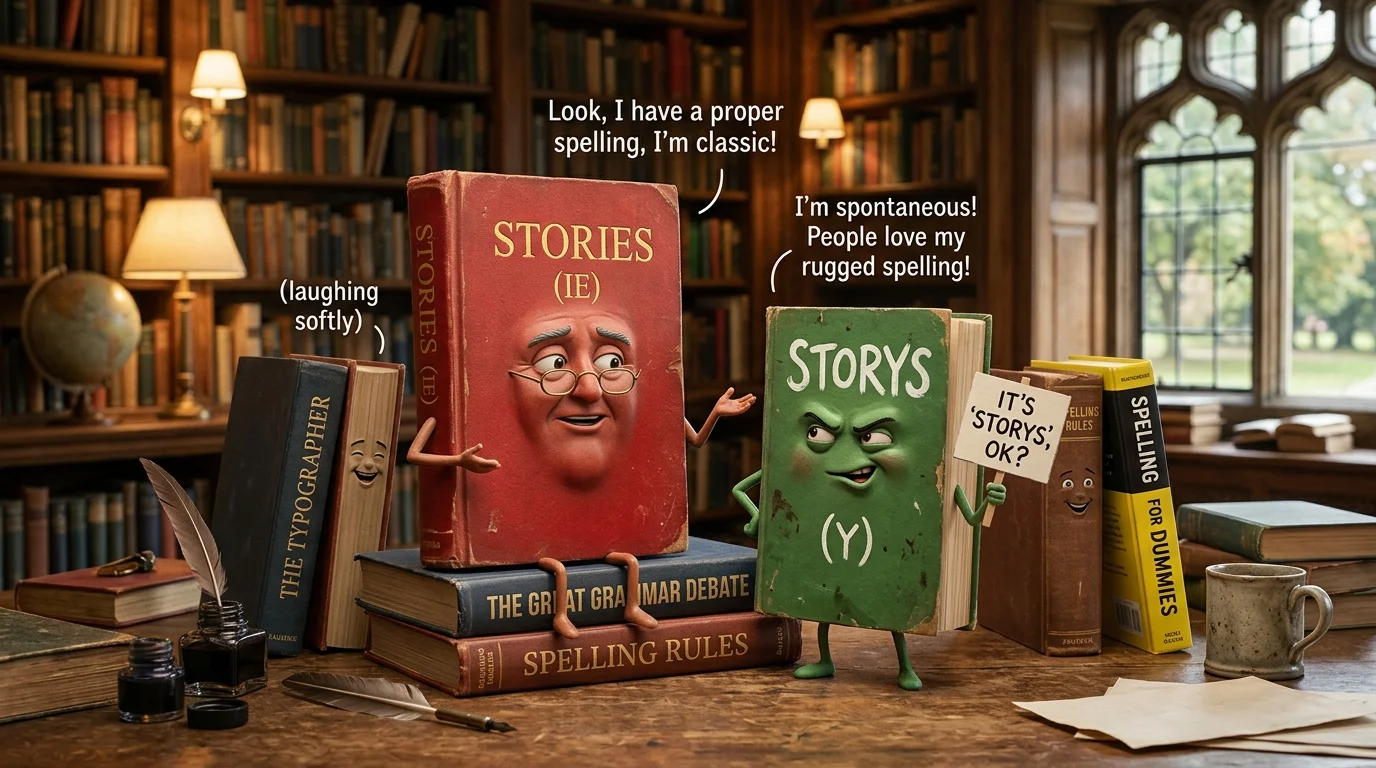
Quick Answer: Storys vs Stories
- Stories is the correct plural form of story.
- Storys is incorrect and should not be used.
Quick Examples
✅ She told several interesting stories.
✅ The book contains short stories from around the world.
❌ She told several interesting storys.
❌ The book contains short storys from around the world.
What Does “Stories” Mean?
Stories is the plural form of story.
A story can refer to:
- A narrative or tale
- A fictional account
- A real-life experience
- A news report
- A level of a building (in some contexts)
When to Use Stories
Use stories when referring to more than one story.
Examples
- Children enjoy listening to bedtime stories.
- The magazine published several inspiring stories.
- Her stories captivated the audience.
- The website features success stories from customers.
Key Insight
Whenever you mean “more than one story,” the correct form is stories.
What Does “Storys” Mean?
Storys is not a correct English word.
It is a spelling mistake caused by adding -s directly to story instead of applying the correct pluralization rule.
Why Does This Mistake Happen?
Many nouns form plurals like this:
- Book → Books
- Chair → Chairs
- Table → Tables
As a result, some writers incorrectly assume:
Story → Storys ❌
However, nouns ending in a consonant + y require a spelling change.
Examples
Incorrect:
- I read many storys last year.
- The teacher shared several storys.
Correct:
- I read many stories last year.
- The teacher shared several stories.
Key Insight
If a noun ends in a consonant followed by y, replace the y with ies to form the plural.
Storys vs Stories: Key Differences
Quick Comparison
- Stories = Correct plural form
- Storys = Misspelling
Comparison Table
| Feature | Stories | Storys |
|---|---|---|
| Correct English Spelling | Yes | No |
| Dictionary Recognition | Yes | No |
| Plural of Story | Yes | No |
| Accepted in Formal Writing | Yes | No |
| Example | Interesting stories | ❌ Interesting storys |
Why “Stories” Is Correct: The Grammar Rule
Rule: Consonant + Y → IES
When a noun ends with a consonant followed by y, change the y to ies when making it plural.
Examples
| Singular | Plural |
| Story | Stories |
| City | Cities |
| Baby | Babies |
| Family | Families |
| Party | Parties |
Key Insight
Because story ends with the consonant r followed by y, the plural becomes stories.
Storys vs. Stories: Reddit
The correct plural of story is stories, not storys. This rule applies in standard English grammar, including everyday writing and Reddit discussions.
When a noun ends in a consonant followed by -y, change the y to i and add -es.
One story → Two stories
One baby → Two babies
One city → Two cities
One party → Two parties
Storys is a common spelling mistake. You may see it in informal online posts, comments, or usernames, but it is not the standard plural spelling.
On Reddit, users may discuss storys vs. stories when correcting spelling or asking about English grammar. The correct choice remains stories.
Correct: I read several interesting stories on Reddit.
Incorrect: I read several interesting storys on Reddit.
Storys vs. Stories vs. Storey
Although stories and storeys sound alike, they have different meanings. The word storys is not a standard English plural.
Word | Meaning | Example |
|---|---|---|
Story | A tale, account, or narrative | She told me a funny story. |
Stories | More than one tale or narrative | I enjoy reading short stories. |
Storey | One level of a building (British English) | The house has one storey. |
Storeys | More than one building level (British English) | The building has five storeys. |
Storys | Incorrect standard spelling | Avoid writing storys. |
The main difference is the subject you are discussing.
Use stories for books, experiences, news reports, and fictional narratives. Use storeys for building levels in British English.
In American English, story and stories are also used for building levels.
Examples:
The author published three short stories.
The apartment building has eight storeys.
The hotel has twelve stories.
My grandmother told us wonderful stories.
Storys vs. Stories Grammar
According to standard English grammar, stories is the correct plural form of story. The spelling changes because of a common noun-ending rule.
When a noun ends in a consonant followed by y, replace the final y with ies to make it plural.
The spelling rule:
Story → Stories
Country → Countries
Family → Families
Library → Libraries
Dictionary → Dictionaries
However, when a noun ends in a vowel followed by y, simply add -s.
Examples:
Boy → Boys
Toy → Toys
Day → Days
Key → Keys
Monkey → Monkeys
This distinction explains why storys is incorrect while stories is correct.
Use stories in these sentences:
My children love bedtime stories.
She writes inspiring stories about real people.
The newspaper published several interesting stories.
We shared funny stories during dinner.
Remember that storey follows a different spelling pattern in British English. Its plural is storeys, not stories, when referring to building levels.
Storys vs. Stories Examples
The easiest way to understand the difference is to compare correct and incorrect sentences.
Incorrect | Correct |
|---|---|
I love reading storys. | I love reading stories. |
She writes beautiful storys. | She writes beautiful stories. |
The book contains five storys. | The book contains five stories. |
We shared our childhood storys. | We shared our childhood stories. |
He posts interesting storys online. | He posts interesting stories online. |
More examples using stories:
The teacher asked students to write original stories.
I enjoy listening to stories about different cultures.
These stories teach valuable life lessons.
Her travel stories inspire people to explore new places.
The website features stories from everyday readers.
My grandfather remembers many stories from his childhood.
Examples using storeys:
The office building has ten storeys.
They live in a three-storey house.
The apartment block contains several storeys.
The new building will have twenty storeys.
These examples show why context matters. Stories refers to narratives, while storeys refers to building levels in British English.
Storys or Stories on Instagram
The correct spelling is stories when referring to Instagram Stories. Instagram uses this feature to let users share photos, videos, and other updates that disappear after 24 hours, unless saved or highlighted.
The word storys is incorrect in this context.
Correct examples:
I posted three stories on Instagram today.
She shares beautiful travel stories.
I watched all your Instagram stories.
He regularly uploads funny stories.
You can add music to your Instagram stories.
Incorrect example:
– I posted three storys on Instagram today.
If you are writing a caption, blog post, or social media guide, always use Instagram Stories as the standard spelling.

Stories or Storeys for Buildings
Both stories and storeys can refer to the levels of a building. The correct choice depends on the English variety you are using.
American English: Use story for one building level and stories for multiple levels.
British English: Use storey for one building level and storeys for multiple levels.
Examples:
American English | British English |
|---|---|
A two-story house | A two-storey house |
A five-story building | A five-storey building |
A ten-story apartment | A ten-storey apartment |
A twenty-story hotel | A twenty-storey hotel |
Both forms are correct within their respective varieties of English.
Be careful not to confuse building levels with narratives. For example:
The building has six stories. (American English)
The building has six storeys. (British English)
The book contains six stories. (Narratives in both varieties)
Quick tip: If your article targets American readers, use stories for building levels. If it targets British readers, use storeys.
Storey Plural
The plural of storey is storeys in British English. A storey refers to one level or floor of a building.
The spelling does not change to stories in British English when discussing buildings.
Singular | Plural |
|---|---|
One storey | Two storeys |
A single-storey house | Several single-storey houses |
A three-storey building | Three-storey buildings |
One upper storey | Multiple upper storeys |
Examples in sentences:
The new apartment building has eight storeys.
Their house has two storeys and a small attic.
The shopping center contains four storeys.
Workers inspected every storey of the building.
The hotel is a modern fifteen-storey structure.
In American English, the corresponding spelling is story → stories.
For example, an American writer would say, “The hotel has fifteen stories,” while a British writer would usually say, “The hotel has fifteen storeys.”
Plural of Story Book
The plural of story is stories, and the plural of storybook is storybooks.
The spelling depends on whether you are pluralizing the individual word or the complete compound noun.
Singular | Plural |
|---|---|
Story | Stories |
Book | Books |
Storybook | Storybooks |
Story book | Story books |
Examples:
My child enjoys reading storybooks.
The library has hundreds of storybooks.
She bought three new storybooks for her students.
These storybooks contain colorful illustrations.
The teacher asked everyone to bring their favorite storybooks.
If you mean books containing stories, you can also write books of stories or story books.
However, storybooks is the common closed-compound spelling for books designed to tell stories, especially children’s books.
Remember: Story → Stories, Storybook → Storybooks, and Storey → Storeys (British English, for buildings).
Real-World Usage Scenarios
Example 1
❌ She enjoys writing short storys.
✅ She enjoys writing short stories.
🎯 Lesson: Use stories when referring to multiple narratives.
Example 2
❌ The newspaper published several storys.
✅ The newspaper published several stories.
🎯 Lesson: News reports are also called stories.
Example 3
Teacher: What kind of books do you like?
Student: I enjoy adventure stories.
🎯 Lesson: The correct plural is stories.
Example 4
❌ He shared funny storys during dinner.
✅ He shared funny stories during dinner.
🎯 Lesson: Replace y with ies.
Example 5
❌ The website features customer success storys.
✅ The website features customer success stories.
🎯 Lesson: Professional writing requires stories.
Common Mistakes People Make
Mistake 1: Simply Adding S
Incorrect:
- Storys
Correct:
- Stories
Why It Happens
Writers apply the standard plural rule instead of the special y-to-ies rule.
Mistake 2: Forgetting the Consonant + Y Rule
Incorrect:
- Storys
- Familys
- Partys
Correct:
- Stories
- Families
- Parties
Why It Happens
English pluralization rules can be easy to overlook.
Mistake 3: Using Storys in Professional Writing
Incorrect:
- The report contains customer storys.
Correct:
- The report contains customer stories.
Why It Matters
Incorrect spelling can make writing appear less professional.
Memory Tricks to Remember the Difference
Trick 1: Y Changes to IES
Remember:
Story → Stories
Simply replace:
Y → IES
Trick 2: Think of City → Cities
If you know:
City → Cities
Then remember:
Story → Stories
Both follow the same rule.
Trick 3: Visual Pattern
Correct:
Stories
Incorrect:
Storys
Whenever a word ends in a consonant + y, the plural typically ends in ies.
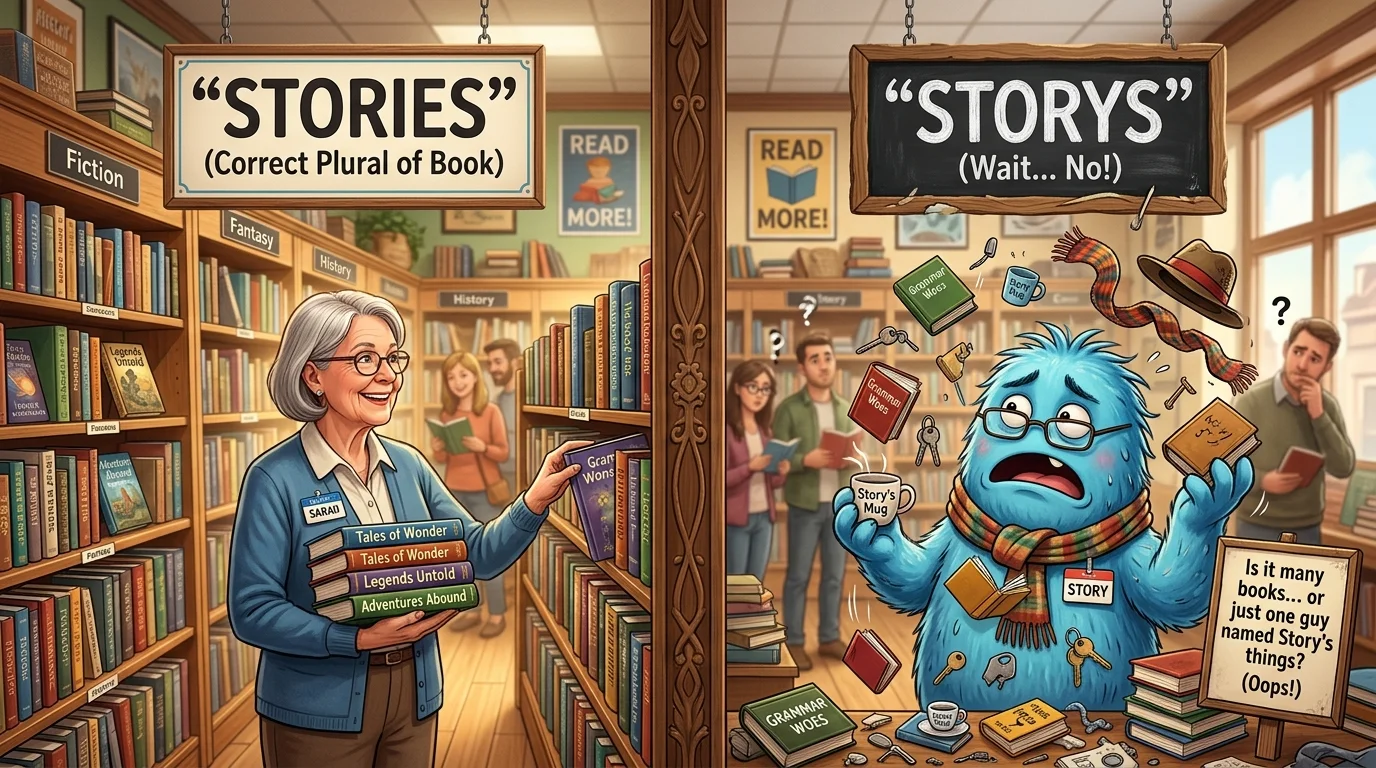
Expert Insight: Why English Uses “Stories”
The plural form stories follows a centuries-old English spelling rule designed to preserve pronunciation and readability.
When a noun ends in a consonant followed by y, replacing y with ies creates a smoother written form and clearer pronunciation.
This pattern applies to many common English words, including:
- Story → Stories
- Family → Families
- Party → Parties
- Country → Countries
Because the rule is firmly established in modern English grammar, stories is the only accepted plural form.