
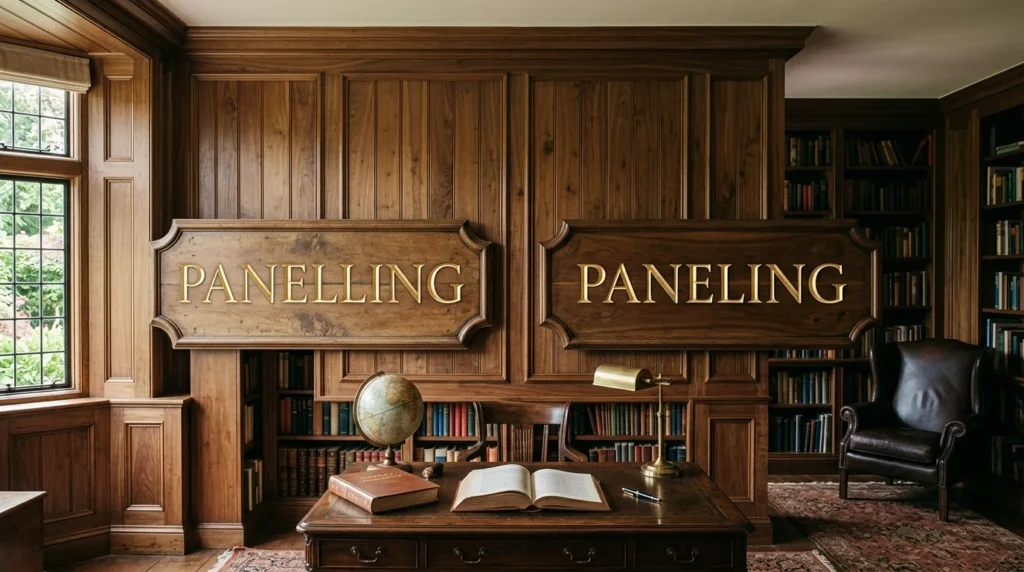
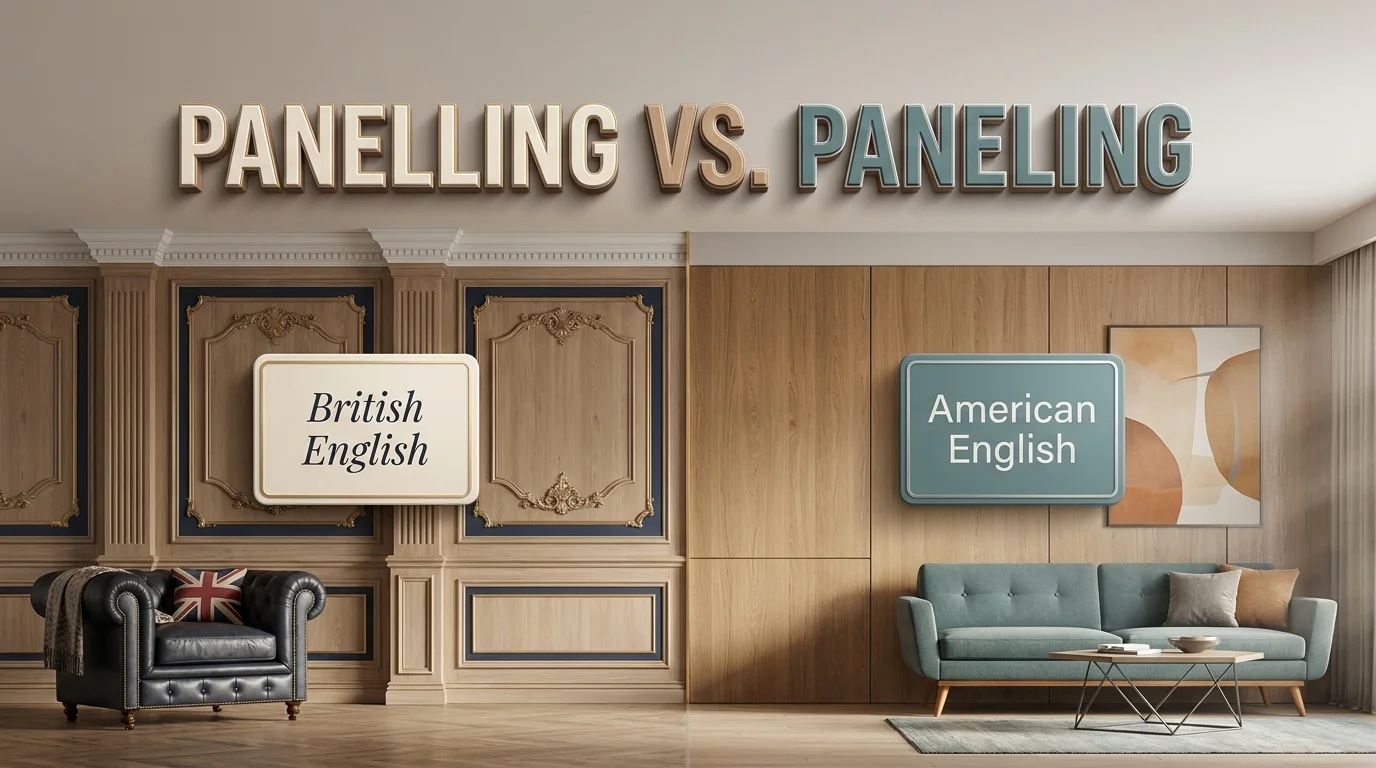
Quick Answer: Panelling vs. Paneling
Panelling is the British English spelling.
Paneling is the American English spelling.
🇬🇧 British English: panelling
🇺🇸 American English: paneling
There is no meaningful difference in definition or pronunciation.
What Does “Panelling” Mean?
Panelling is the standard British English spelling of the word.
It refers to the use or installation of panels, especially on walls, ceilings, or other surfaces.
Examples
The room features traditional oak panelling.
The wooden panelling gives the hallway a classic appearance.
They removed the old wall panelling during the renovation.
🎯 Key Insight: If you’re writing primarily for a UK, British, Australian, or other Commonwealth audience, panelling is generally the safer spelling.
What Does “Paneling” Mean?
Paneling is the standard American English spelling.
It has the same meaning as panelling.
Examples
The room features traditional oak paneling.
The wooden paneling gives the hallway a classic appearance.
They removed the old wall paneling during the renovation.
🎯 Key Insight: If your audience uses American English, use paneling.
Panelling vs. Paneling: Main Difference
| Feature | Panelling | Paneling |
|---|---|---|
| Meaning | Covering or decorating a surface with panels | Same |
| Spelling system | British English | American English |
| Pronunciation | Same | Same |
| Plural/root | Panel | Panel |
| Typical audience | UK and Commonwealth English | US English |
| Example | Wall panelling | Wall paneling |
| Memory clue | British double L | American single L |
Bottom Line
Panelling = British spelling
Paneling = American spelling
Why Does One Have Two Ls?
The spelling difference comes from a broader pattern in how British and American English handle words ending in -el when adding suffixes such as -ing.
British English often doubles the final consonant:
panel → panelling
American English commonly keeps one l:
panel → paneling
You can see similar regional differences in words such as:
travelling / traveling
labelled / labeled
cancelled / canceled
However, spelling conventions can vary by word, so it’s better to learn established forms rather than apply the rule mechanically to every word.
Panelling vs. Paneling in British English
For British English, use:
panelling
Examples
The Victorian house has beautiful wooden panelling.
Wall panelling is becoming popular in modern interiors.
The contractor installed decorative panelling in the dining room.
This spelling is also generally appropriate for publications following British-style spelling conventions.
Panelling vs. Paneling in American English
For American English, use:
paneling
Examples
The house has beautiful wood paneling.
Wall paneling can add texture to a room.
The contractor installed decorative paneling in the dining room.
🎯 Lesson: Don’t mix spelling systems within the same piece of content unless you’re intentionally discussing the difference.
Panelling vs. Paneling in Interior Design
Both forms are especially common when discussing:
- Wall design
- Woodwork
- Interior decoration
- Renovation
- Home improvement
- Decorative walls
- Architectural details
British English
Wooden wall panelling can make a room feel warmer.
American English
Wooden wall paneling can make a room feel warmer.
The meaning remains unchanged.
Panelling vs. Paneling: Real-World Usage Scenarios
Scenario 1: UK Interior Design Article
Traditional wall panelling is popular in period homes.
🎯 Lesson: British audience → panelling.
Scenario 2: US Home Improvement Website
Modern wall paneling can transform a plain room.
🎯 Lesson: American audience → paneling.
Scenario 3: British Renovation Project
We decided to install oak panelling in the dining room.
🎯 Lesson: UK spelling uses -lling.
Scenario 4: American Renovation Project
We decided to install oak paneling in the dining room.
🎯 Lesson: US spelling uses -ling.
Scenario 5: Comparing Both Forms
“Panelling” is British English, while “paneling” is American English.
🎯 Lesson: Both are correct; choose based on your target audience.
Paneling Meaning
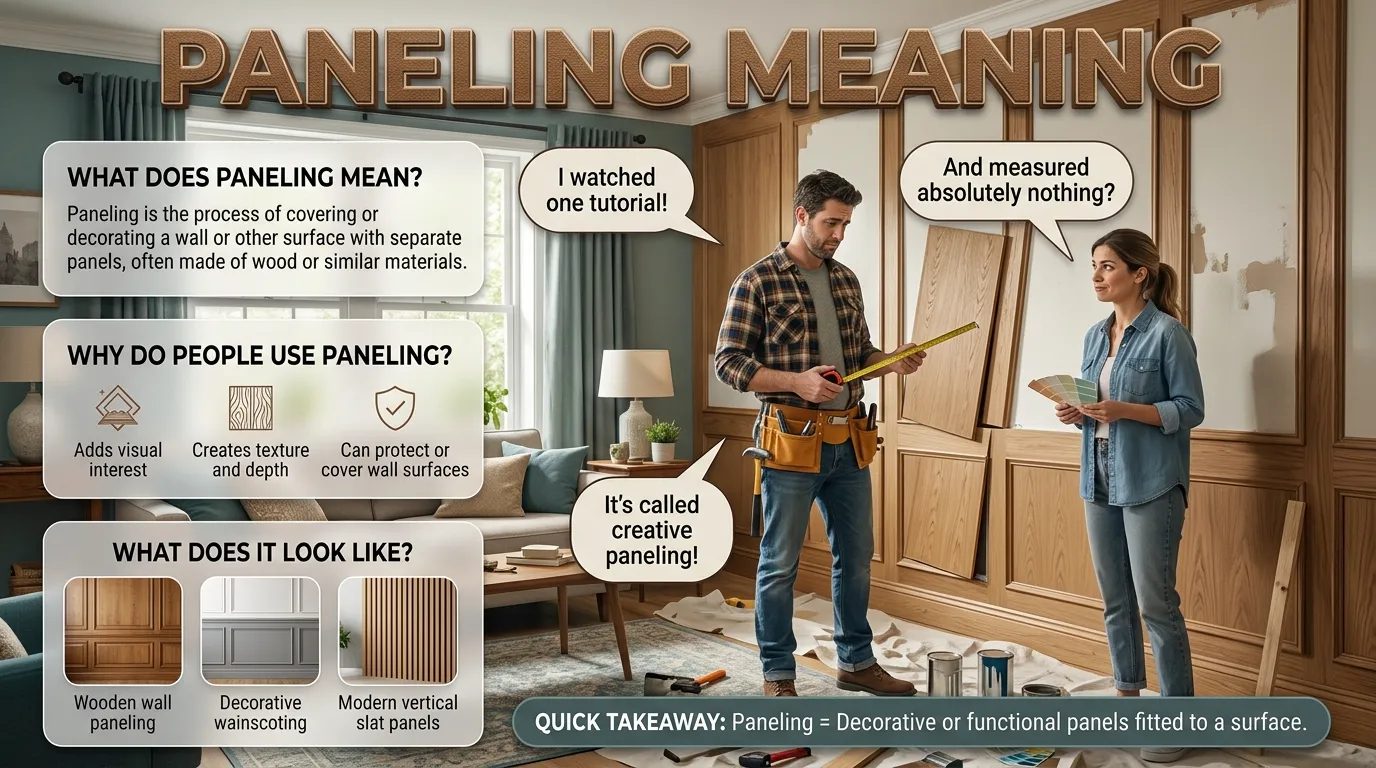
Paneling refers to the process of covering or decorating a surface with panels, usually made from wood, MDF, PVC, or other materials. It is commonly used on walls, ceilings, doors, and other interior surfaces to add texture, protect the underlying material, or improve the appearance of a room.
In American English, paneling is the standard spelling, while panelling is the more common British English spelling. Both words have the same meaning.
For example, a living room may feature decorative wood paneling to create a traditional look, while a modern bedroom may use vertical wall panels to add visual interest behind the bed.
Paneling can be functional as well as decorative. Depending on its material and installation, it may help conceal minor surface imperfections, protect walls from everyday wear, or provide additional insulation. However, not all paneling offers significant insulation or moisture protection.
What Is Panelling in Interior Design?
Panelling in interior design refers to the use of panels to enhance or cover interior surfaces, particularly walls. It can create a sense of depth, introduce patterns, define different areas of a room, and complement a particular decorating style.
Interior designers use panelling in traditional, contemporary, rustic, and minimalist spaces. The appearance depends on the panel material, shape, finish, and installation pattern.
For example, a formal dining room may feature raised wood panels, while a contemporary hallway might use narrow vertical slats to make the walls appear taller.
Common applications include:
Living rooms: Decorative panels behind a sofa or television.
Bedrooms: Headboard walls featuring wood slats or upholstered panels.
Hallways: Durable lower-wall panels that protect against scuffs.
Dining rooms: Traditional rectangular panels that create a formal atmosphere.
Bathrooms: Moisture-resistant panels designed for suitable wet-area applications.
Panelling can cover an entire wall or be installed on only part of it. The right option depends on the room’s proportions, existing finishes, maintenance requirements, and desired style.
Wall Panelling
Wall panelling is the installation of panels on interior or exterior walls to change their appearance or provide surface protection. Interior wall panelling is especially popular in living rooms, bedrooms, hallways, and dining areas.
Different materials and layouts create different effects. Wood panels can add warmth, painted MDF panels can provide a clean decorative finish, and PVC panels may offer a lightweight option for areas where moisture resistance is important.
Popular wall panelling styles include:
Shaker-style panelling: Simple rectangular frames that suit traditional and transitional interiors.
Board-and-batten: Wide boards or flat wall surfaces divided by narrow vertical strips.
Tongue-and-groove panelling: Interlocking boards that create a continuous surface.
Slat wall panelling: Narrow vertical or horizontal strips that create a linear pattern.
Raised-panel panelling: Decorative panels with raised central sections, often associated with classic interiors.
Flat-panel panelling: Smooth, recessed, or framed panels that provide a more understated appearance.
Wall panelling can make a plain room feel more detailed and visually structured. However, thick panels may reduce usable space slightly, and poorly installed panels can show uneven joints or gaps.
Before choosing a design, consider the wall’s condition, room humidity, panel thickness, cleaning requirements, and whether the finish will work with the flooring and furniture.
Paneling Synonym
The best synonym for paneling depends on how the word is being used. In interior design, related terms include wall cladding, wall covering, wall treatment, and decorative wall panels.
Synonym or related term | Meaning |
|---|---|
Wall cladding | A material applied to a wall’s surface for protection or appearance |
Wall covering | A broad term for materials used to cover walls |
Wall treatment | A decorative or functional finish applied to a wall |
Decorative panels | Individual panels installed to enhance a surface |
Wainscoting | Wall panelling traditionally applied to the lower portion of a wall |
Wood cladding | Wood boards or panels used to cover a surface |
Boarding | Covering a surface with boards |
Panelwork | A structure or decorative arrangement made from panels |
These terms are related, but they are not always interchangeable. For example, wainscoting refers to a particular wall treatment, while paneling describes a broader category of panel-based finishes.
If you need a synonym for an article or design description, wall panelling or decorative wall panels is often appropriate when referring specifically to interior walls.
Paneling Types
Paneling comes in several types, each with different materials, designs, costs, and maintenance requirements. Some types emphasize traditional craftsmanship, while others suit contemporary interiors.
Wood Paneling
Wood paneling uses solid wood, wood veneer, or engineered wood products to cover a surface. It can create a warm, natural appearance and is available in many finishes, from light oak to dark walnut.
It is suitable for living rooms, bedrooms, offices, and feature walls. Solid wood and veneer products may require careful maintenance to prevent damage from moisture or changes in humidity.
MDF Paneling
Medium-density fiberboard (MDF) paneling is made from engineered wood fibers. It is commonly used for painted decorative wall designs, including rectangular frames, Shaker-style panels, and custom patterns.
MDF provides a smooth surface that is easy to paint, but standard MDF is vulnerable to moisture. Moisture-resistant grades are available for certain applications, subject to manufacturer instructions.
PVC Paneling
PVC paneling is made from polyvinyl chloride, a type of plastic. It is lightweight and generally easy to clean, making it useful for some kitchens, bathrooms, utility areas, and other interiors.
Its suitability depends on the specific product, installation method, temperature conditions, and exposure to water. Not every PVC panel is appropriate for direct shower exposure or other demanding wet environments.
Shiplap Paneling
Shiplap consists of horizontal or vertical boards with specially shaped edges that overlap or fit together to create a consistent pattern. It is often used in farmhouse, coastal, and contemporary interiors.
Painted white shiplap creates a bright, simple look, while natural wood finishes emphasize texture.
Board-and-Batten Paneling
Board-and-batten panelling combines broad boards or a flat backing surface with narrow strips called battens. The resulting pattern typically features vertical divisions.
It is often installed in entryways, bedrooms, dining rooms, and hallways. Depending on the design, it can make a room feel taller or give a wall a more structured appearance.
Slat Paneling
Slat paneling uses narrow strips of wood or another material arranged in parallel lines. It is popular for television feature walls, headboard walls, offices, and contemporary interiors.
Some slat systems incorporate acoustic backing to help absorb sound, but the level of sound absorption depends on the complete system rather than the slats alone.
Raised-Panel and Flat-Panel Designs
Raised-panel designs feature decorative central sections that project outward, creating a traditional appearance. Flat-panel designs have simpler surfaces and are often associated with modern or transitional interiors.
Both can be used on walls, cabinet fronts, and doors, although the construction and dimensions may differ depending on the application.
Paneling Interior
Interior paneling is used to decorate and sometimes protect surfaces inside a building. It can be installed on walls, ceilings, doors, built-in storage, and other architectural features.
The best interior paneling depends on the room’s purpose and design.
In a living room, a wood-slat feature wall can create a focal point behind the television. In a bedroom, painted panels behind the bed can function as a decorative alternative to wallpaper. In a hallway, durable lower-wall panelling can help protect areas that experience frequent contact.
When selecting interior paneling, consider these factors:
Style: Choose a pattern that complements the furniture, flooring, and overall interior design.
Material: Compare solid wood, MDF, PVC, veneer, and other options according to their properties.
Moisture: Use products suitable for the room’s humidity and exposure to water.
Maintenance: Consider whether the surface needs painting, sealing, wiping, or other upkeep.
Installation: Some systems are designed for straightforward installation, while others require accurate measuring, cutting, and professional finishing.
Paneling does not automatically make a room look better. The scale of the design matters: large framed panels may suit spacious rooms, while narrow slats or simpler patterns can work well in smaller spaces.
Paneling Door
Door paneling refers to the panels incorporated into a door’s construction or attached to its surface for decorative purposes. Panelled doors are common in homes, offices, and other buildings.
Traditional panelled doors often feature rectangular sections framed by rails and stiles. Modern versions may have flat panels, minimalist grooves, or geometric patterns.
Common door panel styles include:
Raised-panel doors: Feature central panels that project outward from the surrounding frame.
Recessed-panel doors: Have panels set slightly inward from the frame.
Flat-panel doors: Use simple, flat sections for a clean appearance.
Shaker doors: Feature a straightforward rectangular frame and a flat central panel.
Glass-panel doors: Incorporate glass sections to allow light to pass through.
Panelled doors can complement traditional, transitional, and contemporary interiors. The material may be solid wood, engineered wood, MDF, or another door-construction material.
It is important to distinguish between a panelled door and a door with decorative wall panelling attached to it. The former describes the door’s design or construction; the latter may refer to an applied decorative treatment.
When choosing a panelled door, consider its durability, finish, maintenance requirements, privacy, and compatibility with the surrounding trim and interior style.
What Is Wood Paneling on Walls Called?
Wood paneling on walls is generally called wood wall paneling, wood wall panelling, or wood wall cladding. The precise term depends on the design and installation method.
Several more specific names are commonly used:
Shiplap: Horizontal or vertical boards with overlapping or interlocking edges.
Tongue-and-groove paneling: Boards that fit together using a tongue on one edge and a groove on the other.
Board-and-batten: A design featuring broad boards or a backing surface with narrow vertical strips.
Wood slat wall: A wall treatment made from narrow, parallel strips of wood.
Wainscoting: Panelling applied to the lower portion of a wall, which may be made from wood or other materials.
Raised-panel wall panelling: Framed panels with central sections that project outward.
Veneer paneling: Panels finished with a thin layer of natural wood over a substrate.
For example, a wall covered with narrow vertical oak strips would commonly be described as a wood-slat feature wall. A dining room with rectangular framed panels along its lower walls might be described as having wood wainscoting.
If you are referring to wood panels in general, wood wall paneling is the clearest term. If you know the specific design, using its established name provides a more precise description.
Common Mistakes With Panelling and Paneling
Mistake 1: Thinking One Spelling Is Incorrect
❌ Paneling is always wrong.
Not true.
Paneling is standard American English.
❌ Panelling is always wrong.
Also incorrect.
Panelling is standard British English.
Mistake 2: Mixing US and UK Spelling
If your article is written in British English, using:
panelling
alongside unrelated American spellings can make the content stylistically inconsistent.
Likewise, American English content should generally use:
paneling
🎯 Why it happens: Both spelling systems are widely encountered online.
Mistake 3: Changing the Meaning
The extra l does not create a different meaning.
panelling = paneling
The difference is spelling, not definition.
Mistake 4: Assuming “Paneling” Is a Typo
If you’re reading an American website, paneling is completely normal.
Likewise, panelling is normal in British English.
Panelling vs. Paneling: Which Should You Use?
Use panelling if:
- You’re writing in British English
- Your audience is primarily in the UK
- Your publication follows British spelling
- You’re targeting a Commonwealth English audience that follows this convention
Use paneling if:
- You’re writing in American English
- Your audience is primarily in the United States
- Your publication follows American spelling
For SEO
Don’t create separate pages simply because these spellings differ.
If the search intent is the same, the better approach is usually to choose the spelling that matches your target audience and maintain consistency.
For example:
UK audience → wall panelling
US audience → wall paneling
Memory Tricks: Panelling vs. Paneling
🇬🇧 Trick 1: British = More Letters
Think:
British English often keeps the extra L → panelling
🇺🇸 Trick 2: American = Simpler Spelling
Think:
American English → paneling
⭐ One-Line Memory Trick
Panelling = UK
Paneling = US
Expert Insight: Why British and American Spelling Differ
British and American English developed different spelling conventions over time.
American English spelling was influenced by efforts to establish more standardized and sometimes simplified forms, while British English retained many traditional spellings.
The difference between:
panelling
and
paneling
is therefore part of a broader pattern of regional spelling variation.
The same distinction appears in many words involving consonant doubling:
travelling / traveling
modelling / modeling
labelled / labeled
cancelled / canceled
However, the exact rules vary depending on the word and the style guide being followed.
Quick Test: Panelling or Paneling?
1. Writing for a UK audience:
The room has beautiful wooden ________.
Answer: panelling ✅
2. Writing for a US audience:
The room has beautiful wooden ________.
Answer: paneling ✅
3. “Is panelling wrong?”
No. It is standard British English.
4. “Is paneling wrong?”
No. It is standard American English.
5. “Do they mean the same thing?”
Yes.
The difference is primarily regional spelling.