

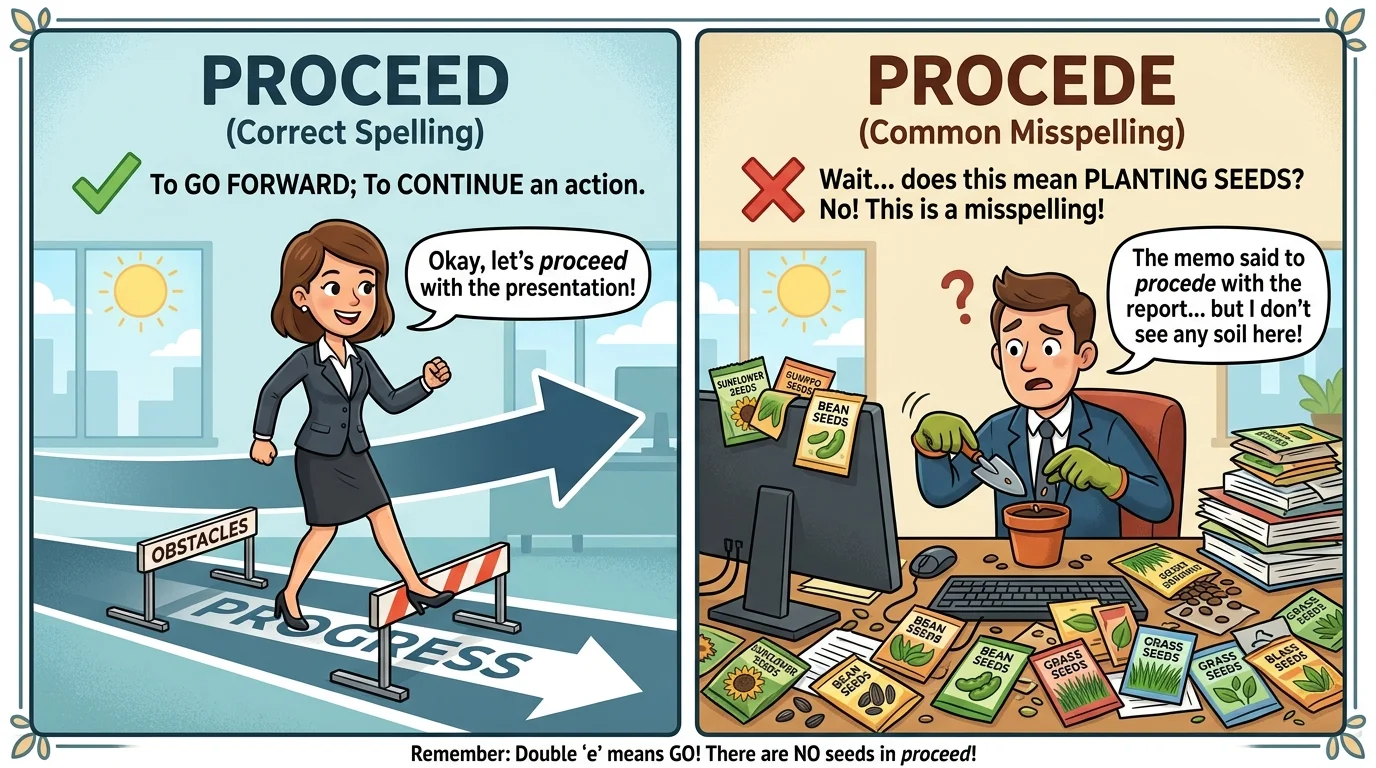
Quick Answer: Proceed vs Procede
- Proceed is the correct spelling.
- Procede is incorrect and should not be used.
Quick Examples
✅ Please proceed with the next step.
❌ Please procede with the next step.
What Does “Proceed” Mean?
Proceed is a verb that means:
- To continue doing something
- To move forward in action or process
- To begin or carry on after a pause or instruction
When to Use Proceed
Use proceed when talking about:
- Continuing an activity
- Moving forward in a process
- Giving permission to continue
- Advancing to the next stage
Examples
- You may proceed to the next round.
- The meeting will proceed as scheduled.
- Please proceed with caution.
- After approval, we can proceed with development.
Key Insight
Whenever you mean “continue forward,” the correct spelling is proceed.
What Does “Procede” Mean?
Procede is not a standard English word.
It is simply a misspelling caused by confusion with similar-looking words such as “precede” or “procedure.”
Why Does This Mistake Happen?
The confusion comes from:
- Similar pronunciation
- Influence of words like precede
- Incorrect assumption that English uses “-ede” endings
But in this case:
Proceed = correct ❌
Procede = incorrect ❌
Examples
Incorrect:
- We will procede with the plan.
- Please procede carefully.
Correct:
- We will proceed with the plan.
- Please proceed carefully.
Key Insight
If you see procede, it should always be corrected to proceed.
Proceed vs Procede: Key Differences
Quick Comparison
- Proceed = Correct spelling
- Procede = Misspelling
Comparison Table
| Feature | Proceed | Procede |
|---|---|---|
| Correct English Spelling | Yes | No |
| Dictionary Recognition | Yes | No |
| Meaning: Continue Forward | Yes | No |
| Accepted in Formal Writing | Yes | No |
| Example | Proceed with plan | ❌ Procede with plan |
Precede vs. Proceed Model
Precede and proceed are two correctly spelled English verbs, but they have different meanings. The easiest way to understand their difference is to remember that pre means before, while proceed means moving forward.
Precede means to come before something in time, order, position, or sequence. Proceed means to continue an activity, move forward, or advance to the next stage.
For example, breakfast precedes lunch because people usually eat breakfast before lunch. After breakfast, they may proceed with their daily activities.
Examples of precede:
A short introduction will precede the presentation.
Monday precedes Tuesday in the calendar.
The teacher’s instructions preceded the examination.
A warning should precede any dangerous activity.
The opening ceremony will precede the main event.
Examples of proceed:
Please proceed to the next question.
We will proceed with the discussion after lunch.
The company decided to proceed with its expansion plans.
After receiving permission, the workers proceeded with construction.
You can proceed to the checkout counter.
The difference becomes clearer when both words appear in the same sentence:
“The introduction will precede the lecture, and the students will proceed with their questions afterward.”
Here, precede describes what happens first, while proceed describes what happens next.
Proceed vs. Procede Reddit
People searching for proceed vs. procede on Reddit are generally trying to understand which spelling is correct and why these words are confused.
The answer is straightforward: proceed is correct, while procede is a misspelling.
The confusion often comes from the spelling of similar words, including precede, concede, and recede. These words end in -cede, whereas proceed ends in -ceed.
Consider these examples:
Incorrect: Please procede with the application.
Correct: Please proceed with the application.
Incorrect: We should procede to the next stage.
Correct: We should proceed to the next stage.
Incorrect: The manager asked us to procede carefully.
Correct: The manager asked us to proceed carefully.
There is no difference in meaning between two accepted forms here because procedе is not a standard alternative spelling. Whenever you want to express continuing or moving forward, use proceed.
Proceed vs. Procede Examples
The easiest way to recognize the correct spelling is to compare incorrect and correct sentences. Since procedе is not a standard English word, it should always be replaced with proceed when the intended meaning is to continue or move forward.
Incorrect and correct examples:
1. Incorrect: We need to procede with the meeting.
Correct: We need to proceed with the meeting.
2. Incorrect: Please procede to the next page.
Correct: Please proceed to the next page.
3. Incorrect: The company will procede with its plans.
Correct: The company will proceed with its plans.
4. Incorrect: You may procede after receiving approval.
Correct: You may proceed after receiving approval.
5. Incorrect: The teacher asked everyone to procede quietly.
Correct: The teacher asked everyone to proceed quietly.
6. Incorrect: How should we procede from here?
Correct: How should we proceed from here?
7. Incorrect: The investigation will procede tomorrow.
Correct: The investigation will proceed tomorrow.
8. Incorrect: We cannot procede without permission.
Correct: We cannot proceed without permission.
More examples of proceed in everyday English:
The passengers should proceed to their boarding gates.
Let’s proceed with the original plan.
The discussion proceeded without interruption.
The project is proceeding according to schedule.
After completing the first task, proceed to the second one.
These examples show that proceed works in conversations, instructions, professional writing, and formal communication.
Proceed vs. Procede Grammar
From a grammatical perspective, proceed is a verb that can describe continuing an action, moving forward, or advancing through a process. It is commonly used as an intransitive verb, meaning it does not normally take a direct object.
For example:
We will proceed with the investigation.
The students proceeded to the classroom.
The meeting proceeded smoothly.
Notice that we say proceed with the investigation, not proceed the investigation, in ordinary standard usage.
The word has several grammatical forms:
Base form: Proceed
Third-person singular: Proceeds
Present participle: Proceeding
Past tense: Proceeded
Past participle: Proceeded
Examples:
She proceeds carefully with every assignment.
They are proceeding with the construction.
He proceeded to explain the situation.
The project has proceeded without major problems.
What about precede?
Precede is also a verb, but it commonly takes an object because it describes something that comes before another thing.
Examples:
The introduction precedes the main article.
A meeting preceded the official announcement.
The opening speech will precede the award ceremony.
The main grammatical distinction is that proceed describes continuing or advancing, while precede describes coming before something.
Proceed vs. Procede Synonym
Since proceed is the correct word and procedе is a misspelling, only proceed has standard English synonyms.
The best synonym depends on the context in which you use the word.
Synonyms of proceed:
Continue – To keep doing something without stopping.
Advance – To move forward or make progress.
Progress – To develop or move toward a goal.
Continue onward – To keep moving in a particular direction.
Move forward – To advance to the next stage.
Carry on – To continue an activity.
Go ahead – To begin or continue something.
Pursue – To continue working toward a goal.
Resume – To start again after a pause.
Advance further – To move ahead in a process.
Examples:
Please continue with your explanation.
We should advance to the next stage.
The project will progress according to schedule.
You can go ahead with your application.
The team decided to resume its work.
Synonyms of precede:
If you are looking for a related word that means “to come before,” consider:
Predate
Antedate
Come before
Go before
Lead up to
Preexist
For example, “The announcement preceded the event” can be rewritten as “The announcement came before the event.”
Remember that proceed and precede have different synonyms because they express different ideas.
Succeed vs. Precede
Succeed and precede are two different English verbs that can be confusing because of their similar spelling. However, they express different ideas when discussing order or sequence.
Succeed means to achieve a desired result, accomplish a goal, or come after someone in a position or role. Precede means to come before something in time, order, or position.
For example, a new manager may succeed an old manager, meaning the new manager takes over the position. However, the old manager precedes the new manager because they held the position first.
Examples of succeed:
She worked hard to succeed in her career.
The young businessman hopes to succeed in his new venture.
The new director will succeed the previous director.
Good preparation can help students succeed in examinations.
He succeeded in completing the difficult task.
Examples of precede:
Monday precedes Tuesday.
The introduction precedes the conclusion.
A short announcement will precede the ceremony.
The first chapter precedes the second chapter.
The opening speech will precede the main performance.
An easy way to remember:
Succeed = Achieve success or come after someone in a position.
Precede = Come before something.
One important detail is that succeed has more than one meaning. It can describe achieving success or taking someone’s place.
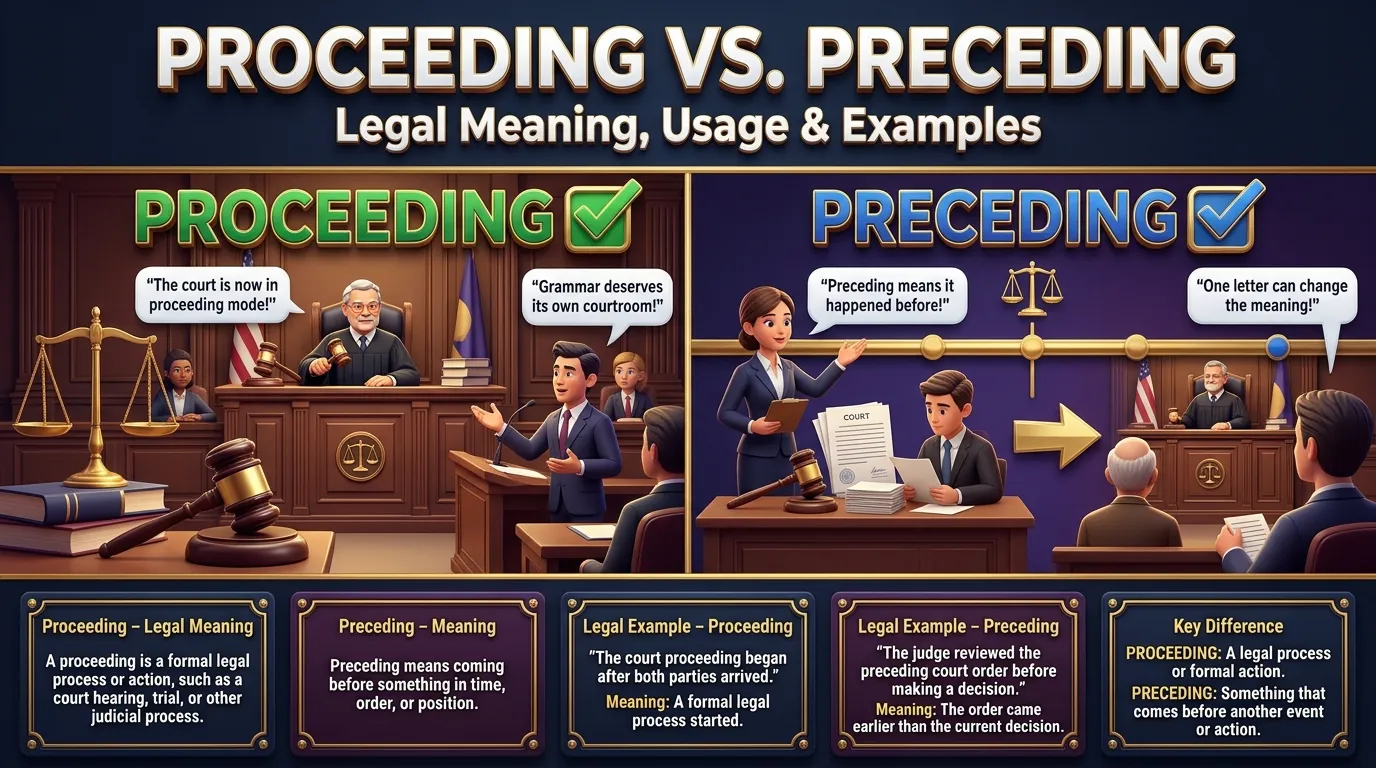
Proceeding vs. Preceding Legal
In legal writing, proceeding and preceding have different meanings and are used in different contexts.
Proceeding refers to a formal legal process or action, such as a court hearing, trial, lawsuit, or administrative case. Preceding describes something that happened before a particular event, date, decision, or legal action.
Understanding this distinction is important because confusing these terms can change the meaning of a legal sentence.
What does proceeding mean in legal terms?
A legal proceeding is a formal process in which a court, tribunal, or authorized body examines a dispute, application, or legal matter.
Examples:
The court scheduled the legal proceeding for next Monday.
The defendant attended the criminal proceedings.
The judge postponed the proceeding until further notice.
The parties reached an agreement before the proceedings began.
The legal proceeding continued after the evidence was presented.
The word proceedings is also commonly used to describe the overall legal process or a series of formal legal actions.
What does preceding mean in legal terms?
Preceding means happening or existing before a particular point in time or event. In legal documents, it often describes earlier hearings, decisions, statements, paragraphs, or events.
Examples:
The preceding court order must be reviewed before making a new decision.
The judge considered the evidence presented during the preceding hearing.
The preceding agreement contained important legal conditions.
The events preceding the lawsuit were discussed during the trial.
The preceding paragraph explains the relevant legal requirements.
Proceeding vs. Preceding: Legal Examples
The legal proceeding began on Monday. (A formal legal process started.)
The preceding hearing took place last week. (The earlier hearing happened before the current one.)
The court decided to proceed with the case. (The court decided to continue.)
The preceding decision influenced the current judgment. (An earlier decision influenced the present one.)
In short, proceeding relates to a formal legal process, while preceding refers to something that came before.
Real-World Usage Scenarios
Example 1
❌ You may procede to the next stage.
✅ You may proceed to the next stage.
🎯 Lesson: Moving forward always uses proceed.
Example 2
❌ The project will procede as planned.
✅ The project will proceed as planned.
🎯 Lesson: Project continuation = proceed.
Example 3
Teacher: What should we do next?
Student: We should proceed with the experiment.
🎯 Lesson: Scientific steps use proceed.
Example 4
❌ Please procede with caution in this area.
✅ Please proceed with caution in this area.
🎯 Lesson: Safety instructions use proceed.
Example 5
❌ The court decided to procede with the hearing.
✅ The court decided to proceed with the hearing.
🎯 Lesson: Legal processes always use proceed.
Common Mistakes People Make
Mistake 1: Using “cede” Instead of “ceed”
Incorrect:
- Procede
Correct:
- Proceed
Why It Happens
Words like:
- Precede
- Concede
- Recede
make learners assume similar patterns apply.
Mistake 2: Confusing With “Procedure”
Incorrect assumption:
- Proceed → Procede
Correct understanding:
- Procedure is a different word entirely
Mistake 3: Using Procede in Formal Writing
Incorrect:
- The team will procede with development.
Correct:
- The team will proceed with development.
Why It Matters
Spelling mistakes reduce credibility in professional communication.
Memory Tricks to Remember the Difference
Trick 1: Double “E” Means Forward Motion
Think:
Proceed = double E = keep going
Trick 2: Connect With “Proceed = Proceed Forward”
The word literally means:
- Proceed = go forward
Trick 3: Visual Pattern
Correct:
Proceed
Incorrect:
Procede
Always remember the double e in the middle.
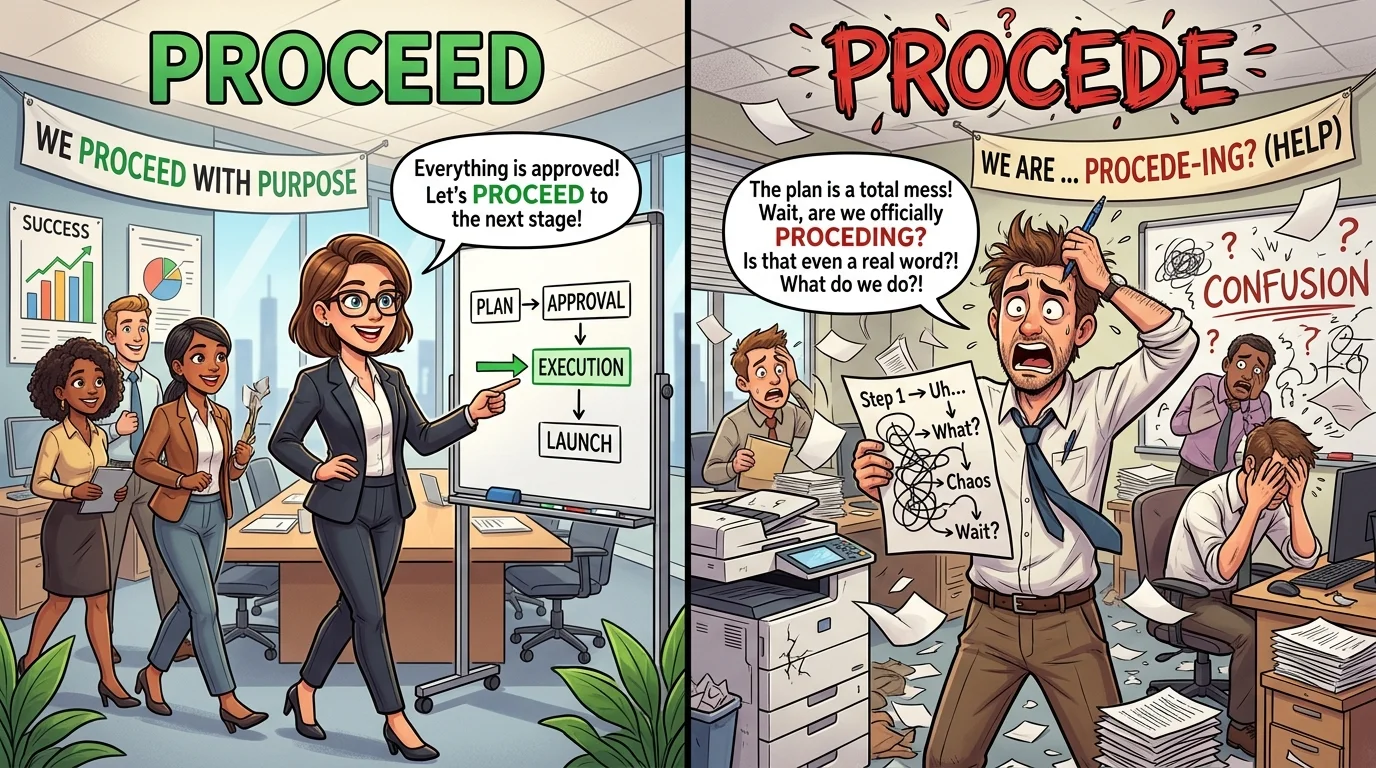
Expert Insight: Why “Proceed” Is Spelled This Way
The word proceed comes from Latin roots:
- pro- = forward
- cedere = go
So the meaning is literally:
👉 “to go forward”
English preserved the -ceed ending in several related words:
- Proceed
- Exceed
- Succeed
- Recede (exception in vowel pattern but same root family)
Because of this shared structure, proceed is standardized with -ceed, not -cede.