
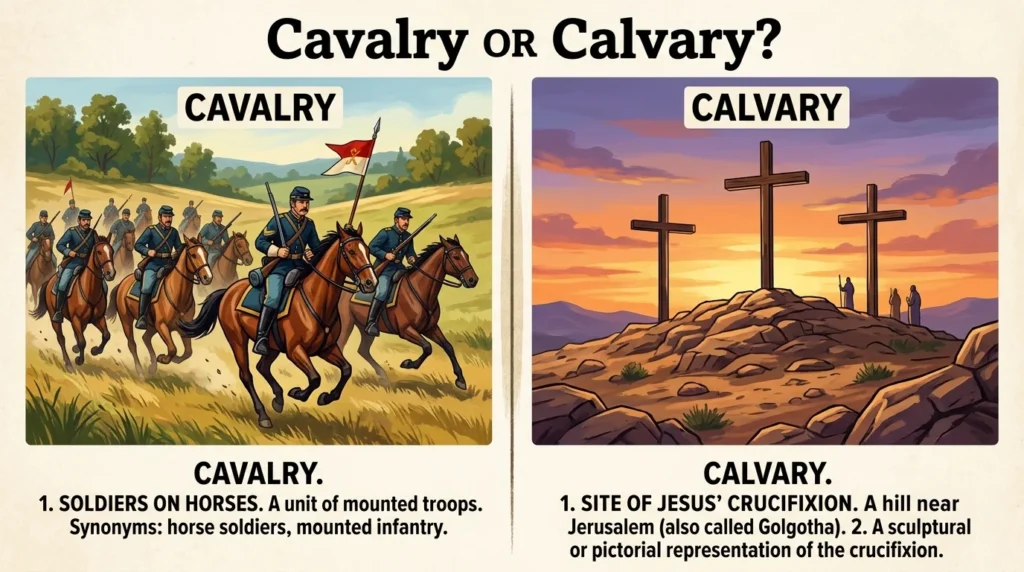
Quick Answer: Cavalry vs. Calvary
Cavalry means soldiers or military forces traditionally associated with horses.
Calvary refers to the hill outside Jerusalem where Jesus Christ was crucified, and it can also refer to a representation of the crucifixion.
The easiest way to remember:
- Cavalry = soldiers + horses
- Calvary = crucifixion + Christianity
So, if you are talking about the military, use cavalry. If you are talking about the crucifixion of Jesus, use Calvary.
What Does “Cavalry” Mean?
Cavalry is a noun referring to soldiers or military units traditionally trained to fight while riding horses.
Historically, cavalry played an important role in warfare because mounted soldiers could move quickly across battlefields, scout enemy positions, launch attacks, and pursue retreating forces.
Although modern militaries generally do not use horses in the same way they once did, the word cavalry is still widely used for military units and formations.
Examples of “Cavalry”
- The cavalry arrived just before the battle began.
- The army sent its cavalry to scout the enemy’s position.
- The cavalry unit moved rapidly across the battlefield.
Key Insight
Think of cavalry whenever your sentence involves:
- Soldiers
- The military
- Horses
- Mounted troops
- Warfare
- Military units
Cavalry = military.
What Does “Calvary” Mean?
Calvary is a proper noun associated with Christianity. It refers to the place traditionally identified as the site where Jesus Christ was crucified.
The word comes through Latin from a term associated with Golgotha, the place of the crucifixion.
Because Calvary is a religious term, it is normally capitalized when referring specifically to the biblical place.
Examples of “Calvary”
- The painting depicts Jesus on the road to Calvary.
- The church displayed a scene representing Christ at Calvary.
- The sermon focused on the significance of Calvary.
Key Insight
When the subject is Jesus, the crucifixion, Christianity, or Golgotha, the correct word is Calvary.
Calvary = crucifixion.
Cavalry or Calvary Pronunciation
Cavalry and Calvary are spelled differently and have different meanings, even though their pronunciations can sound very similar in everyday speech.
Cavalry is pronounced approximately KAV-uhl-ree /ˈkævəlri/. It refers to soldiers who historically fought on horseback and, in modern military usage, to units traditionally associated with mounted or armored reconnaissance and combat.
Calvary is pronounced approximately KAL-vuh-ree /ˈkælvəri/. It is a biblical and religious term referring to the place associated with the crucifixion of Jesus.
The spelling difference is important because using Calvary when you mean military troops is a common spelling mistake.
- The cavalry arrived at the battlefield. ✅
- The calvary arrived at the battlefield. ❌
Cavalry vs Calvary
The easiest way to distinguish the two words is by meaning and context.
| Word | Meaning | Typical context |
|---|---|---|
| Cavalry | Military troops historically associated with horseback riding | Army, warfare, military history |
| Calvary | The place associated with Jesus’ crucifixion | Christianity, Bible, religion |
For example:
The general ordered the cavalry to move toward the enemy.
Here, cavalry refers to a military unit.
By contrast:
The sermon discussed the significance of Calvary.
Here, Calvary refers to the biblical place connected with the crucifixion.
Although the words look and sound similar, they should not be treated as interchangeable.
Cavalry or Calvary Slang
Neither cavalry nor Calvary is normally considered slang. However, cavalry appears in the informal expression “bring in the cavalry” or “call in the cavalry.”
In this expression, cavalry is used figuratively to mean bringing additional help, support, or reinforcements when a situation becomes difficult.
For example:
We have tried everything. Time to call in the cavalry.
This does not necessarily mean actual soldiers. It can simply mean asking experienced people or additional resources for help.
Calvary, meanwhile, retains its religious meaning and is not normally used as slang.
Bring the Cavalry Meaning
The expression “bring the cavalry” means to bring additional help or reinforcements, especially when someone needs support in dealing with a difficult situation.
The expression comes from the historical role of cavalry as military forces that could provide additional strength or arrive to support troops.
For example:
The project is behind schedule, so we’re bringing in the cavalry.
Here, the cavalry could mean additional employees, experts, technicians, or other people who can help solve the problem.
Another example:
If the server goes down again, we’ll call in the cavalry.
The phrase is usually informal and figurative.
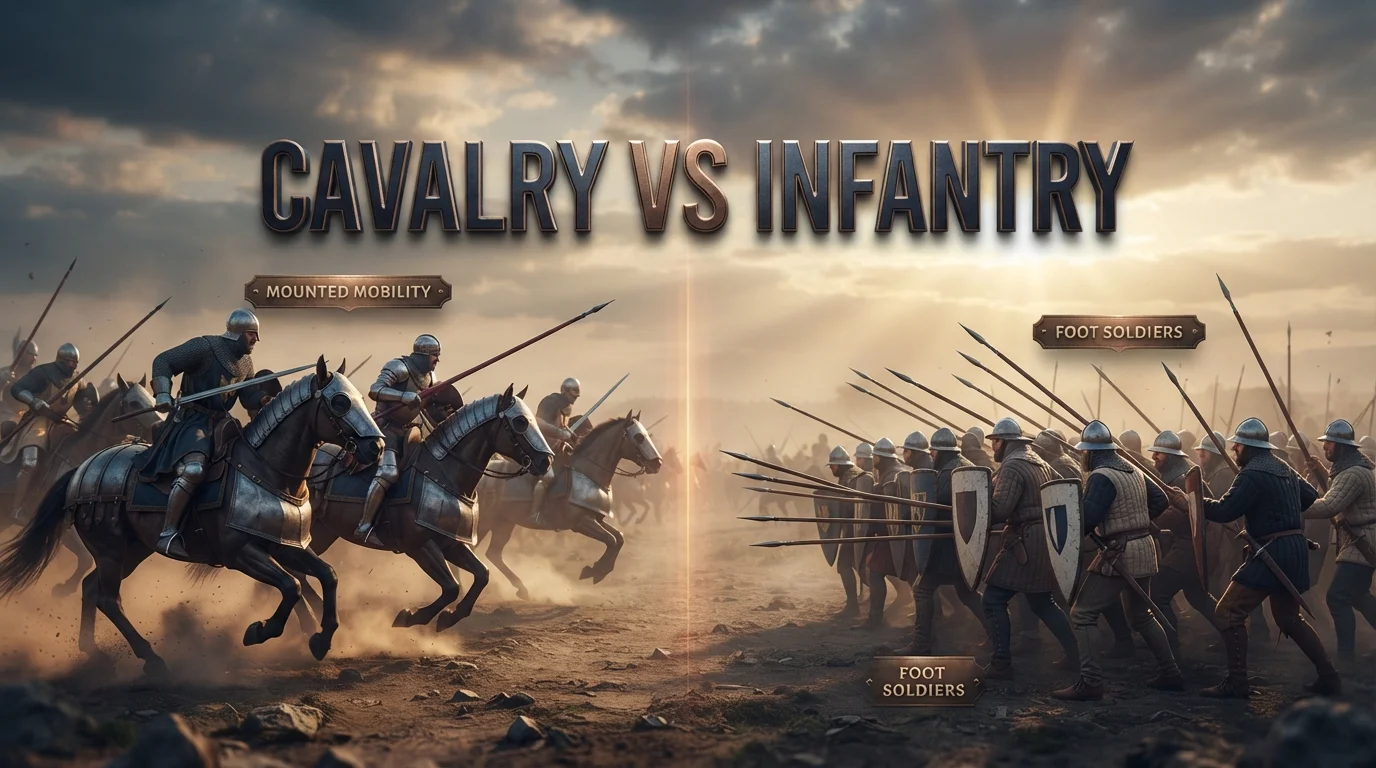
Cavalry vs Infantry
Cavalry and infantry are both military terms, but they traditionally describe different types of troops.
Infantry refers to soldiers who fight primarily on foot.
Cavalry historically referred to soldiers who fought on horseback. In modern militaries, the term can refer to units whose roles have evolved to include armored vehicles, reconnaissance, and other operations rather than traditional horseback combat.
For example:
The infantry advanced on foot.
The cavalry was sent ahead to conduct reconnaissance.
The exact organization and role of cavalry varies between military forces and historical periods, so the traditional horse-mounted definition does not describe every modern cavalry unit.
What Does Calvary Mean in the Army?
Calvary does not mean a military unit in the army. The military word is cavalry.
If you are talking about soldiers or a military unit, use:
The cavalry moved toward the front line.
Calvary has a different meaning and is primarily associated with the Christian account of Jesus’ crucifixion.
A quick memory trick is:
Cavalry = soldiers
Calvary = crucifixion
So if your sentence is about the army, soldiers, horses, armored units, or military operations, the correct spelling is cavalry.
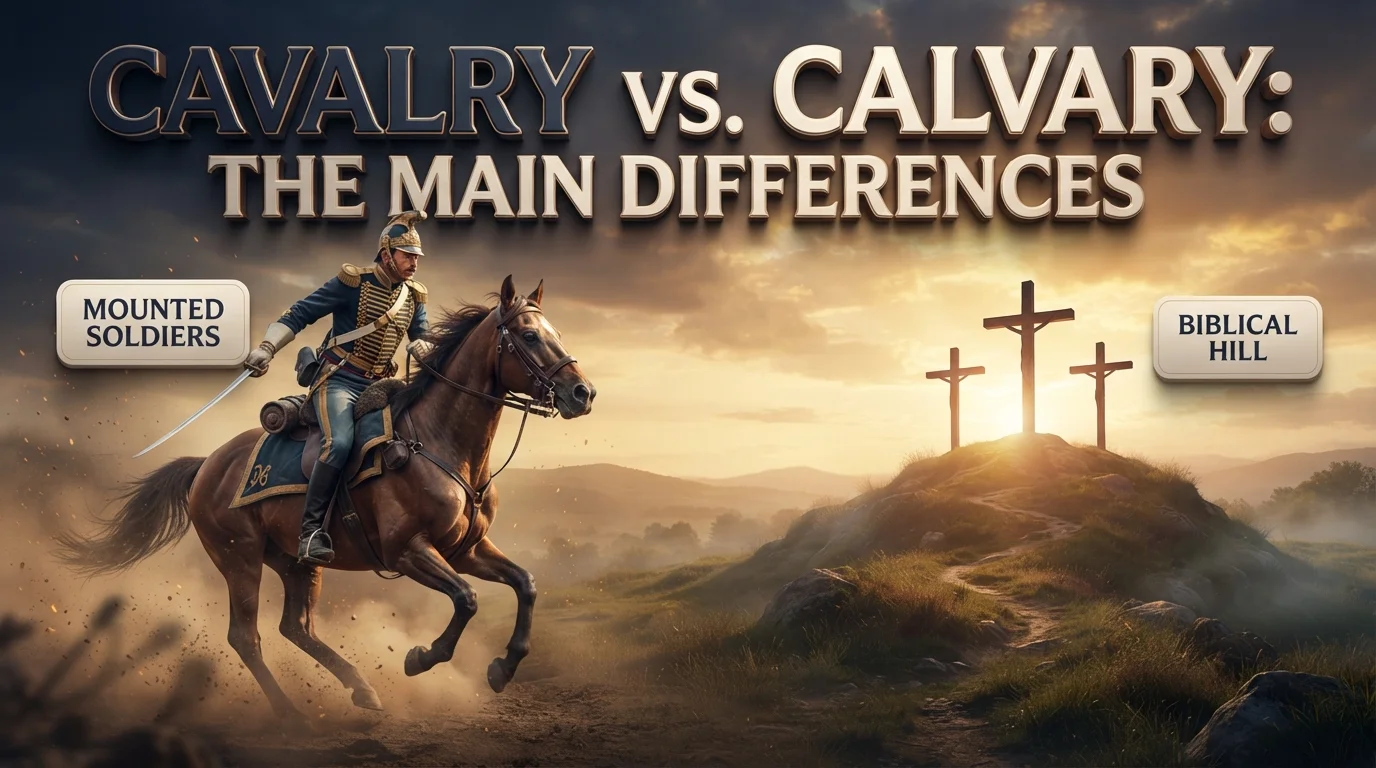
Cavalry vs. Calvary: The Main Differences
The two words differ in meaning, origin, context, and usage.
Cavalry
- Refers to military forces or soldiers
- Traditionally associated with horses
- Used in military and historical contexts
- Usually a common noun
- Connected with warfare and armies
Calvary
- Refers to the place associated with the crucifixion of Jesus
- Used primarily in Christian and religious contexts
- Usually capitalized when referring to the biblical place
- Connected with Christianity and the crucifixion
Comparison Table
| Feature | Cavalry | Calvary |
|---|---|---|
| Meaning | Military troops, traditionally mounted soldiers | Place associated with Jesus’ crucifixion |
| Context | Military, historical, warfare | Religious, Christian, biblical |
| Associated with | Soldiers and horses | Jesus and the crucifixion |
| Part of speech | Noun | Proper noun |
| Capitalization | Usually lowercase | Usually capitalized |
| Example | The cavalry entered the battlefield. | Jesus was crucified at Calvary. |
| Memory clue | Cavalry → cavalry soldiers | Calvary → Calvary and Christ |
Cavalry or Calvary: Real-World Usage Scenarios
Scenario 1: A Military Battle
Incorrect:
The calvary attacked the enemy.
Correct:
The cavalry attacked the enemy.
🎯 Lesson: The sentence is about soldiers and warfare, so cavalry is correct.
Scenario 2: A Religious Discussion
Incorrect:
Jesus was crucified at Cavalry.
Correct:
Jesus was crucified at Calvary.
🎯 Lesson: The sentence refers to the place associated with the crucifixion, so use Calvary.
Scenario 3: A Historical Novel
The commander ordered the cavalry to advance.
🎯 Lesson: Even though the story may involve religious or historical themes, the immediate meaning is military. Therefore, cavalry is the correct word.
Scenario 4: A Church Service
The pastor spoke about the sacrifice of Christ at Calvary.
🎯 Lesson: The context is Christian theology and the crucifixion, so Calvary is correct.
Scenario 5: “Send in the Cavalry”
You may also encounter the expression:
Send in the cavalry!
This phrase can be used literally for military forces or figuratively to mean bringing help or reinforcements when a difficult situation needs to be rescued.
🎯 Lesson: This expression always uses cavalry, because the original idea comes from military troops.
Common Mistakes With Cavalry and Calvary
Mistake 1: Using “Calvary” for military troops
❌ The calvary charged across the field.
✅ The cavalry charged across the field.
Why it happens:
The words have very similar spellings and pronunciations, so writers often substitute one for the other.
Mistake 2: Using “Cavalry” for the crucifixion
❌ The story describes Jesus at Cavalry.
✅ The story describes Jesus at Calvary.
Why it happens:
People often recognize cavalry as the more familiar word and accidentally use it in religious contexts.
Mistake 3: Forgetting capitalization
❌ Jesus was crucified at calvary.
✅ Jesus was crucified at Calvary.
Why it happens:
Calvary is a proper name when referring to the biblical location, so it is normally capitalized.
Why Are Cavalry and Calvary So Easy to Confuse?
The confusion comes largely from their similar spelling and pronunciation.
Both words contain the letters c-a-l-v-a-r-y, but their meanings developed from different linguistic roots.
Cavalry is associated historically with mounted military forces and ultimately relates to words connected with horses and riding.
Calvary, on the other hand, comes from the name associated with the biblical location of Christ’s crucifixion.
In other words, their similarity is mainly a spelling and sound problem—not a meaning problem.
Memory Tricks: How to Remember Cavalry vs. Calvary
Here are several easy ways to keep them straight.
🐎 Trick 1: Cavalry Has “Caval”
Think of cavalry as connected to cavalcade, cavalier, and historical riding.
Cavalry → horses → soldiers
✝️ Trick 2: Calvary Has “Cal”
Think of Calvary as a Christian term.
Calvary → Christ → crucifixion
The repeated C gives you a useful mental connection:
Calvary = Christ
🧠 Trick 3: Remember the Extra “A”
Cavalry has an extra a compared with Calvary.
Think:
Cavalry has an extra A for Army.
So:
Cavalry → A → Army
This is one of the simplest shortcuts for remembering the difference.
Cavalry and Calvary: Pronunciation
The words are also easy to confuse when spoken.
Cavalry
Cavalry is commonly pronounced approximately like:
KAV-uhl-ree
Calvary
Calvary is commonly pronounced approximately like:
KAL-vuh-ree
Because their pronunciations can sound similar in rapid speech, context becomes especially important.
When you see the word in writing, however, the meaning should determine which spelling you choose.
Expert Insight: Why the Difference Matters
From a linguistic perspective, cavalry and Calvary are a classic example of easily confused words that have become similar in form while remaining completely different in meaning.
This type of confusion is sometimes called a homophonic or near-homophonic spelling problem, depending on pronunciation and dialect.
The important lesson is that spelling should be guided by semantic context.
Ask yourself:
What am I talking about?
If the answer is soldiers, warfare, horses, or a military unit, choose cavalry.
If the answer is Jesus, Christianity, the crucifixion, or the biblical place, choose Calvary.
This context-based approach is much more reliable than trying to memorize the spellings in isolation.
Quick Test: Which Word Should You Use?
Fill in the blank with cavalry or Calvary.
- The general sent the ________ to reinforce the troops.
- The sermon focused on Christ’s sacrifice at ________.
- The ________ moved across the battlefield.
- The painting showed Jesus at ________.
Answers
- cavalry
- Calvary
- cavalry
- Calvary
The pattern is simple:
Military = cavalry
Crucifixion = Calvary