


Quick Answer
Effort is the correct spelling and a standard English word.
Affort is not recognized as a standard English word and is usually a misspelling of effort.
If you’re talking about hard work, energy, or an attempt to accomplish something, always use effort.
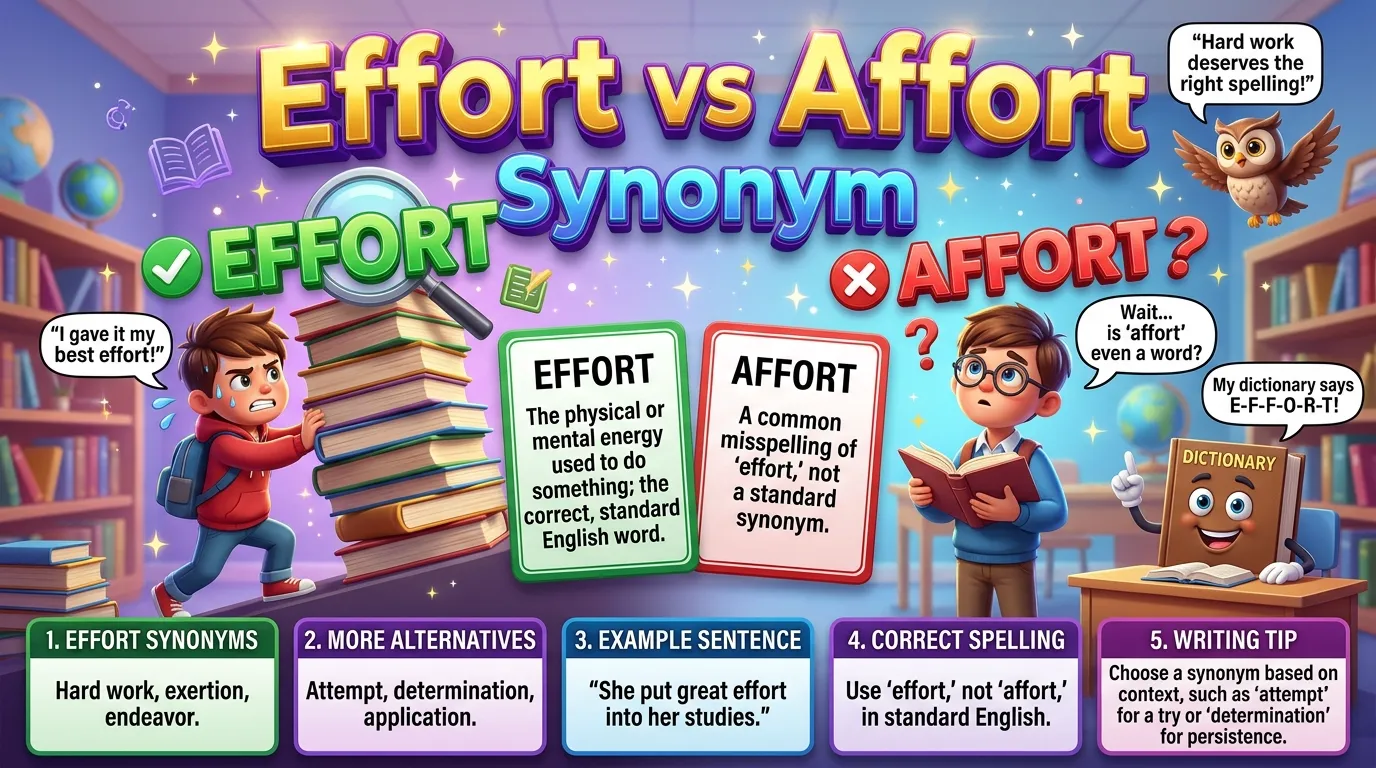
Effort vs. Affort: Synonym
The words effort and affort do not have the same status in English. Effort is a standard noun with several useful synonyms, while affort is generally an incorrect spelling and has no established synonyms of its own.
Common synonyms for effort include:
Attempt: An act of trying to do something.
Endeavor: A serious or determined effort to achieve something.
Hard work: The use of considerable time and energy to complete a task.
Exertion: The physical or mental use of energy.
Struggle: An attempt to overcome a difficulty.
Undertaking: A task or project that requires work.
Application: The act of putting energy and attention into a task.
Determination: A strong commitment to achieving a goal.
Examples:
She made an effort to learn a new language.
She made an attempt to learn a new language.
His hard work helped him complete the project.
Their collective efforts improved the team’s performance.
Although these words are related, they are not always interchangeable. For example, exertion often emphasizes the use of physical or mental energy, while attempt emphasizes trying to accomplish something.
If you meant afford rather than affort, its synonyms might include manage, have the means, or be able to pay, depending on the context.
Effort Meaning
The word effort refers to the energy, work, or determination someone uses to achieve a particular result. It can describe physical activity, mental concentration, or an attempt to overcome a challenge.
Effort is not always measured by the final result. Someone may put considerable effort into a task without succeeding immediately. The word emphasizes the work or energy invested in trying to accomplish something.
Examples of effort in different situations:
Education: She put considerable effort into preparing for her exams.
Work: The team made a special effort to finish the project on time.
Fitness: Building strength requires consistent effort and practice.
Relationships: Maintaining a strong friendship takes effort from both people.
Personal growth: He made an effort to become more confident when speaking in public.
The word can also describe how difficult an action feels. For example, “Opening the heavy door required considerable effort” means the person had to use significant physical strength.
In everyday English, effort commonly appears in expressions such as make an effort, put effort into something, a great effort, and a joint effort. These phrases describe different ways of trying, working, or contributing toward a goal.
Effort vs. Affort: Examples
The difference between effort and affort becomes clear when you compare their spelling and usage. In standard English, effort is correct when you mean work or energy, while affort is generally a spelling error.
Sentence | Correct or incorrect? | Explanation |
|---|---|---|
I made an effort to help her. | Correct | Effort means an attempt to help. |
He put effort into his business. | Correct | Effort describes the work invested. |
She made an affort to finish early. | Incorrect | Use effort, not affort. |
We appreciate your effort. | Correct | The word refers to the work someone has done. |
I cannot afford a new phone. | Correct | Afford means having enough money or resources. |
They made a great effort to win. | Correct | Effort describes their hard work and determination. |
Here are additional examples showing how to use effort naturally:
Learning a new skill takes time and effort.
Despite his best efforts, he could not solve the problem.
The students worked together in a joint effort to organize the event.
Every small effort can contribute to meaningful progress.
She made an extra effort to welcome the new employees.
One useful point is that effort can be singular or plural. Use effort when referring to work generally or one particular attempt. Use efforts when referring to multiple attempts or contributions.
For example, “Her effort was appreciated” refers to her work as a whole. “Her efforts were appreciated” can emphasize the different things she did.
Affort Meaning
“Affort” is not a standard English word in ordinary modern usage. It is most often a misspelling of effort or, in some sentences, afford. The intended correction depends on the meaning of the sentence.
If someone writes, “I made an affort to help my friend,” the correct sentence is “I made an effort to help my friend.” Here, the person means they tried to help.
However, if someone writes, “I cannot affort this car,” the intended word is probably afford: “I cannot afford this car.” This means the car is too expensive or beyond the person’s available financial resources.
Compare these examples:
Incorrect: I put a lot of affort into my homework.
Correct: I put a lot of effort into my homework.
Incorrect: I cannot affort a holiday this year.
Correct: I cannot afford a holiday this year.
The distinction is important because effort and afford have different meanings and grammatical uses. Effort is a noun, while afford is a verb.
When checking your writing, consider whether you mean the energy used to do something or the ability to pay for or manage something. That will help you choose the correct word.
Effect vs. Affect
Effect and affect are commonly confused because they look and sound similar. However, they usually serve different grammatical roles.
Effect is most commonly a noun meaning a result or consequence. Affect is most commonly a verb meaning to influence or make a difference to something.
Examples of effect:
The new schedule had a positive effect on productivity.
Lack of sleep can have a negative effect on concentration.
The medicine produced an unexpected effect.
The policy had a significant effect on the community.
Examples of affect:
Lack of sleep can affect your concentration.
The weather may affect our travel plans.
Her teacher’s advice affected her confidence.
The changes could affect the entire team.
A simple way to remember the distinction is to think of affect as an action and effect as a result.
For example, “The rain affected the match” means the rain influenced the match. “The effect of the rain was a delayed match” identifies the result.
There are exceptions: effect can be a verb meaning to bring something about, as in “effect a change,” and affect can be a noun in specialized psychology contexts. However, the usual noun-versus-verb distinction works for most everyday writing.
Put Effort Meaning
The expression “put effort” means to devote energy, time, attention, or hard work to a task or goal. In everyday English, the more natural expression is often “put effort into something” or “put a lot of effort into something.”
For example, “She puts a lot of effort into her writing” means she spends time and energy improving her work.
Examples:
You need to put effort into learning English if you want to improve.
He puts a great deal of effort into his job.
They put considerable effort into organizing the school event.
I am trying to put more effort into my relationships.
She put extra effort into preparing for the interview.
The phrase can also be used when encouraging someone. For example, “If you put more effort into your practice, you may see better results.” This means that additional work and commitment may help you improve.
Common expressions with effort include:
Make an effort: Try to do something.
Put effort into: Invest time and energy in a task.
Make every effort: Try as hard as possible.
Go to great lengths: Take considerable action to achieve something.
Put in the effort: Do the necessary work.
For example, “He made an effort to apologize” emphasizes his attempt, while “He put a lot of effort into his presentation” emphasizes the time and energy he invested.
Effort Pronunciation
The word effort is pronounced EF-ert, with the stress on the first syllable.
Deep Explanation: Affort
Definition
Affort is not a standard English word in modern usage.
Most dictionaries do not recognize it as a valid contemporary term.
Usage Rules
Avoid using affort in:
- Academic writing
- Business communication
- Emails
- Articles
- Reports
- Everyday writing
Context
People often write affort because:
- It sounds similar to effort
- They confuse it with words beginning with af-
- English pronunciation can make the initial vowel sound unclear
Examples
Incorrect:
- I appreciate your affort.
- She made a great affort.
- Their affort paid off.
Correct:
- I appreciate your effort.
- She made a great effort.
- Their effort paid off.
Key Insight
Whenever you mean hard work or an attempt to achieve something, affort should be replaced with effort.
Deep Explanation: Effort
Definition
Effort is a noun that means:
- Physical or mental exertion
- Hard work
- An attempt to achieve something
- Energy directed toward a goal
Usage Rules
Use effort whenever you’re discussing:
- Work
- Achievement
- Improvement
- Performance
- Determination
- Problem-solving
Common Contexts
- Best effort
- Team effort
- Great effort
- Extra effort
- Effort and dedication
- Effort to improve
Real Examples
- She put a lot of effort into the project.
- Their effort helped the company succeed.
- Learning a language requires consistent effort.
- We appreciate everyone’s effort.
Key Insight
Effort is the only correct spelling in standard English.
Effort vs Affort
Key Differences
- Effort is correct.
- Affort is incorrect.
- Effort appears in dictionaries.
- Affort is generally a spelling error.
- Professional writing always uses effort.
Comparison Table
| Feature | Affort | Effort |
|---|---|---|
| Standard English Word | No | Yes |
| Dictionary Recognition | No | Yes |
| Meaning | None in modern usage | Hard work or attempt |
| Formal Writing | Avoid | Use |
| Professional Usage | Incorrect | Correct |
| Example | Great affort ❌ | Great effort ✔ |
Real-World Usage Scenarios
Scenario 1
Employee: “I gave my best affort.”
Manager: “The correct word is effort.
🎯 Lesson: Professional communication requires effort.
Scenario 2
Student: “My effort improved my grades.”
Teacher: “That’s excellent.”
🎯 Lesson: Academic discussions use effort.
Scenario 3
Coach: “Your effort during practice was impressive.”
Athlete: “Thank you.”
🎯 Lesson: Sports contexts frequently use effort.
Scenario 4
Parent: “I appreciate the effort you put into your homework.”
Child: “I worked hard on it.”
🎯 Lesson: Everyday English consistently uses effort.
Scenario 5
Team Leader: “This success was a team effort.”
Staff: “We all contributed.”
🎯 Lesson: Collaboration-related phrases commonly include effort.
Common Mistakes
Mistake 1: Writing Affort Instead of Effort
Incorrect:
- Strong affort
- Great affort
- Team affort
Correct:
- Strong effort
- Great effort
- Team effort
Why It Happens
Many learners spell words based on how they sound rather than how they are written.
Mistake 2: Confusing Effort with Similar-Sounding Words
Words like:
- Affect
- Afford
- Affection
may lead people to mistakenly write affort.
Why It Happens
English spelling patterns are not always predictable.
Mistake 3: Using Affort in Professional Documents
Using affort can make writing appear unedited and unprofessional.
Always use effort.
Memory Tricks
Trick 1: Remember “E for Energy”
Effort begins with E, and effort requires Energy.
Trick 2: Think of Common Phrases
You often hear:
- Best effort
- Team effort
- Extra effort
Notice they all use effort.
Trick 3: Use the Dictionary Test
If you’re referring to work, determination, or trying to achieve something, the word is almost certainly effort.

Expert Insight
The word effort comes from Old French and ultimately traces back to Latin roots relating to exertion and strength. Over centuries, it became the standard English term for physical, mental, or emotional exertion toward a goal.
The spelling affort never developed as an accepted modern English equivalent. As a result, dictionaries, style guides, educators, editors, and professional writers consistently recognize effort as the correct form.
This is why you’ll encounter effort in business communication, academic writing, journalism, literature, and everyday conversation, while affort is generally treated as a spelling mistake.