


Quick Answer: Perc vs. Perk
Perk = a benefit, advantage, or extra.
Perc = a specialized abbreviation or slang term whose meaning depends on context.
For example:
- Free parking is a great perk.
- She perked up after hearing the good news.
- “Percs” can be used as slang for certain prescription pills.
🎯 Simple rule: If you mean a benefit or advantage, the correct word is perk.
What Does “Perk” Mean?
Perk is a common English word that can function as both a noun and a verb.
Perk as a Noun
As a noun, perk means an extra benefit or advantage.
It is especially common when talking about jobs, memberships, hotels, and other situations where someone receives additional benefits.
Free health insurance is a major perk of the job.
One perk of working from home is avoiding the commute.
Free breakfast is a nice hotel perk.
🎯 Key Insight: When perk means an advantage or extra benefit, it is usually a noun.
Perk as a Verb
As a verb, perk means to become more cheerful, lively, alert, or energetic.
The expression perk up is particularly common.
She perked up when she heard the good news.
A cup of coffee helped him perk up.
🎯 Key Insight: Perk up = become more energetic or cheerful.
What Does “Perc” Mean?
Perc is not normally the correct spelling when you mean benefit.
Its meaning depends on the context.
Perc as an Informal Shortening
In some contexts, perc can be an informal shortening related to a percolator or percolation, particularly when discussing coffee.
The old coffee perc is still working.
This use is relatively specialized and is much less common than perk.
Perc as Slang
In informal slang, perc or percs can refer to Percocet or certain prescription opioid pills.
The slang can sometimes be used loosely, so the exact meaning should be determined from context.
🎯 Important: This slang meaning is completely different from perk, meaning a benefit.
Perc vs. Perk: Main Difference
| Feature | Perc | Perk |
|---|---|---|
| Common meaning | Context-dependent abbreviation/slang | Benefit or advantage |
| Standard everyday word? | Less common | Yes |
| Can mean a job benefit? | ❌ No | ✅ Yes |
| Can be a verb? | Specialized uses | ✅ Yes |
| Common phrase | Depends on context | “Perk up” |
| Example | “The coffee perc is old.” | “Free parking is a perk.” |
| Slang use | Can refer to prescription pills | Generally no |
| Best synonym | Depends on context | Benefit / advantage |
Perc vs. Perk: The Biggest Difference
The easiest distinction is:
Perk = benefit
Perc = context-dependent term
Compare:
Free parking is a perk of the job.
Here, perk means an extra benefit.
But:
The song mentions “percs.”
Here, percs may be slang for prescription opioid pills.
🎯 Lesson: If you’re talking about advantages, benefits, or extras, use perk, not perc.
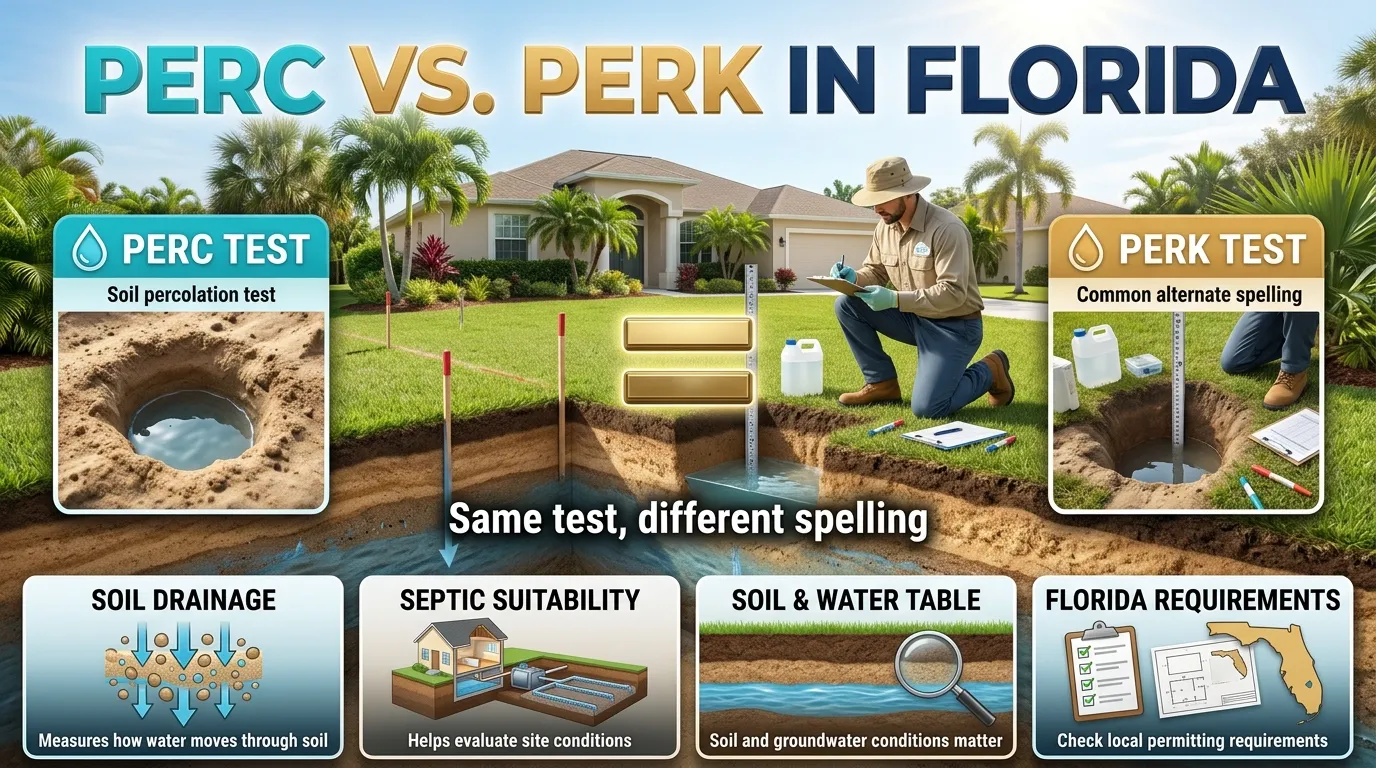
Perc vs. Perk in Florida
“Perc” and “perk” sound alike, but they have different meanings. When discussing land, septic systems, or property development in Florida, perc is the term associated with a percolation test. A perk is a benefit, advantage, or special privilege.
A perc test measures how quickly water drains through soil. It helps determine whether the soil may be suitable for a septic drainfield, which treats wastewater from a property that is not connected to a public sewer system.
For example, a buyer might ask, “Has this Florida property passed a perc test?” before purchasing land intended for a home with a septic system.
The word perk appears in a different context. Someone might say, “One perk of buying this property is its large backyard.” Here, perk means an advantage, not a soil test.
In everyday conversation, people sometimes use “perk test” when they mean “perc test.” When discussing septic-system approval, soil drainage, or building on vacant land, “perc test” is the appropriate term.
Florida property owners should also understand that passing a perc test does not automatically guarantee septic-system approval or a building permit. Local conditions, soil evaluations, groundwater levels, and applicable regulations can affect whether a proposed system is approved.
What to Do If Your Land Fails a Perc Test
If your land fails a perc test in Florida, it does not automatically mean the property is unusable or that you cannot build a home. However, it may mean the soil or site conditions are unsuitable for a conventional septic drainfield. Your next steps depend on why the test failed and whether another approved wastewater solution is available.
Start by reviewing the results with the professional who performed the site evaluation. Soil that drains too slowly, drains too quickly, or has a high seasonal groundwater level may require a different approach.
Here are some possible steps to consider.
1. Request a detailed site evaluation. Ask whether the problem involves soil permeability, groundwater depth, unsuitable soil layers, or another site condition. Understanding the cause helps determine which alternatives are realistic.
2. Investigate another suitable location on the property. A large parcel may contain an area with better soil or more favorable groundwater conditions. A qualified evaluator can determine whether another location meets applicable requirements.
3. Ask about an alternative septic system. Depending on the site and local regulations, an engineered or advanced treatment system may be permitted where a conventional system is unsuitable. Approval is not guaranteed.
4. Check whether public sewer service is available. If a nearby public sewer system can legally serve the property, connecting to it may eliminate the need for an individual septic drainfield. Connection costs, availability, and local requirements must be confirmed.
5. Review the property’s development potential. If neither an approved septic system nor a public sewer connection is feasible, the land may have significant limitations for residential construction. Consult the appropriate permitting authority before investing in major site work.
In Florida, the septic permitting authority depends on the county. The Florida Department of Environmental Protection handles the program in certain counties, while local county health departments handle permitting elsewhere.
Verdict: A failed perc test is a reason to investigate alternatives, not to assume the land is worthless. Confirm the reason for failure and obtain professional guidance before spending money on a redesign or purchasing the property.
Perc Test Cost
The cost of a perc test in Florida depends on the property, soil conditions, number of test locations, excavation requirements, and professional fees. Some evaluations are relatively straightforward, while difficult sites may require more extensive investigation.
For preliminary budgeting, a basic perc test or site evaluation may cost several hundred dollars. More complex evaluations involving extensive excavation, additional testing, engineering, or septic-system design can cost considerably more.
The main factors affecting perc test cost include:
Property size: Larger or irregularly shaped parcels may require evaluation at multiple locations.
Soil conditions: Difficult soil conditions may require additional investigation.
Excavation equipment: Some sites need a backhoe or other machinery to prepare test holes or exploratory pits.
Professional services: A private site evaluator, soil specialist, or engineer may charge different fees depending on the work required.
Government fees: Application, evaluation, and permitting fees may be charged separately.
Retesting: If the initial evaluation identifies a problem, additional testing may increase the total cost.
It is important to distinguish the cost of a basic perc test from the cost of a complete septic site evaluation and system design. These are not necessarily the same service.
Before hiring anyone, request an itemized estimate explaining whether excavation, official documentation, application fees, and any required follow-up testing are included.
Verdict: Budget for several hundred dollars for a straightforward evaluation, but obtain a local quote before relying on a specific figure. Complex sites and engineered septic solutions can cost substantially more.
Who Performs a Perc Test?
A perc test is generally performed by a qualified soil-testing professional or site evaluator, although the exact requirements depend on the location and purpose of the test.
In Florida, a septic system requires an approved site evaluation to determine whether the property can support an onsite sewage treatment and disposal system. A qualified professional may perform the evaluation, or the relevant permitting authority may provide the service.
Depending on the circumstances, the person involved may be a soil scientist, engineer, septic-system designer, or another appropriately qualified evaluator.
The process typically involves examining the soil, assessing site conditions, and determining whether the proposed drainfield location meets applicable requirements. The evaluation may consider soil characteristics, groundwater levels, drainage conditions, and the available area for the system.
If you are preparing to build a house, do not assume that a test conducted independently by a homeowner will satisfy permitting requirements. The authority responsible for approving the septic system determines what evaluation and documentation it will accept.
Before scheduling the test, ask the relevant Florida permitting office:
Which professionals are authorized to perform the evaluation?
Can the agency conduct the evaluation itself?
What site plans and property information are required?
Does the proposed project require additional soil testing or engineering?
What fees and documentation apply?
Verdict: Contact the appropriate Florida septic permitting authority first, then hire a qualified professional whose evaluation meets the applicable requirements.
Perc Test Near Me
If you are searching for a perc test near me in Florida, start with the agency responsible for septic-system permitting in your county. It can explain the local evaluation process and help you determine whether to arrange testing through the agency or a private professional.
The correct contact depends on the county where the property is located. Since January 2, 2025, the Florida Department of Environmental Protection has handled septic-system permitting in 16 counties, primarily in the Panhandle. County health departments continue to handle permitting in other Florida counties.
When looking for a nearby perc test provider, consider the following options.
Your county health department: This is a useful starting point for confirming local septic requirements, evaluation procedures, and applicable fees.
The Florida Department of Environmental Protection: If your property is in a county covered by its onsite sewage program, the department can explain the relevant process.
Private site evaluators: Qualified professionals may offer soil and site evaluations for residential construction, vacant land purchases, or septic-system planning.
Septic-system designers and engineers: These professionals may be helpful if the property has difficult soil conditions or requires an alternative wastewater system.
Before booking an appointment, confirm that the provider’s work will be accepted for your intended purpose. Ask about the total fee, expected turnaround time, excavation requirements, and whether an official report is included.
A property that appears suitable for construction may still face septic-system restrictions because of groundwater conditions, setbacks, or other site limitations.
Verdict: The best place to find a perc test near you is the permitting authority for the county where your land is located. Confirm the requirements before paying for private testing.
Failed Perc Test Alternatives
If a conventional perc test fails, several alternatives may be worth investigating. The right option depends on the reason for failure, the size of the property, local regulations, groundwater conditions, and whether public sewer service is available.
Alternative septic systems: Some sites may qualify for an engineered or advanced treatment system. These systems can treat wastewater differently from conventional septic systems, but they still require suitable site conditions and regulatory approval.
An alternative drainfield location: If the original test area is unsuitable, another part of the property may have more favorable soil conditions. A qualified evaluator can determine whether another location is viable.
Public sewer connection: If a public sewer line can serve the property, connecting to it may provide an alternative to an individual septic system. Confirm connection availability, capacity, fees, and local requirements.
Additional soil or groundwater evaluation: Further investigation may clarify whether the initial result reflects a specific problem with the tested location or a broader limitation affecting the parcel.
Reconsidering the proposed development: If wastewater disposal cannot be approved, you may need to reconsider the intended use of the land. A failed test can affect whether a proposed home or other development is feasible.
It is important not to assume that adding sand, changing the drainage pattern, or moving soil will automatically make a property suitable for a septic system. Unauthorized grading or soil alterations may create additional problems and will not necessarily satisfy permitting requirements.
Before choosing an alternative, request a professional assessment and written confirmation of the applicable approval process.
Verdict: Engineered septic systems, another approved drainfield location, and public sewer connections are possible alternatives, but availability depends on the property’s conditions and local regulations.
Do You Need a Perc Test for City Sewer?
Generally, you do not need a perc test for wastewater disposal if your property connects to an available public sewer system rather than using a septic system. A perc test is primarily associated with evaluating soil for onsite wastewater disposal.
However, connecting to a public sewer does not mean that every other property approval requirement disappears. The local utility or municipality may require a connection permit, capacity confirmation, inspection, or other documentation.
There are several situations to consider.
Property with an available public sewer connection: If the property is approved to connect to the municipal sewer system, a perc test is generally unnecessary for that connection itself.
Property without public sewer access: If the property must use a septic system, an approved site evaluation may be required before the system can be permitted.
Property near a sewer line: A sewer line nearby does not automatically mean that connection is available or mandatory. The local utility must confirm whether the property can connect and whether any special requirements apply.
Property with an existing septic system: A home may already have an approved septic system even if sewer service later becomes available. Whether a connection is required depends on applicable local rules and circumstances.
Before purchasing vacant land, verify the actual sewer connection status with the local utility rather than relying solely on a listing description or the apparent location of nearby sewer infrastructure.
Verdict: A perc test is generally unnecessary when a property uses an approved public sewer connection, but confirm the utility’s requirements and the property’s permitted wastewater arrangement.
How Long Is a Perc Test Good For?
There is no single expiration period that applies to every perc test in Florida. The validity of a test or site evaluation depends on the applicable regulations, the property’s circumstances, and the requirements of the agency responsible for approval.
You may encounter general guidance suggesting that perc tests remain valid for two to five years. However, that timeframe should not be treated as a universal Florida rule. An approved evaluation may have specific conditions, and an older result may need to be reviewed before it can support a new permit application.
Several factors can affect whether an earlier evaluation remains useful:
Age of the evaluation: The permitting authority may have specific requirements for older reports or approvals.
Changes to the property: Grading, excavation, fill placement, or altered drainage can affect site conditions.
Groundwater conditions: Seasonal groundwater levels can influence septic-system suitability.
Changes in regulations: Updated requirements may affect whether an older evaluation can be used for a new project.
Changes to the proposed system: A different building, drainfield location, or wastewater design may require additional evaluation.
If you are buying vacant land, ask for a copy of the previous site evaluation and any associated septic approval. Then confirm with the responsible agency whether the documents remain acceptable for your intended project.
Do not assume that an old passing test guarantees that a new septic system will be approved. A site evaluation is only one part of the permitting process.
Real-World Usage Scenarios
Scenario 1: Workplace Benefits
“What’s the best perk of working here?”
The speaker is asking about an additional benefit.
“The flexible schedule is my favorite perk.”
🎯 Lesson: Perk is very common when discussing employment benefits.
Scenario 2: Hotel Benefits
“Free breakfast is one of the perks of staying here.”
Here, perks means extra benefits.
🎯 Lesson: A perk doesn’t have to be related to employment.
Scenario 3: Becoming More Energetic
“He perked up after getting some rest.”
Here, perk is a verb.
🎯 Lesson: Perk up means to become more lively, alert, or cheerful.
Scenario 4: Informal Drug Slang
“The lyrics mention percs.”
In this context, percs may be slang referring to prescription opioid pills.
🎯 Lesson: Perc/percs can have a completely different slang meaning from perk.
Common Mistakes
Mistake 1: Writing “Perc” When You Mean “Benefit”
❌ Free parking is a great perc.
✅ Free parking is a great perk.
Why it happens: The two words are pronounced similarly, so they are easy to mix up when writing.
Mistake 2: Assuming “Perc” Is an Alternative Spelling of “Perk”
❌ Not in the meaning benefit.
✅ Perk is the correct spelling for an advantage or extra benefit.
Mistake 3: Confusing “Perk” and “Perk Up”
The job has many perks. → noun
She perked up. → verb
Both are correct, but they perform different grammatical functions.
Mistake 4: Assuming Every “Perc” Has the Same Meaning
The meaning of perc depends on context. It can be used in specialized or slang contexts, so you should look at the surrounding sentence.
Perk vs. Benefit vs. Bonus
These words are related, but they aren’t always interchangeable.
| Word | Meaning | Example |
|---|---|---|
| Perk | Extra advantage | “Free parking is a perk.” |
| Benefit | Something that provides an advantage | “Health insurance is a benefit.” |
| Bonus | An additional reward, often money | “She received a performance bonus.” |
Easy Distinction
Perk = extra advantage
Benefit = something helpful or advantageous
Bonus = extra reward
🎯 Key Insight: In workplace English, perk often refers to an additional benefit beyond basic salary.
Memory Tricks: Perc vs. Perk
⭐ Perk = Benefit
Remember:
PERK = an EXTRA
If something is an extra advantage, it’s a perk.
☕ Perc = Percolator
For the coffee-related use:
Perc → Percolator
💊 Perc = Slang
For the slang meaning:
Perc/percs → prescription-pill slang
One-Line Memory Trick
A PERK gives you an advantage; a PERC depends on the context.
Expert Insight: Why “Perc” and “Perk” Get Confused
The confusion is primarily phonetic. In many accents, the words sound extremely similar, especially in fast speech.
However, their meanings are unrelated in ordinary usage.
Perk has an established place in standard English:
Employee perks include flexible hours and free parking.
Perc, by contrast, is much more dependent on context and is commonly encountered as an abbreviation, informal shortening, or slang expression.
Therefore, in professional, academic, or general writing, if you mean benefit, there is no reason to use perc.
Quick Test: Perc or Perk?
1. “Free parking is a job ___.”
Perk ✅
2. “She began to ___ up after hearing the news.”
Perk → perk up ✅
3. “The company offers several employee ___.”
Perks ✅
4. “The old coffee ___ is still in the kitchen.”
Perc can be used informally in connection with a percolator. ✅
5. “The song refers to ___.”
Percs may be slang for prescription opioid pills, depending on context. ✅