
Quick Answer
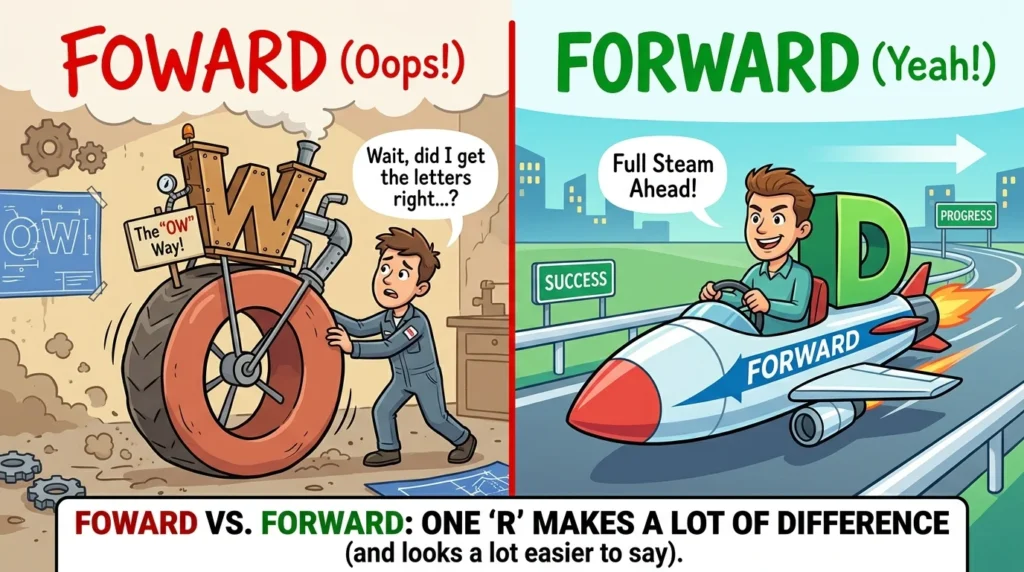
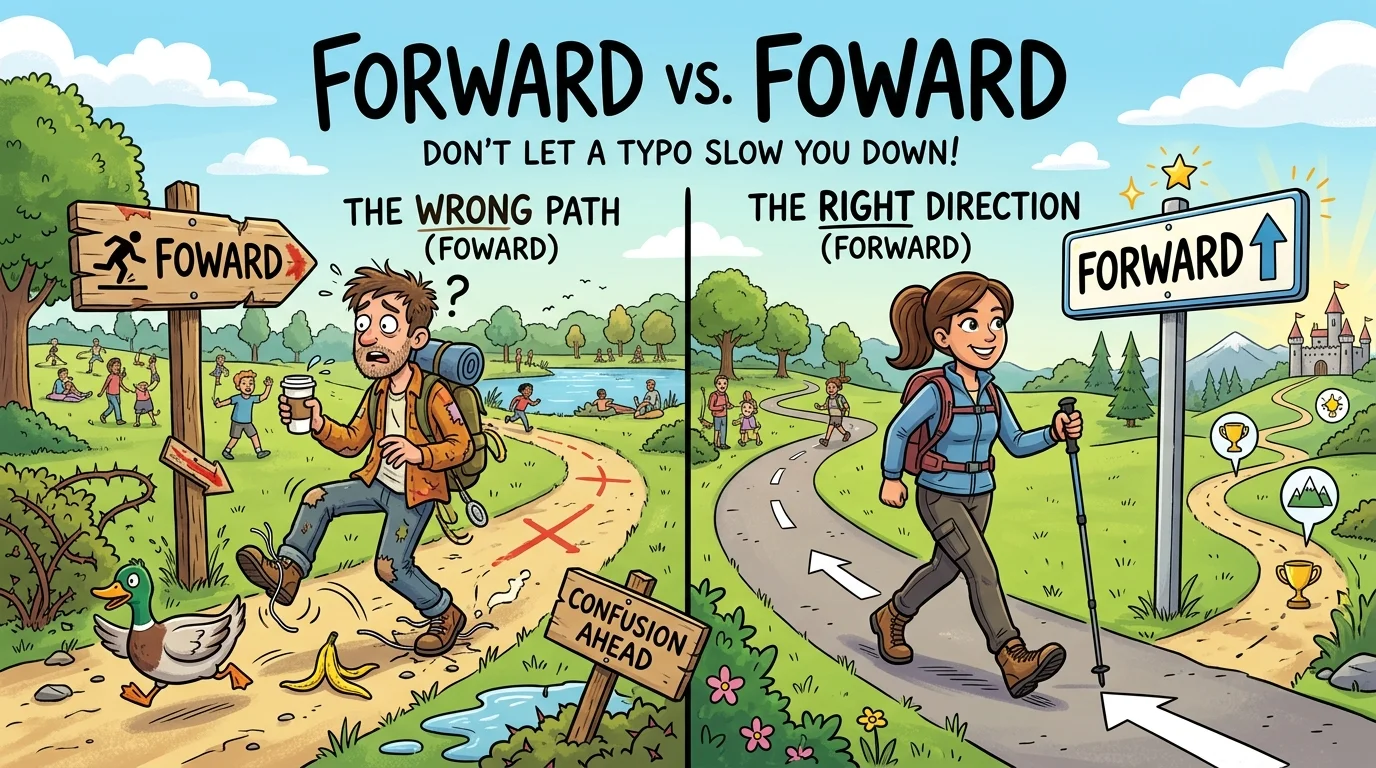
Forward is the correct spelling and is widely used as an adjective, adverb, verb, and noun.
Foward is an incorrect spelling of forward and is considered a typo or misspelling in modern English.
If you’re wondering which one to use, choose forward every time.
What Does “Forward” Mean?
Forward is a versatile English word that generally means toward the front, ahead, onward, or progressing.
It can function as multiple parts of speech depending on the sentence.
Forward as an Adverb
Used to indicate movement toward the front.
Examples:
- Please move forward in the line.
- She stepped forward to speak.
- The car rolled forward slowly.
Forward as an Adjective
Used to describe something positioned ahead or relating to progress.
Examples:
- The forward section of the ship was damaged.
- We need a forward-thinking strategy.
- He has a forward attitude toward innovation.
Forward as a Verb
Means to send or pass something on.
Examples:
- Please forward the email to the manager.
- I forwarded the documents yesterday.
- Can you forward this message to the team?
Forward as a Noun
Commonly used in sports.
Examples:
- The team’s forward scored two goals.
- She plays as a forward in soccer.
Key Insight
Forward is a standard English word accepted worldwide and used in business, education, sports, technology, and everyday communication.
What Does “Foward” Mean?
Foward has no accepted meaning in modern standard English.
It is generally considered:
- A spelling mistake
- A typographical error
- A misspelling of forward
Examples of Incorrect Usage
❌ Please move foward.
❌ I will foward the email.
❌ Let’s look foward to the future.
Correct Versions
✅ Please move forward.
✅ I will forward the email.
✅ Let’s look forward to the future.
Key Insight
If you see foward, it should almost always be corrected to forward.
Foward vs Forward: Key Differences
Quick Comparison
| Feature | Foward | Forward |
|---|---|---|
| Meaning | No accepted meaning | Ahead, onward, send, progress |
| Dictionary Recognition | No | Yes |
| Correct English Spelling | No | Yes |
| Used in Professional Writing | No | Yes |
| Accepted Worldwide | No | Yes |
| Example | Incorrect | Correct |
Difference at a Glance
Forward
- Correct spelling
- Recognized by dictionaries
- Used in formal and informal writing
- Functions as multiple parts of speech
Foward
- Incorrect spelling
- Not recognized in standard English
- Usually a typo
- Should be replaced with forward
Real-World Usage Scenarios
Example 1: Workplace Email
❌ Can you foward the report?
✅ Can you forward the report?
🎯 Lesson: When sending documents or emails, always use forward.
Example 2: Physical Movement
❌ Step foward and introduce yourself.
✅ Step forward and introduce yourself.
🎯 Lesson: Movement toward the front requires forward.
Example 3: Looking Ahead
❌ We are foward-thinking leaders.
✅ We are forward-thinking leaders.
🎯 Lesson: The compound adjective is always forward-thinking.
Example 4: Future Plans
❌ I look foward to meeting you.
✅ I look forward to meeting you.
🎯 Lesson: The phrase look forward to is fixed and always spelled with an “r.”
Example 5: Sports Context
❌ The foward scored a goal.
✅ The forward scored a goal.
🎯 Lesson: In sports, the player position is called a forward.
Common Mistakes People Make
Mistake 1: Dropping the “r”
Many writers accidentally omit the letter r when typing quickly.
Why it happens:
- Fast typing
- Autocorrect failures
- Pronunciation habits
Correction
❌ foward
✅ forward
Mistake 2: Email Terminology
Because email forwarding is a common task, people frequently mistype the word.
Correct phrase:
✅ Forward the email
Incorrect phrase:
❌ Foward the email
Mistake 3: The Phrase “Look Forward To”
This is one of the most commonly misspelled expressions in English.
Correct
✅ I look forward to hearing from you.
Incorrect
❌ I look foward to hearing from you.
Memory Tricks to Remember the Difference
Trick 1: Remember the Word “For”
The correct spelling begins with for.
FOR + WARD = FORWARD
Since you’re moving “for” the future or “for” progress, think of forward.
Trick 2: Think of “Ward”
The ending ward appears in many directional words:
- Forward
- Backward
- Upward
- Downward
- Toward
This pattern helps reinforce the correct spelling.
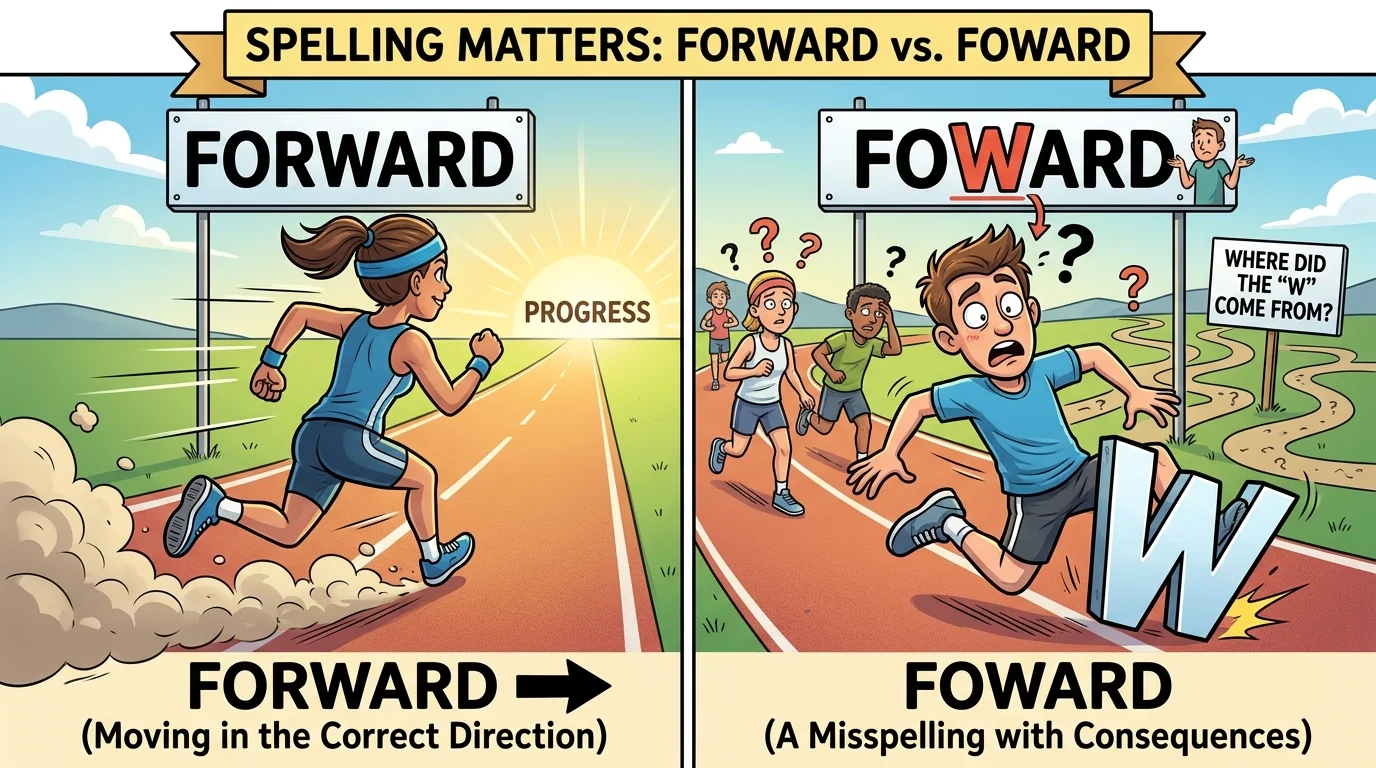
Trick 3: Spot the Missing Letter
If you write foward, ask yourself:
“Where did the r go?”
The correct spelling always includes the r after fo.
Expert Insight
From a linguistic perspective, forward originates from older English forms combining elements meaning “before” and “direction.” Over centuries, it became the standard spelling throughout English-speaking regions.
Unlike many spelling debates that involve regional differences—such as licence vs license or colour vs color—there is no legitimate variant here.
Forward is the universally accepted spelling in both American and British English.
Therefore:
- American English uses forward
- British English uses forward
- Canadian English uses forward
- Australian English uses forward
There is no recognized standard English context where foward is preferred.