
Quick Answer
Villain is the correct English spelling and refers to an evil character, wrongdoer, or antagonist.
Villian is a spelling mistake and is not recognized as a standard English word.
If you’re writing in English, always use villain.
What Does “Villain” Mean?
Definition
A villain is a person who performs evil actions, causes harm, or opposes the hero in a story.
The word can also describe a dishonest, cruel, or morally bad person in real life.
Usage Rules
Use villain when referring to:
- An antagonist in a story
- A criminal or wrongdoer
- Someone who behaves dishonestly or cruelly
- A person responsible for a problem
Examples
- The villain tried to take over the kingdom.
- Every superhero needs a memorable villain.
- The detective finally caught the villain.
- Many classic movies feature a powerful villain.
Key Insight
The word villain is commonly used in literature, movies, television, comics, and everyday conversation.
What Does “Villian” Mean?
Definition
Villian is not a standard English word.
It is simply a misspelling of villain.
Usage Rules
There are no accepted grammar rules for using villian because dictionaries do not recognize it as a correct spelling.
Examples
Incorrect examples:
- ❌ The villian escaped from prison.
- ❌ The movie’s villian was terrifying.
- ❌ Batman fought the villian.
Correct versions:
- ✅ The villain escaped from prison.
- ✅ The movie’s villain was terrifying.
- ✅ Batman fought the villain.
Key Insight
Whenever you see villian, it should almost always be corrected to villain.
Villain vs Villian: Key Differences
Bullet Point Differences
- Villain is the correct spelling.
- Villian is a misspelling.
- Villain appears in dictionaries.
- Villian does not appear as a standard word.
- Villain is used in books, movies, and journalism.
- Villian should be avoided in all forms of writing.
Comparison Table
| Feature | Villain | Villian |
|---|---|---|
| Correct English Spelling | Yes | No |
| Dictionary Recognition | Yes | No |
| Meaning | Evil character or wrongdoer | None |
| Professional Writing | Correct | Incorrect |
| Literary Usage | Common | Incorrect |
| Example | The villain was defeated. | The villian was defeated. |
Villain vs Antagonist: Meaning and Difference
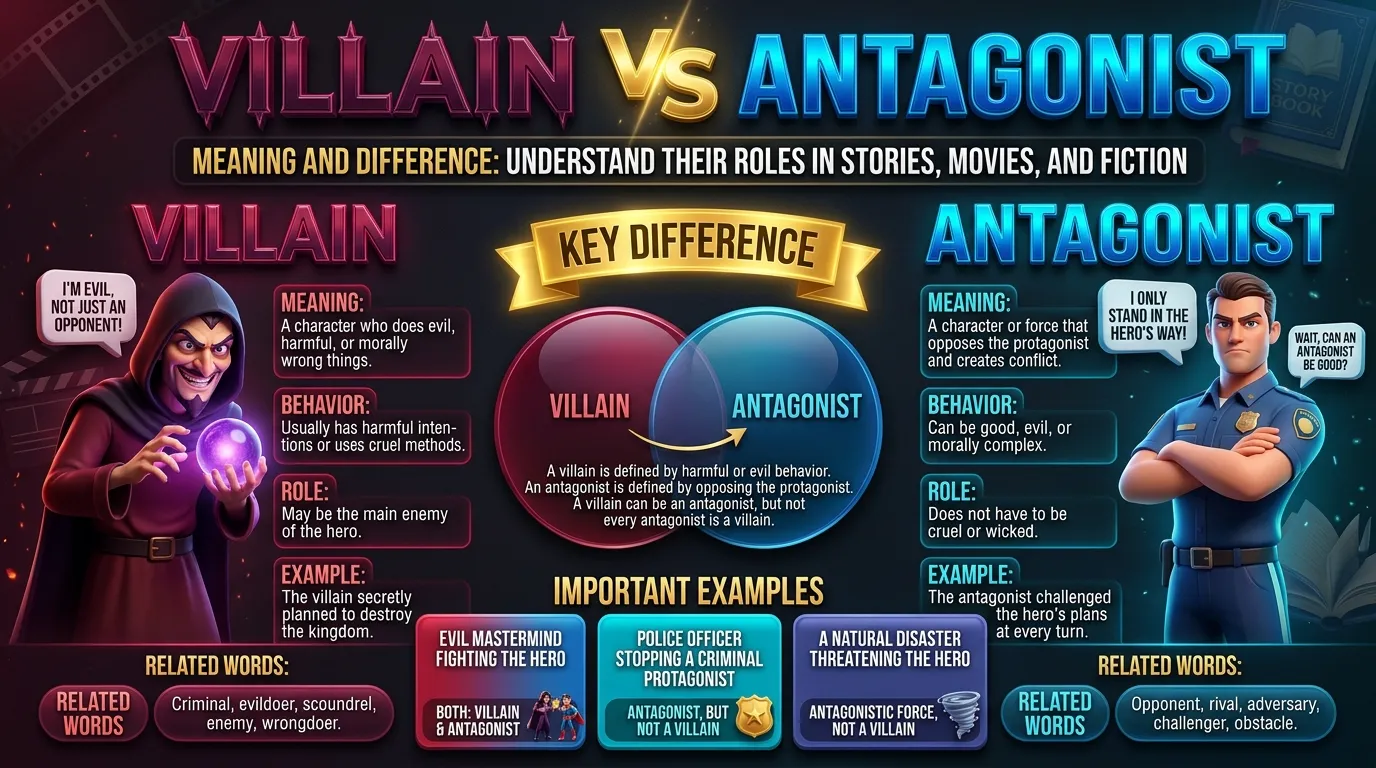
The words villain and antagonist are often used interchangeably, especially when discussing movies, novels, anime, and fictional characters. However, they do not have exactly the same meaning. A villain is a character who behaves cruelly, causes harm, or deliberately does wrong things. An antagonist is a character or force that opposes the main character and creates conflict in a story.
The biggest difference is that a villain is usually defined by their evil actions or intentions, while an antagonist is defined by their role in the story. Not every antagonist is a villain. For example, a police officer trying to stop a criminal protagonist can be an antagonist without being evil. Similarly, a villain can sometimes be a secondary character rather than the main antagonist.
Villain Character: Meaning, Traits, and Examples
A villain character is a fictional person who creates trouble, causes conflict, or acts against the interests of other characters. Villains often serve as the main source of danger or opposition in a story.
A well-developed villain is not necessarily evil without a reason. Some villains have complicated backgrounds, personal struggles, emotional wounds, or beliefs that influence their decisions.
Common characteristics of a villain include:
Cruelty: They deliberately hurt or mistreat others.
Manipulation: They influence people through lies or deception.
Ambition: They may want power, wealth, control, or recognition.
Selfishness: They prioritize their own interests over others.
Revenge: They may seek punishment against someone who wronged them.
Lack of empathy: They often ignore the suffering of others.
For example, a fictional king who destroys villages to expand his kingdom could be considered a villain. A scientist who creates dangerous experiments to gain unlimited power could also play the role of a villain.
However, villains do not always have to be completely evil. Some stories introduce morally complicated villains whose motivations make readers question whether their actions are entirely unjustified.
Villain vs Villain Fights: What Does It Mean?
Villain vs villain fights refer to battles between two characters who both have villainous personalities, goals, or intentions. Instead of a traditional hero fighting an evil character, two opposing villains compete against each other.
These fights are often entertaining because both characters may possess extraordinary abilities, intelligence, strength, or dangerous ambitions.
For example, imagine two fictional crime leaders fighting over control of a city. Neither character represents the traditional hero, and both want to defeat the other for personal gain.
Common reasons behind villain vs villain fights include:
Competition for power and control.
Revenge for past betrayals.
Conflicting ambitions and goals.
Battles over territory or resources.
Personal rivalries and broken alliances.
These confrontations can make a story more unpredictable because viewers cannot always identify a morally good side.
Villain vs Villain Movies: Popular Examples
Movies featuring villain vs villain conflicts offer something different from traditional hero-versus-villain stories. They allow audiences to watch powerful or morally questionable characters compete against each other.
Here are some popular movies featuring notable villain-versus-villain conflicts or rivalries:
1. Godzilla vs. Kong (2021)
A monster-versus-monster confrontation.
Godzilla and Kong face each other in spectacular battles. Although they are not conventional human villains, their conflict delivers the excitement of two powerful opponents fighting for dominance.
2. Freddy vs. Jason (2003)
Two iconic horror antagonists.
Freddy Krueger and Jason Voorhees are both terrifying horror characters. Their confrontation brings two recognizable fictional killers into direct competition.
3. Alien vs. Predator (2004)
Two dangerous fictional species.
The movie brings together two famous science-fiction creatures. Their confrontation creates an intense survival battle.
4. Batman v Superman: Dawn of Justice (2016)
A conflict between two opposing heroes.
Batman and Superman are not traditional villains, but their ideological disagreement creates a major confrontation between two powerful characters.
5. King Kong vs. Godzilla (1962)
A classic monster rivalry.
This earlier movie features two famous giant creatures fighting against each other in an iconic cinematic showdown.
Not every example is technically a villain-versus-villain story. Some are monster battles or conflicts between morally different opponents. The common attraction is seeing two powerful characters face each other without relying on a traditional hero-versus-villain formula.
Villain Pronunciation
The word villain has two syllables, with the stress placed on the first syllable. It is pronounced differently from how some people expect when reading its spelling.
A useful pronunciation tip is to avoid giving the second syllable a strong, separate emphasis. The first syllable carries the stress.
Villain vs Villain Fights in Anime
Villain vs villain fights in anime are battles between two antagonistic or morally questionable characters. These confrontations often involve powerful abilities, personal rivalries, competing ambitions, and dramatic twists.
Anime fans enjoy these matchups because they can reveal how different characters use their intelligence, strength, and special powers.
Here are some recognizable examples:
1. Frieza vs. Cell – Dragon Ball Z
A popular hypothetical villain matchup.
Frieza and Cell are two major villains from the Dragon Ball universe. Both possess incredible strength and destructive abilities. Their hypothetical battle is a popular discussion among fans.
2. Madara vs. Obito – Naruto Shippuden
Two powerful characters with conflicting ambitions.
Madara and Obito share connections to the same larger plan, but their relationship involves manipulation, competing interests, and disagreements about how to achieve their goals.
3. Sukuna vs. Mahito – Jujutsu Kaisen
Two dangerous cursed spirits.
Both characters are exceptionally dangerous, but they have very different personalities and attitudes toward power. Their interactions create an interesting villain-versus-villain dynamic.
4. DIO vs. Kars – JoJo’s Bizarre Adventure
Two iconic antagonists from different story arcs.
DIO and Kars are powerful antagonists with ambitious personalities. A direct fight between them is a popular hypothetical matchup among fans.
5. Light Yagami vs. Johan Liebert – Death Note and Monster
A hypothetical battle of intelligence.
Light and Johan are two psychologically complex antagonists from different anime series. A confrontation between them would be more about manipulation, strategy, and intelligence than physical strength.
Some of these are hypothetical matchups rather than actual fights shown in their anime. They remain interesting because fans enjoy comparing the abilities, personalities, and strategies of different villains.
Correct Spelling of Villain
The correct spelling is VILLAIN.
The word villain refers to an evil, wicked, or harmful person, especially a character who opposes the hero in a fictional story.
Here is the correct letter-by-letter spelling:
V
I
L
L
A
I
N
Villain is the accepted spelling in both British and American English. There is no spelling difference between the two varieties.
Examples:
The villain escaped before the police arrived.
Everyone feared the villain in the movie.
The author created a mysterious villain for her novel.
The hero finally defeated the villain.
Quick memory tip: Remember the spelling as V-I-L-L-A-I-N. The word has two Ls and ends with A-I-N, not I-A-N.
Real-World Usage Scenarios
Scenario 1
❌ The villian stole the treasure.
✅ The villain stole the treasure.
🎯 Lesson: Villain is the correct spelling for an evil character.
Scenario 2
❌ The superhero defeated the villian.
✅ The superhero defeated the villain.
🎯 Lesson: The word always ends with -ain, not -ian.
Scenario 3
❌ The novel’s main villian was clever.
✅ The novel’s main villain was clever.
🎯 Lesson: Books and stories use the spelling villain.
Scenario 4
❌ The police finally arrested the villian.
✅ The police finally arrested the villain.
🎯 Lesson: Villain can refer to real-life criminals as well as fictional characters.
Scenario 5
❌ Everyone knew who the villian was.
✅ Everyone knew who the villain was.
🎯 Lesson: Remember the correct letter order: a before i in the final syllable.
Common Mistakes
Mistake 1: Switching the Letters “A” and “I”
Many people accidentally write villian because they reverse the letters.
Why It Happens
English contains many words ending in “-ian,” causing writers to assume villain follows the same pattern.
Correction
Remember that the correct ending is -ain.
Mistake 2: Typing Too Quickly
Fast typing often causes the letters to be transposed.
Why It Happens
The words look visually similar.
Correction
Proofread carefully and verify the spelling.
Mistake 3: Learning the Word by Sound Alone
Pronunciation does not clearly reveal the spelling.
Why It Happens
The final syllable sounds similar to many “-ian” words.
Correction
Memorize the word visually: villain.
Memory Tricks
Trick 1
Think of:
VillAIN
A villain causes pain.
Notice that both words contain “ain.”
Trick 2
Remember:
Hero vs Villain
Many books and movies use this pairing, making the correct spelling easier to recall.
Trick 3
The ending is:
AIN
Not:
IAN
If you remember pain, you’ll remember villain.
Expert Insight
The word villain comes from Old French and originally referred to a farm worker or person of low social status. Over time, its meaning evolved and became associated with dishonorable or immoral behavior.
Today, villain is one of the most recognizable terms in storytelling. It appears frequently in literature, film, television, gaming, and journalism. Because of its unusual spelling, it remains one of the most commonly misspelled English words.
Professional editors, publishers, educators, and dictionaries universally recognize villain as the correct spelling, while villian is treated as an error.