
Quick Answer
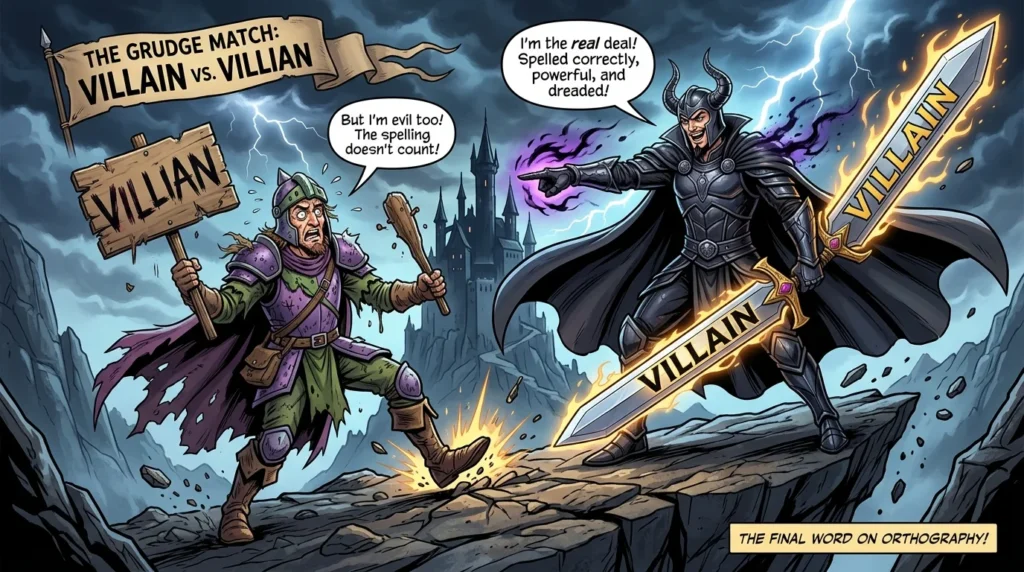
Villain is the correct English spelling and refers to an evil character, wrongdoer, or antagonist.
Villian is a spelling mistake and is not recognized as a standard English word.
If you’re writing in English, always use villain.
What Does “Villain” Mean?
Definition
A villain is a person who performs evil actions, causes harm, or opposes the hero in a story.
The word can also describe a dishonest, cruel, or morally bad person in real life.
Usage Rules
Use villain when referring to:
- An antagonist in a story
- A criminal or wrongdoer
- Someone who behaves dishonestly or cruelly
- A person responsible for a problem
Examples
- The villain tried to take over the kingdom.
- Every superhero needs a memorable villain.
- The detective finally caught the villain.
- Many classic movies feature a powerful villain.
Key Insight
The word villain is commonly used in literature, movies, television, comics, and everyday conversation.
What Does “Villian” Mean?
Definition
Villian is not a standard English word.
It is simply a misspelling of villain.
Usage Rules
There are no accepted grammar rules for using villian because dictionaries do not recognize it as a correct spelling.
Examples
Incorrect examples:
- ❌ The villian escaped from prison.
- ❌ The movie’s villian was terrifying.
- ❌ Batman fought the villian.
Correct versions:
- ✅ The villain escaped from prison.
- ✅ The movie’s villain was terrifying.
- ✅ Batman fought the villain.
Key Insight
Whenever you see villian, it should almost always be corrected to villain.
Villain vs Villian: Key Differences
Bullet Point Differences
- Villain is the correct spelling.
- Villian is a misspelling.
- Villain appears in dictionaries.
- Villian does not appear as a standard word.
- Villain is used in books, movies, and journalism.
- Villian should be avoided in all forms of writing.
Comparison Table
| Feature | Villain | Villian |
|---|---|---|
| Correct English Spelling | Yes | No |
| Dictionary Recognition | Yes | No |
| Meaning | Evil character or wrongdoer | None |
| Professional Writing | Correct | Incorrect |
| Literary Usage | Common | Incorrect |
| Example | The villain was defeated. | The villian was defeated. |
Real-World Usage Scenarios
Scenario 1
❌ The villian stole the treasure.
✅ The villain stole the treasure.
🎯 Lesson: Villain is the correct spelling for an evil character.
Scenario 2
❌ The superhero defeated the villian.
✅ The superhero defeated the villain.
🎯 Lesson: The word always ends with -ain, not -ian.
Scenario 3
❌ The novel’s main villian was clever.
✅ The novel’s main villain was clever.
🎯 Lesson: Books and stories use the spelling villain.
Scenario 4
❌ The police finally arrested the villian.
✅ The police finally arrested the villain.
🎯 Lesson: Villain can refer to real-life criminals as well as fictional characters.
Scenario 5
❌ Everyone knew who the villian was.
✅ Everyone knew who the villain was.
🎯 Lesson: Remember the correct letter order: a before i in the final syllable.
Common Mistakes
Mistake 1: Switching the Letters “A” and “I”
Many people accidentally write villian because they reverse the letters.
Why It Happens
English contains many words ending in “-ian,” causing writers to assume villain follows the same pattern.
Correction
Remember that the correct ending is -ain.
Mistake 2: Typing Too Quickly
Fast typing often causes the letters to be transposed.
Why It Happens
The words look visually similar.
Correction
Proofread carefully and verify the spelling.
Mistake 3: Learning the Word by Sound Alone
Pronunciation does not clearly reveal the spelling.
Why It Happens
The final syllable sounds similar to many “-ian” words.
Correction
Memorize the word visually: villain.
Memory Tricks
Trick 1
Think of:
VillAIN
A villain causes pain.
Notice that both words contain “ain.”
Trick 2
Remember:
Hero vs Villain
Many books and movies use this pairing, making the correct spelling easier to recall.
Trick 3
The ending is:
AIN
Not:
IAN
If you remember pain, you’ll remember villain.
Expert Insight
The word villain comes from Old French and originally referred to a farm worker or person of low social status. Over time, its meaning evolved and became associated with dishonorable or immoral behavior.
Today, villain is one of the most recognizable terms in storytelling. It appears frequently in literature, film, television, gaming, and journalism. Because of its unusual spelling, it remains one of the most commonly misspelled English words.
Professional editors, publishers, educators, and dictionaries universally recognize villain as the correct spelling, while villian is treated as an error.